



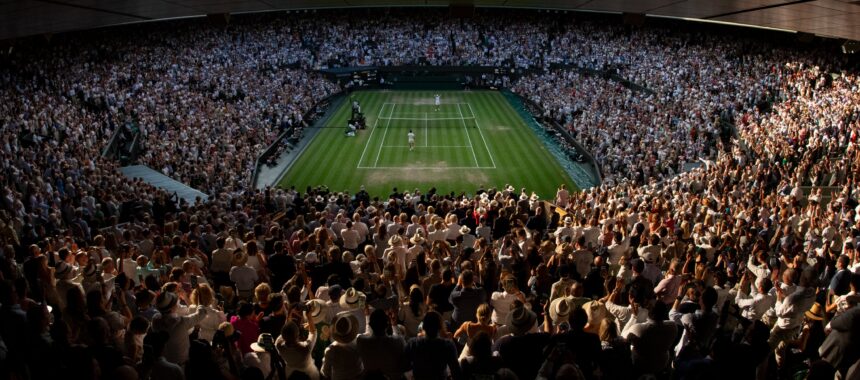
Every year the same thing happens. The clay court season ends, the rankings are clear, the form book looks settled, and everyone arrives at SW19 confident they know what is going to happen. And then within the first week Wimbledon reminds everyone that it has its own rules and always has.
I have been following tennis long enough to know that Wimbledon is the one major where I genuinely question everything I think I know going in. Not because the tennis is worse or the field is weaker but because grass does something to the game that no other surface quite replicates. The bounce is lower, the ball moves faster off the court, the serve becomes a weapon in a way it simply is not on clay, and players who look unbeatable on one surface can look genuinely vulnerable on another in ways the rankings do not always warn you about in advance.
Why Grass Makes Everything Harder to Call
This is the conversation that serious tennis followers have every June and it goes to the heart of why tennis betting on Wimbledon is a fundamentally different exercise to betting on Roland Garros or the Australian Open. On clay and hard courts you can lean on recent form, head to head records and ranking positions with reasonable confidence because the surface rewards consistency. Grass punishes it. A big serve and a willingness to come to the net can beat a player with a significantly better ranking if the conditions are right and the draw falls a certain way. The market knows this and prices it in but imperfectly because grass court form data is genuinely thin compared to the other two surfaces.
The numbers back this up in a way that should give pause to anyone backing the obvious favourites. In the Wimbledon women’s singles, every eventual winner aside from one entered the tournament at 1200 or longer odds over a recent stretch of tournaments, with Rybakina going off at 100-1 in 2022, Vondrousova at 100-1 in 2023 and Krejcikova at 125-1 in 2024. Three consecutive winners at triple digit odds. That is not a blip. That is the women’s draw at Wimbledon telling you something important about how much the surface disrupts normal order.
The men’s side is more predictable but only relative to the women’s. It is still grass. The upsets still happen and they tend to happen earlier and more violently than anywhere else in the calendar.
The Sinner Question
Sinner is the favourite and honestly it is hard to argue with that. He won Wimbledon in 2025 and the way he won it mattered. Beating Alcaraz in a final, on grass, when Alcaraz had won the thing twice before and moves around SW19 like he invented the surface. That is not a fluke result. That is a player who figured something out.
What I find interesting about Sinner on grass is that it still does not look entirely natural and yet somehow it keeps working. He is a baseline player at heart. He wants long rallies, he wants time on the ball, he wants to construct points methodically in a way that grass actively discourages. And yet his serve has quietly become one of the best on tour, his movement has tightened up considerably, and there is something about the way he handles pressure on big points that just does not crack. He went through the whole of 2025 with a doping case hanging over him that would have broken most players mentally before the first ball was even struck. He won three majors. I do not know what you do with that information other than take him seriously on every surface regardless of what the conventional wisdom says about his game.
But here is what I keep coming back to. Sinner built his game on clay and hard courts. The baseline exchanges, the patient construction of points, the ability to absorb pace and redirect it. Grass compresses all of that. Points are shorter, margins are smaller and the serve matters more than any other shot in the game at SW19. He has demonstrated he can adapt. He has also only won Wimbledon once. Alcaraz has won it twice and moves on grass like he was born to play on it.
Alcaraz is currently priced at 6/5 with bet365 making him the slight favourite over Sinner at 7/5, with Djokovic next at 8/1 and then a significant gap to Zverev and Draper at 16/1. Those prices feel broadly right and also slightly boring which is exactly what Wimbledon tends to punish.
The Women’s Draw and Why It Is Always More Interesting
If you follow tennis closely you already know this but it is worth saying clearly for anyone who does not. The women’s draw at Wimbledon is best of three sets rather than five. That one structural difference has enormous implications for how matches play out and consequently for how the betting markets behave.
Five sets gives a favourite time to recover from a poor start, find their level and impose themselves on the match over time. Three sets does not. An off day in the first set at Wimbledon for a top woman can become a loss before she has had the chance to figure out what went wrong. This is why you get Vondrousova winning the title at 100-1. This is why Rybakina won it two years earlier having barely been considered a genuine threat in the pre-tournament coverage.
For 2026 the women’s tournament sees Swiatek and Sabalenka leading at 11/4. Swiatek winning Wimbledon in 2025 was significant because she had historically been a clay court specialist whose grass court record lagged well behind her performances elsewhere. She adapted. Players do adapt. But the history of this draw suggests treating any price shorter than 5/1 with real scepticism regardless of ranking.
What Actually Predicts Performance on Grass
This is the part that most casual tennis betting coverage skips past. If you are trying to assess who is actually going to perform at Wimbledon rather than who the rankings say should, there are a few things worth looking at seriously.
Queen’s Club and Eastbourne are the two main grass court warmup events and they matter more than most people give them credit for. Players who arrive at Wimbledon having already put in several hours on grass in match conditions are in a meaningfully different position to those who have come straight from the clay. Form from the lead-up events at Queen’s and Eastbourne is a strong guide to who has already settled into the surface.
Serve statistics on grass versus other surfaces tell you a lot about which players are going to be dangerous in ways the ranking does not capture. A player ranked 40th in the world with a serve that moves at 220 kilometres an hour and a solid net game is a different proposition on grass to what they are on clay. The tour generates this data and it is worth looking at before committing to anything in the first week of the draw.
The draw itself matters enormously and this is something the outright market only partially prices in. A route through the top half or bottom half that avoids a specialist grass courter until the later rounds is a genuinely significant advantage and that information only becomes available once the draw is made.
A Final Thought on Wimbledon and Patience
The worst tennis betting strategy at Wimbledon is to back the same players you would back everywhere else and expect the same results. The best is to take the surface seriously as a variable, respect the history of what grass does to form books, and look for the players whose games genuinely suit the conditions rather than the ones who simply rank highest.
Sinner and Alcaraz will probably contest the final again. The tennis arguments for both of them are compelling and the market is pricing them accordingly. But Wimbledon has been making fools of that kind of confidence for as long as anyone has been watching and this year will not be any different.

