



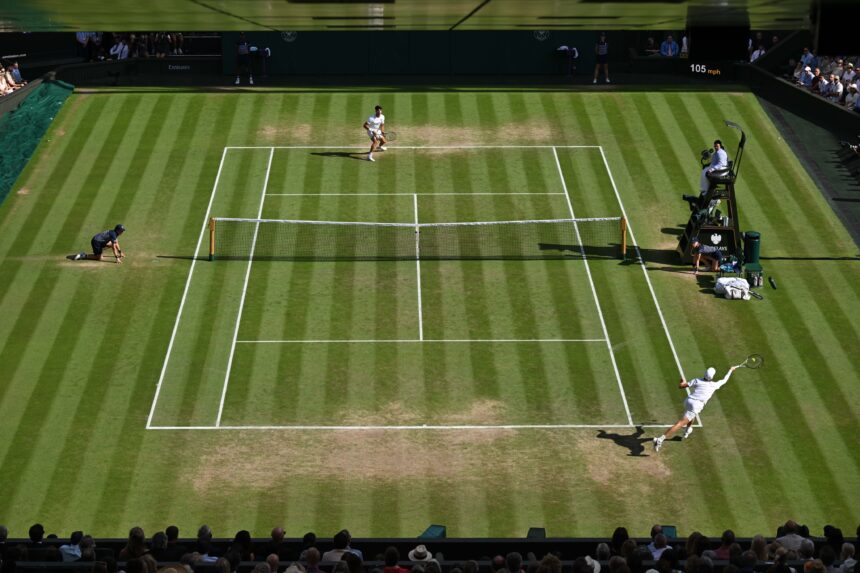
As players head to the Wimbledon grass courts, it will be impossible for them to escape one issue which could impact their performance levels – the heat.
Temperatures have been soaring in the United Kingdom recently, leading to the issuing of rare red weather warnings in parts of the country. The alert is only used when temperatures are considered extreme enough to lead to illness and threat to life.
With those conditions potentially lingering throughout Wimbledon, players could begin to feel the exertion as the games and sets wear on. But heat rules are in place for the 2026 Championships which should provide relief if situations begin to spiral out of control.
Understanding the Wimbledon Heat Rule
Although a heat rule has been enforced by the WTA for over 30 years, the ATP only introduced a standardised rule for the 2026 season. A decision was made following the Shanghai Masters in October 2025, where temperatures reached 34 degrees Celsius in 80% humidity during the day.
At Wimbledon, the rule applies to all singles events in the qualifying and main draw, but it can only be activated when the heat stress index reaches or exceeds 30.1 degrees Celsius. Based on the Wet Bulb Globe Temperature, a heat stress monitor measures air temperature, wind speed, humidity, and surface temperature at specific times – 30 minutes before play, at 2pm, and 5pm.
Only one of the players on court needs to trigger the rule, which will then stop play for 10 minutes (15 minutes for wheelchair events) between the second and third set for best-of-three set matches, or between the third and fourth set for best-of-five matches.
That brief window could provide the necessary respite to re-energise players before a deciding set. For fans tracking how these mid-match pauses impact momentum and individual chances of winning, prediction markets offer a way to follow the shifting probabilities in real-time.
If you want to use these platforms during the heat of the tournament, taking advantage of an exclusive Goal.com Kalshi promo code will give you a headstart.
The specifics of the rule
While the rule will give players a chance to recover, there are limits on what is allowed during the break in play. Changing clothes and using the restroom is completely fine, but medical treatment and coaching is forbidden.
Moreover, the guidelines won’t apply to matches played under a roof. Although Centre Court and Court Number One’s roofs are primarily used to keep rain out, they do also provide shade which protects players and spectators.
The heat rule also won’t be introduced for matches that were suspended overnight if one set has been completed for best-of-three matches. For matches that could potentially span five sets, two must already have been played to prevent the guidelines from being used.
If conditions become unplayable or dangerous, the officials can suspend play entirely until the index drops. That is only expected to happen if the heat stress index exceeds 32.2 degrees Celsius.
How games might be impacted by hot temperatures
Of course, variances in playing conditions will also impact the style of play on the SW19 courts too. Higher temperatures will increase pressure inside the ball, leading to a faster-paced game and higher bounces, particularly as the surface hardens in the sun.
Should the humidity become a factor, the ball won’t slow down, but players will be impacted as they sweat more on court. Energy conservation will then become more of a factor in prolonged matches.
It seems more apparent than ever that this year’s winners won’t simply be dictated by their skill, but how well they can adapt to the conditions and recover off the court. Whoever can thrive in the UK heat and keep their overall game time down could well be crowned a Wimbledon champion in July.

