



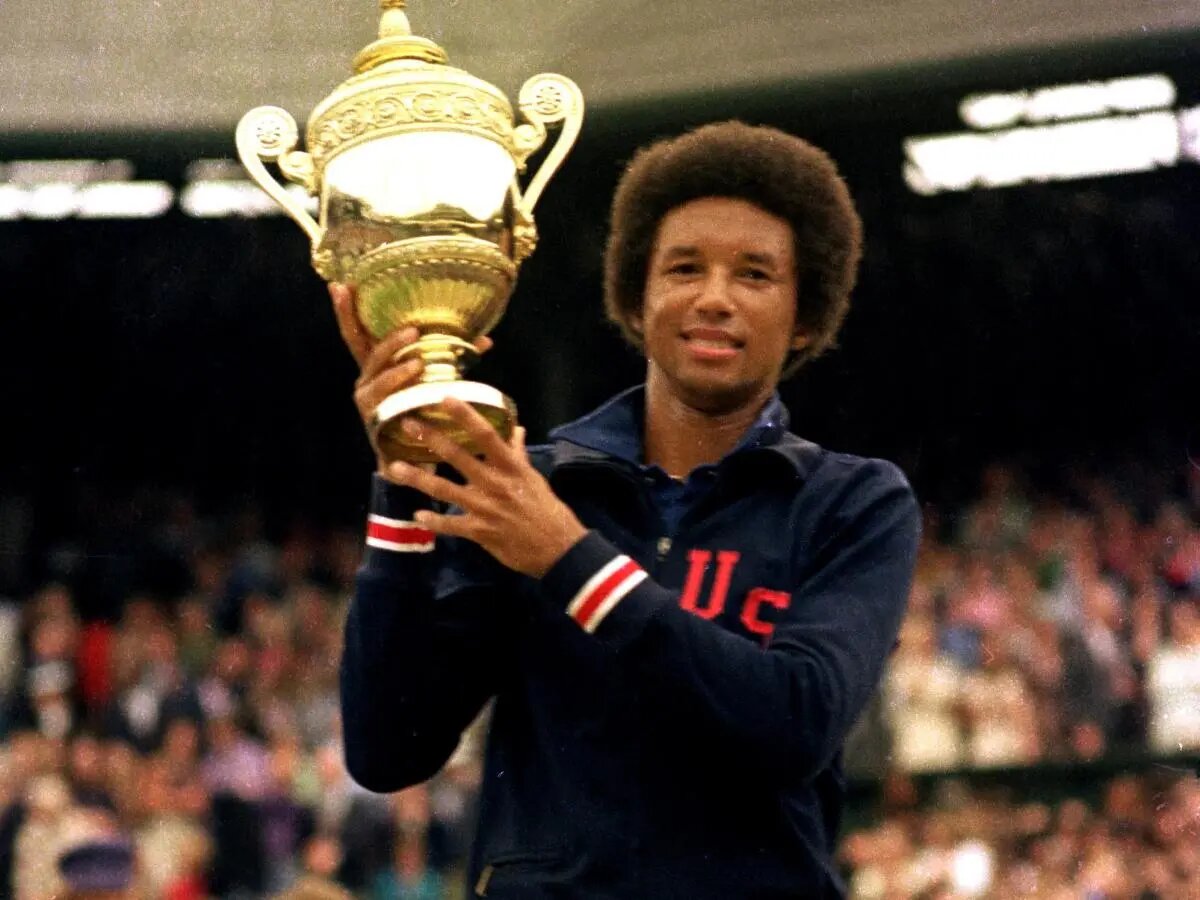
Even before them, though, Zina and Lori gave us something to remember at Wimbledon, where the former reached the final and the latter upset Steffi Graf in the first round, whereas in the men’s field only MaliVai Washington broke through at SW19 by reaching the 1996 final after a comeback from 1-5 down in the semis against Todd Martin. Washington then lost to Krajicek, and once said: “It’s very hard for a black kid to identify with a white tennis player. I mean, who is he more likely to identify with, Michael Jordan and Walter Payton or Boris Becker and Ivan Lendl?”
In 2006, James Blake, the son of an African American dad and of an English mum, reached the highest ranking for a black player in the new millennium at N.4 – he is now the director of the Miami Open.
Althea Gibson once said: “In sports, you’re more or less accepted for what you do than for what you are.” She also added: “No, I don’t see myself as a representative for my people. I think about myself and nobody else…” Another time she was been asked whether she was proud of the Jackie Robinson comparisons that were thrown her way after winning Wimbledon in 1957, to which she replied: “I’m not aware from a racial standpoint… I’m a tennis player, not a Negro tennis player.”
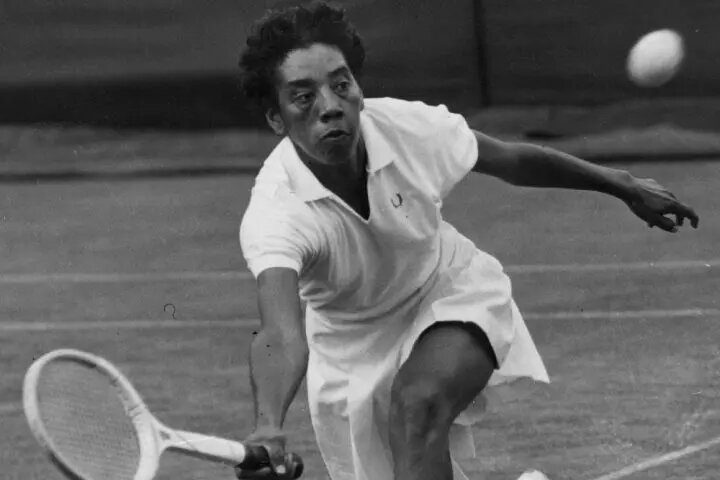
On the other hand, Ashe once said: “I remember that there were some rules meant for Southern black kids. When you were unsure about whether a ball was in or out, and you were playing against a white opponent, you had to call it in. [Editor’s note: I spent some time studying in Tulsa, in Oklahoma, and back then matches were self-regulated at the university level, so I remember my embarrassment for having to call some lightning serves on hardcourts, where the ball leaves no signs – I didn’t want to be thought of as a cheater, but at the same time I didn’t want to give away any points.] Another rule was: if you were serving before a changeover, at the end of the game you had to pick up each ball and give it to your opponent when you walked past him. Doctor Robert Walter Johnson, our coach [at UCLA, in Los Angeles], knew that we were going to a hostile place, so he wanted our behaviour to be irreprehensible. It would take me years to get over such an emotional toll of suppressed rage and frustration!”
One time, Ashe was a guest of mine when I was the Tournament Director in Florence, where I had also organised an exhibition for his delightful wife (a professional photographer), and he said: “Every day I close my eyes and pray that people won’t be as cruel to my children as they have been to me. What drives me mad is walking into someone from my hometown of Richmond, Virginia, only for them to say that they saw me play at Byrd Park when I was a kid. Well, no one could have seen me play there, because at the time Byrd Park was open only to white people!”
Yannick Noah, the last French to win at Roland Garros in 1983 (and the last French man to win a Slam altogether), was born in Yaoundé, in Cameroon, and talked about a different brand of racism early on in his career: “I never had any issues with being black, but the Cameroonian Federation could never stand me. The reason? My mother was white. I’m not an ambassador for any race or country precisely because of that: my mother being white and my father being black… inside I don’t feel neither white nor black. I think I did more for people by winning the French Open than I could have by going to South Africa to give speeches against apartheid. Maybe someday I’ll change my mind, perhaps when I’m 35, but I don’t think it will happen.”
However, when Noah changed his hairstyle to his signature dreadlocks, he noticed that white people in France had a harder time accepting him: “All of a sudden, I wasn’t a tennis player anymore. I was black and I was a nobody. People’s reactions became completely different. Nothing terrible, nothing that could lead to a physical fight, just different. And I’ve actually never had any issues being black here [in America]. It’s like Larry Holmes says: ‘If you’re black and you have money, then you’re not black.’”
Even this last quote has some counterarguments, though, because, as Felix Auger-Aliassime said, “if you are driving a Mercedes, cops tend to stop you, like they did with my father, because they think that you probably stole it.”
Some things are undeniably changing, though. Katrina Adams, a former player who reached the 67th spot in the WTA Rankings and a doubles semi-finalist at Wimbledon in 1988 (partnering Zina Garrison) became the first African American USTA president in 2015, and also the very first to get a second term, thanks to changes in federal rules.
Even more notably, tennis now has a spokesperson like Naomi Osaka. The Japanese, currently ranked third in the world, has enjoyed a quick rise to superstardom since winning her first title at Flushing Meadows, and is currently the highest-paid female athlete in the world, surpassing Serena Williams with estimated revenues of 37.4 million dollars. Over time, she has become one of the most outspoken athletes on the issues of inequality, racism and social justice, and even more so after the murder of George Floyd, joining protesters in St. Paul and Minneapolis and publicly backing Black Lives Matter. She explained her decision by penning an op-ed for Esquire: “When I saw the horrific video of George Floyd’s murder and torture at the hands of a cop and his three colleagues, my heart ached. I felt a call to action. Enough was finally enough.”
Throughout her winning campaign in New York, Osaka wore seven different masks honoring victims of police brutality, ending with Tamir Rice, the 12-year-old boy murdered by a policeman in Cleveland because he wielded a replica toy gun at a Rec Center in Cleveland. “George was murdered at the hands of men paid to protect him. And for every George, there is a Brianna, a Michael, a Rayshard,” she had written in Esquire. A few days before the tournament began, she withdrew from her semifinal match at the Cincinnati Premier event (also held at Flushing Meadows this year) as a show of support for the Milwaukee Bucks’ collective decision to boycott an NBA Playoffs game after the shooting of Jacob Blake in Kenosha – the organizers were forced to cancel play for the day, moving the semifinals to the next while re-admitting her into the draw. “Being ‘not racist’ is not enough. We have to be anti-racist.”

Osaka’s ethnic and cultural backgrounds are unique, and her Japanese heritage has come into play as well. “Osaka is grudgingly accepted because she’s hafu – the daughter of a Japanese woman and a Haitian man,” noted The Guardian. “And while that technically means she’s mixed race, recent jokes from a pair of Japanese comedians who said she was ‘too sunburned’ and ‘needed some bleach.’” However, she is positive that discrimination is in the minority (she was chosen to be the face of the 2020 Summer Olympics, after all), and has come to embrace her multi-ethnic, cosmopolitan background as a vehicle of change: “But I am proud, too, of the small part I have played in changing perceptions and opinions. I love the thought of a biracial girl in a classroom in Japan glowing with pride when I win a Grand Slam. I really hope that the playground is a friendlier place for her now that she can point to a role model and be proud of who she is. And dream big.”
At the same time, though, she admitted that dealing with racism in her home country had always been difficult for her. Maybe this is the reason why Osaka hasn’t come into her own as a civil rights leader sooner. This is the same girl who was robbed of the sweetness of triumph when Serena Williams launched a tirade against Ramos, the chair umpire of their 2018 US Open final, deeming him a sexist after he imposed her two penalty points. Williams called him “a thief” and claimed he should apologize to her while Osaka cried in her chair. Her behavior was out of order to say the least, but it should remember that an Australian newspaper, the Herald Sun, published a cartoon of her outburst depicting her stomping on her racquet while the umpire asked her opponent: “Can you just let her win?” In the vignette, Williams’ lips were full and protruding, while Osaka was a blonde Caucasian.
However, the latter facet shows us that, while the road is still long, a lot of mileage has been covered already, because a final between black players under the aegis of a black USTA President (at the time) proves that the days when it was customary to concede to a white opponent on every close call are indeed gone, both temporally and in our collective psyche. Ironically, the fact that Serena Williams was more or less universally criticized for her unsportsmanlike behavior is a testament to the fact that right and wrong can be debated without prejudice, at least in tennis – Madison Keys, Frances Tiafoe, Felix Auger-Aliassime and Sloane Stephens are living proofs of how the game has become more fair and inclusive.
As for the wider social context, Naomi Osaka, the Williams sisters and Katrina Adams boast a platform that is more resonant than any megaphone Arthur Ashe never had. So, if things do not change for good also because of their influence and contribution, then they might never change. That would be a harsh defeat for the whole of humankind.
Translated by Tommaso Villa

