



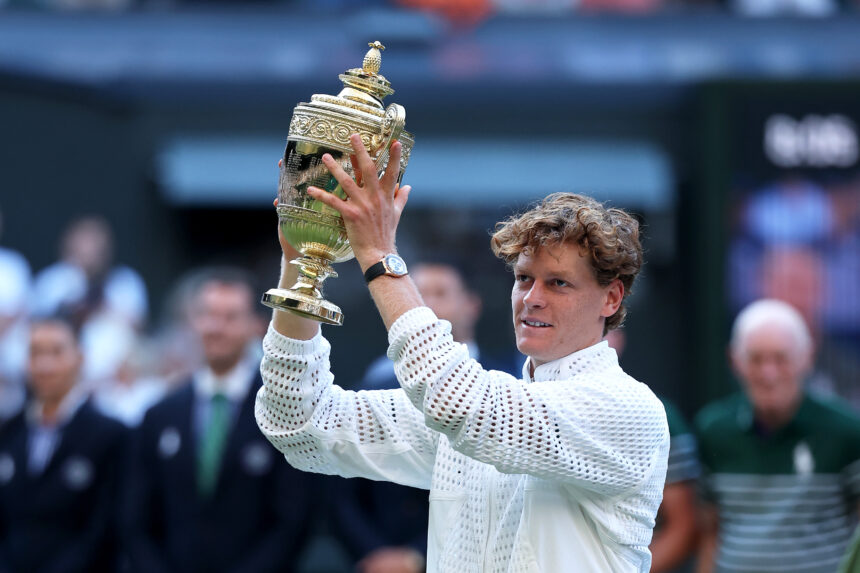
Watching Jannik Sinner secure a second Wimbledon singles title in a row, it was impossible not to celebrate the way he did it this time around. A year ago, Sinner made a remarkable comeback from a set down to defeat his chief rival Carlos Alcaraz in a four set final, and this time he also had to battle from behind to overcome a daunting Alexander Zverev. In fact, Sinner was in an even bigger bind on this occasion.
The recently crowned French Open champion walked out onto the renowned Centre Court and comported himself like a man who had every intention of claiming a second straight major crown. Zverev was serving at his usual high speeds in the range of 134MPH to 139 MPH on his first delivery, and his accuracy was astounding to witness. Time and again. Zverev sent that scorching serve exceedingly close to the lines, and Sinner was hard pressed to get it back.
Until he served at 3-4 in the opening set, Zverev was unstoppable. He conceded only two points in three service games. But in the eighth game Sinner found an opening. After Zverev led 40-15, Sinner took the next three points as Zverev double faulted at deuce. That gave Sinner a crucial break point to move ahead and serve for the set, but he squandered it with a flagrant miss-hit forehand unforced error. Zverev held on, and fittingly that set was settled in a tie-break.
Both players had their chances in that gripping sequence. At 5-5 in this tie-break, Sinner missed another forehand he ought to have made. Now down set point at 5-6, the Italian implemented a drop shot cagily to set up a forehand passing shot winner. He followed with an ace at 134 MPH down the T. Sinner was ahead 7-6 with his own set point, but a composed Zverev took that opportunity away with an ace out wide at 134 MPH and then produced a backhand winner to lead 8-7. Not a single point had gone against the server until Sinner served at 7-8. Zrerev proceeded to lace a forehand down the line for a winner to take that tie-break deservedly 9-7.
The second set replicated the first as neither man could fashion a break of serve. The pressure on Sinner at the start of the second set tie-break was practically palpable. He could not afford to fall behind two sets to love the way Zverev was playing. It was an imperative for him to win this tie-break and get back on level ground to one set all. Sinner’s sense of urgency was apparent as he raced to 4-0 with some stellar returning. Zverev took the next two points, and Sinner was acutely aware as he changed ends of the court that he sorely needed to win the next point. He did just that, releasing a service winner for 5-2. A scintillating forehand down the line winner lifted Sinner to 6-2 and Zverev was understandably shaken. He pulled a backhand wide, and so Sinner prevailed seven points to two.
Early in the third set, Sinner had a 0-30 opportunity with Zverev serving at 0-1, but he did not seize it. To 3-3 they went, and now Sinner was in trouble. Down 0-30, he climbed to 40-30 but lost the next two points. Zverev was at break point for the first time on the Sinner serve. Sinner executed an impeccable forehand drop shot winner as the German fell down. Sinner soon advanced to 4-3 before Zverev got to 40-15 in the eighth game. But he erred on a pair of backhands to make it deuce. The German carved out a third game point but double faulted and lost the next point as well. Sinner was right where he wanted to be with a break point for 5-3. During the ensuing rally, Sinner slipped but regained his balance swiftly. Zverev subsequently sprayed a forehand long, tossing his racket in disgust. Sinner promptly held at love to seal the third set 6-3 with an ace down the T.
Down 0-30 in the fourth game of the fourth set, Sinner poured in four consecutive first serves to hold at 30 for 2-2. And then at 3-3, Zverev fought off two break points but could not escape on the third as Sinner sent a return back with extraordinary depth to open up the court for a routine forehand winner. He held at love for 5-3 with a backhand winner down the line. Serving for the match two games later, Sinner trailed 15-30 but a well placed serve down the T set up a forehand winner for 30-30. Then he chased down a very good Zverev drop shot and angled a backhand crosscourt with admirable alacrity. To match point he travelled with that dazzling shot, and Sinner closed it out right then and there with a dazzling forehand winner down the line. Sinner thus finished off a 6-7 (7), 7-6 (2), 6-3, 6-4 victory to claim a fifth major title. It was a job well done with Sinner unmistakably not at his best on a windswept Centre Court. Zverev was handling the difficult conditions better than Sinner until the start of the third set but thereafter the Italian improved and Zverev lost some faith in his forehand and his serve.
Remarkably, Zverev finished the match at 80% on first serves while Sinner was at 66%. But Sinner won 80% of his first serve points while Zverev took only 71% on his. Sinner also narrowly bested Zverev on second serve points won, 63% to 61%. Most impressive of all, Sinner faced only one break point and was unbroken in four sets. His discipline on serve was instrumental in winning him the match.
On his way to the final, Sinner was seldom the essential Sinner until he collided with seven-time victor Novak Djokovic in the penultimate round. Leaving Roland Garros after an astonishing third round defeat at the hands of Juan Manuel Cerundolo when he was crippled by cramps after leading two sets to love and leading 5-1 in the third, Sinner was understandably rusty at the outset of Wimbledon because he had chosen to skip his usual grass court tuneup in Halle.
Unmistakably lacking his customary rhythm and precision from the backcourt, the Italian found himself down two sets to one against an inspired world No. 50 Miomir Kecmanovic in his opening round skirmish. The defending champion was, however, undismayed by the loss of a third set tie-break in that contest which the Serbian took eight points to six after Sinner was up set point. The top seed subsequently marched comfortably through the last two sets of a 4-6, 6-3, 6-7 (6), 6-2, 6-3 triumph, and was more relieved that exhilarated upon completion of the win.
He then accounted for Portugal’s Nuno Borges 7-6 (4), 7-6 (2), 6-4 before ousting the American Jenson Brooksby 6-4, 6-3, 6-4. In the round of 16, Sinner knocked out Japanese qualifier Shintaro Mochizuki 6-3, 7-6 (0), 6-3. Still struggling to find his best stuff, Sinner defeated Jan-Lennard Struff 7-5, 7-6 (4), 6-3 in a Court One quarterfinal, rallying from set point in the middle set against the 36-year-old German.
Given the subpar nature of his performances in terms of his uneven play from the baseline, many wondered if Sinner would be hard pressed to beat Djokovic in their twelfth career head to head contest. The 39-year-old Serbian had ended a five match losing streak against Sinner in the semifinals of the Australian Open with a stirring five set victory, saving 16 of 18 break points, twice holding from 0-40, and surviving 26 aces from his adversary in a spectacular showing. In fact, Sinner won 154 points in that extraordinary clash while Djokovic secured only 138, but the stunning win was hard earned and richly deserved by the ten-time Australian Open champion because he was unequivocally better on the biggest points than the two-time defending champion. That was a masterful display of clutch supremacy from Djokovic in Melbourne.
In any case, their Wimbledon semifinal was an entirely different story. Sinner was in the zone from start to finish, serving with uncanny potency and accuracy, releasing thunderous groundstrokes off both flanks, returning with excellent pace and consistency, and leaving Djokovic dumbfounded about how to find a way to thwart him. Sinner soared to a 6-4, 6-4, 6-4 triumph that was as good as gold. Djokovic played some remarkably good tennis, saving ten of thirteen break points, making some dazzling shots off the ground, mixing up his game plan as much as possible, and adding considerable velocity on average to his first and second serves.
But Sinner was unstoppable, firing 16 aces, facing only one break point, and winning 88% of his first serve points plus 61% on his second delivery. Moreover, 46% of his first and second serves combined went unreturned. Contrast those mind-boggling numbers with those of Djokovic, who won 76% of his first serve points but just 34% on second serve. Only 29% of his serves were not returned by the unrelenting Sinner. In turn, Sinner, going for his explosive shots freely and fearlessly, still made only 15 unforced errors while Djokovic ended up with 23.
That is just about everything you need to know about that match. But let me add a little more detail. Djokovic came out of the blocks with high purpose and deep intensity, dropping only two points in his first two service games and thumping the ball commandingly from the back of the court. At 2-2, however, the No. 7 seed fell behind 30-40 when Sinner moved him skillfully from side to side and then reached break point with an overhead winner.
Djokovic erased it with searing backhand down the line. He advanced to game point by going behind the Italian with a well struck crosscourt forehand and then held for 3-2 with an ace down the T at 121 MPH. That set went to 4-4 but Djokovic was broken there. At 30-40 in the ninth game, Djokovic directed a forehand approach down the line with very good pace, but Sinner’s reply was magnificent. He laced a two-handed backhand pass down the line with ease and elegance. Sinner held at 30 to seal that set 6-4, having won 20 of 24 points on serve.
A determined Djokovic took a 3-2 second set lead, rescuing himself from 15-40 in the fifth game and holding on after two deuces. Sinner was behind 0-30 in the following game but calmly and resolutely he swept four consecutive points to reach 3-3. Djokovic commenced the seventh game with a double fault and was eventually broken at 30 as Sinner produced a drop shot winner. Buoyed by that break, Sinner held at love for 5-3 with a forehand winner down the line followed by three straight aces. Serving for the set at 5-4, Sinner held at love again with a service winner. In that second set, he secured 20 of 26 points on serve.
Fighting forthrightly, Djokovic was broken in the opening game of the third set after three deuces. He fended off three break points but was stymied on the fourth. Serving-and-volleying on his 117 MPH second delivery, he netted an arduous low forehand first volley. The Serbian was down break point again in the third game but held on steadfastly. Now, at long last, Djokovic arrived at break point on Sinner’s serve, but the Italian barely blinked. He released an ace down the T at 125 MPH, then put away an overhead and followed with a 132 MPH ace out wide to reach 3-1.
At 2-4, Djokovic was in jeopardy again, but he aced Sinner out wide in the ad court at 126 MPH when down break point before releasing a service winner and another ace at 125 MPH for 3-4. Sinner promptly held at love for 5-3 with an ace down the T at 127 MPH. Djokovic held one last time in the ninth game, but the imperturbable Sinner held at love to close out the contest, serving two more aces in that game. This was a masterpiece of a match from the Italian against a Djokovic who was playing top of the line tennis.
And yet, despite bowing out in the semifinals and being denied the chance to compete for a 25th career Grand Slam title two days later, Djokovic could console himself due to an enormously rewarding quarterfinal triumph over No. 3 seed Felix Auger-Aliassime, which started late in the afternoon and played on across a rousing evening for the British fans across five sets. The last three sets were contested under the Centre Court roof.
During the first set of this showdown, Djokovic was troubled by a left calf issue, calling for the trainer at the 5-4 changeover. That set was settled in a tie-break, and Djokovic was thrice down set point. But he prevailed 12 points to 10 as Auger-Aliassime missed a forehand swing volley on the Serbian’s third set point. Not a single service break had been achieved by either player until Djokovic gambled at 3-4,30-40 in the second set. His 119 MPH second serve down the T landed long for a double fault. Although Djokovic had two break points in the next game, the Canadian wiped them away with a service winner and a backhand pass down the line off a conservative overhead from the Serbian. Auger-Aliassime soon held on with an ace to make it one set all.
Up went the roof, and the match came alive on both sides of the net. Finding the range on his returns, Djokovic broke at love for 4-2 in the third set. He closed it out 6-3, and collected the first eight points of the fourth set to establish a 2-0 lead. But Djokovic lost focus considerably to allow Auger-Aliassime back to 2-2, losing his serve at love in the fourth game. They traveled to a tie-break, and Auger-Aliassime took it confidently seven points to four after opening that sequence with an ace.
The fifth set was spectacular as the Canadian fended off three break points on his way to 1-1. At 4-4, Djokovic was in precarious territory at 0-30, but won four points in a row for the hold. At 5-6, Auger-Aliassime fell behind 15-30 and was two points from losing, but he came through with a service winner, an ace, and another service winner to make it to the concluding ten point tie-break. Coming that close to wrapping it up there could have hurt Djokovic tremendously, but he refused to lose his self belief.
Djokovic went into his familiar lockdown mode in that tie-break, lost only one point on serve, did not make any unforced errors, and succeeded 7-6 (12-10), 3-6, 6-3, 6-7 (4-7), 7-6 (10-4) in five hours and fifteen minutes of spellbinding tennis. It was inarguably the match of the tournament and one of the most memorable battles Djokovic has fought in his late thirties. He will treasure the triumph for the rest of his life, although the immense physical, mental and emotional energy he spent surely was consequential in terms of his recovery— despite two days off.
Zverev, meanwhile, had a very straightforward path to his final round appointment with Sinner. The No. 2 seed ousted Alexander Blockx of Belgium 6-4, 6-7 (8), 7-6 (5), 7-6 (0) in the opening round. He took his next two matches in straight sets over Valentin Royer and Marcos Giron, and then defeated No. 13 seed Jiri Lehecka 6-4, 7-5, 3-6, 7-6 (6) in a two day encounter. He followed up by ending a debilitating seven match losing streak against No., 6 seed Taylor Fritz, eclipsing the American 6-4, 6-4, 6-2. Fritz aggravated his knee in the first set and later called for the trainer but Zverev hit for the lines, served sublimely and thoroughly deserved his one-sided victory. He then ousted the British wildcard Arthur Frey 7-6 (0), 6-2, 6-4 to reach his first Wimbledon final, becoming only the 13th male player in the Open Era to reach all four singles finals at the majors. As for Fery, he leaps from No. 114 in the world to No. 36 and his career has been sweepingly altered.
But when all was said and done, Sinner was the central figure of this tournament. His enormous poise under pressure was evident as he turned the final around more with mental toughness and discipline than anything else. Sinner should never be undervalued as a competitor. His inner strength is one of his many virtues.

