



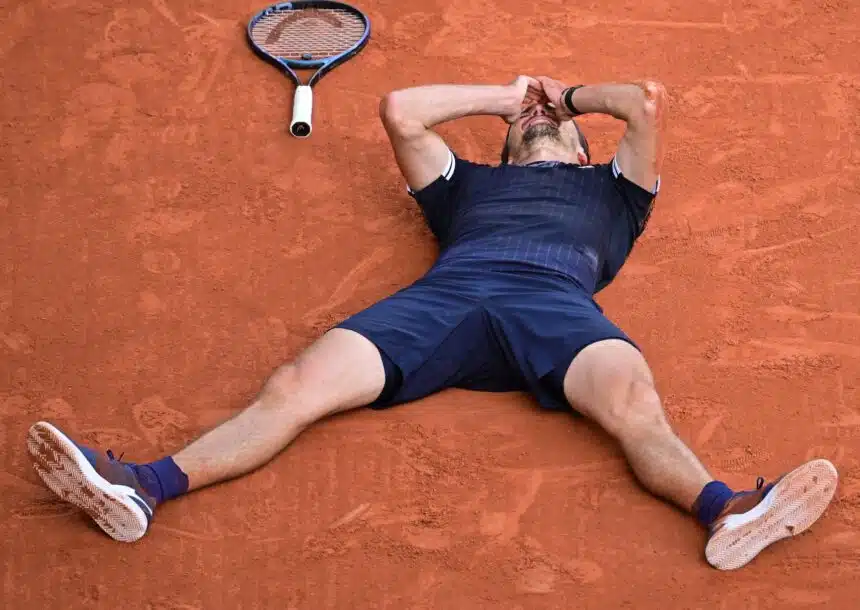
As the years passed and too many opportunities went by the wayside, while the skeptics lined up ruthlessly to question his authenticity as a player of lasting stature, Alexander “Sascha” Zverev seemed to be cementing his place as the consensus choice for the best male tennis player never to win a major tournament. He had been beaten in three Grand Slam finals starting with his loss to Dominic Thiem at the 2020 U.S. Open, continuing with setbacks against Carlos Alcaraz at Roland Garros in 2024 and Jannik Sinner at the Australian Open the following year.
Time and again, Zverev had been on the brink of becoming a member of an exclusive club of players who have triumphed at a major. Not only did he lose those three “Big Four” finals, but he wasted a two sets to love lead in that New York clash with Thiem and later served for that match in the fifth set. In his showdown with Alcaraz at Roland Garros two years ago, he led two sets to one but was crushed in the last couple of sets. Moreover, Zverev had been to no fewer than seven semifinals at Grand Slam tournaments and he has twice been the champion at the prestigious Nitto ATP Finals (2018 and 2021), while also amassing seven Masters 1000 championships.
And so it seems entirely fitting that he now has claimed a major title at last. Zverev, appearing in his 41st career Grand Slam tournament, established himself as the first German man to rule at Roland Garros since Henner Henkel in 1937, and the first male player from his country to seal a Grand Slam crown of any kind since Boris Becker was victorious at the 1996 Australian Open.
Zverev completed the most important fortnight of his professional life by overcoming the No. 10 seed Flavio Cobolli 6-1, 4-6, 6-4, 6-7 (5), 6-1 in a hard fought, uneven, nerve-ridden contest. By becoming the oldest male victor at a major since Goran Ivanisevic won Wimbledon as a wildcard ranked No. 125 in the world twenty-five years ago, the 29-year-old Zverev passed one of the toughest psychological tests of his time as a tennis player. By the early stages of this edition of Roland Garros—with the 2024-25 champion Alcaraz having withdrawn, No. 1 seed Jannik Sinner ousted in the second round and three-time champion Novak Djokovic gone in the third round—Zverev became the prohibitive favorite to rule at Roland Garros, and that surely added to the considerable weight of expectations already engulfing him.
He had come into the final conceding only two sets in six matches— in sharp contrast with two of his previous three final round appearances at the majors. At the 2020 U.S. Open, Zverev contested four matches which went four sets and then rallied from two sets down to beat Pablo Carreno-Busta in a five set semifinal. That may have mattered late in the fifth set against Thiem; all of the hard work surely took its toll. When Zverev lost to Alcaraz in Paris two years ago, he played consecutive five-setters against Tallon Griekspoor and Holger Rune in the third and fourth rounds. After leading two sets to one, he won only three games in the last two sets against Alcaraz in the title round contest as he lost strength in his legs.
Irrefutably, Zverev conserved energy and performed with more efficiency this time around than ever before at the premier events. Cobolli, meanwhile, was understandably apprehensive at the outset of his final with the German competitor. Zverev blitzed through the first set comfortably and confidently while Cobolli seemed overwhelmed by the size of the occasion. The 24-year-old Italian lost a four deuce opening game of the match with more than his share of mistakes. Zverev went to 2-0 with a hold at 15, concluding that game with an ace.
Cobolli was broken again in the fourth game at 15 when he sent a drop shot into the net. Zverev swiftly collected the last two games from 4-1 on his serve, sweeping eight of ten points. Gradually Cobolli—determined to turn himself into the first Italian man since Adriano Panatta fifty years ago to prevail at Roland Garros— found his range off the ground. But all the way until Zverev advanced to 3-2 in the second set, his serving power and precision was suffocating his adversary. Yet Cobolli held on for 3-3 and then Zverev tightened up after leading 30-0 in that seventh game. He later served two double faults and was broken after four deuces, squandering three game points.
Unmistakably invigorated, Cobolli held on for 5-3 with an overhead winner and nearly broke Zverev again in a four deuce, ninth game. Unperturbed, Cobolli’s swagger was apparent as he served out the set in the tenth game. At 5-4, 40-15, Cobolli daringly served-and-volleyed and then crowded the net. Zverev netted a passing shot under pressure. It was one set all.
And yet, Zverev raised the stakes in the third set. The 6’6”, No. 2 seed was thoroughly in rhythm on his delivery. In his five service games across that set, Zverev won 20 of 24 points. The scoreboard pressure on Cobolli was mounting. At 4-5, serving to stay in the set, the Italian led 30-0, but missed a forehand down the line by inches long. Zverev pounced, provoking another forehand error with a deep forehand of his own. At 30-30, a deep return from Zverev coaxed another mistake from Cobolli. It was suddenly set point for the German, who played a safe second serve return off the backhand. Cobolli blinked, missing an inside out forehand. With that crucial four point run, Zverev was ascendant once more, leading two sets to one.
But, inexplicably, he faltered flagrantly at the start of the fourth set. Missing four out of five first serves, double faulting twice, Zverev lost his serve in the first game. But with Cobolli serving at 3-2, the Italian opened with a double fault and fell behind 0-40. He rallied to make it deuce but then made consecutive unforced errors to allow Zverev back to 3-3. Nonetheless, with Cobolli sending more first serve returns back into play, Zverev was broken again to trail 4-3. Cobolli surged to 5-3 but Zverev held at love. And then, despite the onset of cramps, the German played some spectacular shots to break back for 5-5, winning three points with outright winners, sealing that game with a scintillating backhand down the line into the clear.
Both players held to set up a tie-break. In his Roland Garros career, Zverev had won 26 of his 28 tie-breaks and had prevailed in his last 12. When Zverev took a 3-1 lead, he seemed ready to close this historic account in four sets. But he was too cautious with victory in sight. Cobolli came alive off the forehand and on serve on his way to a 4-3 lead, and then Zverev double faulted on the next point. A brilliantly executed drop shot from Cobolli off the forehand gave him double set point at 6-4. Despite missing a leaping high volley on his first set point, the Italian came through with flying colors on the second, connecting sweetly with a forehand down the line for a dazzling winner. Cobolli sealed that tie-break 7-5 with that searing shot.
But then he elected to leave the court for more than six minutes, later explaining that he was dealing with some cramping of his own. That break may have helped Zverev to settle his nerves and get some treatment on his legs from the trainer. Zverev converted on his third break point at the start of the fifth set as Cobolli missed an inside out forehand. Despite opening the second game with a pair of double faults, Zverev saved a break point and held on gamely with a service winner down the T for 2-0.
Now it was Zverev who was the decidedly stronger man physically. With the Italian serving at 30-40 in the third game, Zverev released an immaculate drop shot. Cobolli replied with a decent forehand down the line, but Zverev struck a gorgeous backhand down the line passing shot winner to secure a second service break and a 3-0 lead.
But he had to work assiduously to hold for 4-0. Down 15-40 in the fourth game, he unleashed a backhand crosscourt with good pace to draw an error from Cobolli and then made it back to deuce by chasing down a lob volley from Cobolli and tossing up a good defensive lob. Cobolli could not put his overhead away, and Zverev tossed up another lob even deeper which Cobolli smashed into the net. A double fault from Zverev gave Cobolli a third break point, but Zverev erased that one with a winning overhead and soon held on for 4-0 with a backhand volley winner down the line.
The match was essentially over. Cobolli garnered an easy hold in the fifth game but Zverev collected eight of ten points to close out the contest on his terms, dropping only one game in the fifth set. He now officially owns a Grand Slam singles title, and no one can say he does not deserve it. To be sure, this was a golden opportunity to exploit his experience and declare his greatness on one of the premier stages in the sport. But that is easier said than done.
While Zverev’s quest to raise his historical stock considerably by claiming the sport’s highest clay court honor became the central theme of the tournament this year, the fact remains that there were other developments worthy of mention here. Let’s start with the prohibitive favorite to prevail this time around in Paris, the man who had captured no less than five consecutive Masters 1000 crowns this season and 30 straight matches before he bowed out in a shocking second round contest.
Given his utter domination of the game— along with the absence of 2024-2025 French Open victor Alcaraz— Sinner seemed almost certain to realize his dream of a career Grand Slam on the Parisian red clay. That would have been fitting in the aftermath of Alcaraz taking the Australian Open at the start of the season to complete his career sweep of all four majors. Moreover, the Italian had moved within striking distance of a Roland Garros triumph in both 2024 and 2025 before losing hard fought, five set duels with Alcaraz, conceding the latter only after advancing to triple match point in the fourth set.
But Sinner suffered yet another cramping episode on one of many sweltering days during the first week of the tournament this time around. Facing the left-handed Juan Manuel Cerundolo, the top seed was cruising along methodically, leading two sets to one and 5-1 in the third set. It was at that juncture when Sinner’s cramping emerged. He proceeded to lose 18 consecutive points and 24 of 27 points, dropping six consecutive games to concede the set. In the middle of that astonishing collapse, he was allowed to leave the court by umpire Aurelie Tourte when he was serving for the match a second time at 5-4.
That reprieve did him no good, nor did a bathroom break at the end of the third set. He was unmistakably severely hindered by his cramps the rest of the way. Cerundolo exploited the situation to the hilt, extending the rallies, making Sinner play awkward high balls, using the width of the court skillfully. Cerundolo recorded a 3-6, 2-6, 7-5, 6-1, 6-1 victory by taking 18 of the last 20 games.
Afterwards, Sinner explained that he had “hit a wall” after all of the hard work he put in across the last few months. He surprisingly played down the extremity of the heat. Somehow he did not seem as distraught as his followers believed he would be under these circumstances. Be that as it may, Sinner must find a solution to the cramping. It caused him to retire against Tallon Griekspoor last fall in Shanghai, and could have easily taken him out of the Australian Open in the third round this year against Eliot Spizzirri if the heat rule had not been applied and the match had not been completed under the roof.
I have admired Sinner’s pride and profession enormously. His no nonsense approach to playing the game for a living has been commendable. His conduct on the court has been beyond reproach, and he has won and lost honorably with regularity over the years. But his setback in Paris was inexplicable in some respects.
To be sure, he was flagrantly cramping and the circumstances were out of his control. But the toughest competitors and greatest champions sense the urgency of their predicaments and pull off improbable comebacks. Pete Sampras was in dire straights against Alex Corretja in the quarterfinals of the 1996 U.S. Open but, after throwing up on the court early in the fifth set tie-break, he rallied from match point down to win that match on sheer willpower, and then went on to take the title. Alcaraz was in serious jeopardy this year in the semifinals of the Australian Open. After leading two sets to love against Zverev, he started cramping in the middle of the third set. The Spaniard dropped that set and the fourth but managed to win in five despite the fact that Zverev served for the match at 5-4 in the fifth.
He gradually got better physically in the latter stages of that contest and refused to surrender. In my view, Sinner did not reach back with all of his resources, sense the absolute urgency of his situation, and find a way to win by playing a different brand of tennis to meet the moment. To be sure, he tried to end points swiftly with the serve-and-volley, but did it half-heartedly. He did not give up but seemed to give in.
Meanwhile, three-time Roland Garros champion Novak Djokovic, playing only his fourth tournament of 2026, seemed in command against the No. 28 seed Joao Fonseca as they confronted each other in a riveting third round skirmish. The 39-year-old Serbian— seeded third as he appeared in a record 82nd Grand Slam tournament—was striking the ball beautifully in sweeping the first two sets, leaving his 19-year-old adversary befuddled. Early in the third, however, Djokovic let his guard down a bit, wasting two game points on his serve in the second game and then two break points in the following game.
That put Djokovic in a 0-3 deficit. When Fonseca served for that third set, Djokovic made a serious push and reached break point. But Fonseca unleashed a service winner down the T and then released a pair of aces to seal the set. Djokovic advanced to 4-3 in the fourth set and reached 15-40 on Fonseca’s serve in the eighth game. The unwavering Brazilian saved the first break point with a brave approach shot to Djokovic’s backhand, eliciting a passing shot error into the net. On the second, Fonseca blasted a forehand winner off a decent return from his renowned adversary. He held on steadfastly for 4-4.
Djokovic fought off two break points in a ten minute, three deuce game to reach 5-4. Twice in the tenth game Djokovic was two points away from a four set triumph. At 30-30, Fonseca laced a backhand up the line for a dazzling winner. At deuce, he showed some gumption that was reminiscent in some ways of his opponent’s gumption. Djokovic made a terrific return deep into the corner which Fonseca flicked down the line without much on it. But he went to the net behind that shot and Djokovic was caught off guard, sending a backhand pass into the net.
It was 5-5 now in the fourth set. Djokovic had a game point for 6-5 but Fonseca’s deep return down the middle provoked an error from the Serbian. Two points later, Fonseca got the go ahead break with a searing forehand winner. Off that flank in the last two sets, Fonseca was pounding the ball with astounding pace and remarkable control. He held from 15-30 to close out that fourth set.
And yet, Djokovic put himself back in the driver’s seat early in the fifth set. He broke at love for 3-1, but once more Fonseca struck back boldly. He rallied to 3-3, taking eight of nine points. But, serving in the tenth game and trailing 4-5, Fonseca was three points from losing at 0-15. He promptly swept four points in a row for 5-5 before breaking a fatigued Djokovic in the eleventh game with a forehand drop shot winner. Down 30-40 at 5-6, Fonseca served an ace out wide, followed by an ace down the T, followed by another ace down the T. Three straight untouchable deliveries had lifted Fonseca to a stunning four hour, 53 minute 4-6, 4-6, 6-3, 7-5, 7-5 win.
It was only the second time in his illustrious career that Djokovic had lost a match from two sets to love, and the first such instance since he fell in the quarterfinals at Roland Garros against Jurgen Melzer 16 years earlier. As for Fonseca, he admirably won his next match in the round of 16 against Casper Ruud in four sets, although he benefitted from a botched call on the baseline when he was at set point down in the second set. Be that as it may, Fonseca seems ready to take his game to another level and the feeling grows that he will win his share of majors in the future. As for Djokovic, despite the frustration of losing in a colossal confrontation he could well have won, the state of his game was impressive. Only a fool would not take him seriously at Wimbledon.
Another notable early round casualty at Roland Garros was No. 6 seed Daniil Medvedev. The 6’6”, 30-year-old suffered his seventh career first round loss in Paris, losing 6-2, 1-6, 6-1, 1-6, 6-4 to the Australian Adam Walton in a bizarre match. Medvedev established a 3-1 fifth set lead and had two break points in the fifth game, missing a routine backhand return on one of them. Nonetheless, he still advanced to 4-2 but never won another game. After fighting at full force when the score was locked at 4-4 in that final set, Medvedev had three break points in a marathon six deuce game, but was unsuccessful. Having reached the semifinals in Rome where he gave Sinner a good run for his money, the mercurial Medvedev turned in another subpar performance at Roland Garros. He is endlessly fascinating but simultaneously aggravating with his wild unpredictability and frequent self inflicted wounds.
Across the first four rounds, the men produced some stupendous matches. Perhaps the most arresting of those clashes outside of Fonseca versus Djokovic was the fourth round meeting between 2025 quarterfinalist Frances Tiafoe and the astonishing Italian Matteo Arnaldi. They battled for five hours. The charismatic American was ahead two sets to one and had a 4-1,40-15 lead in the fourth set. He later served for the match at 5-4 and reached 30-15, but lost that set in a tie-break.
The tennis on both sides of the net in this encounter was electrifying. Tiafoe was always looking to take the initiative and surging forward while Arnaldi countered with some timely big hitting of his own, but even more so with his mind boggling defense and old fashioned lobbing.The Italian went to 4-2 in the fifth set with a 0-30 opening on Tiafoe’s serve but the American rallied tenaciously for 4-4. In the end, Arnaldi triumphed 7-6 (5), 6-7 (5), 3-6, 7-6 (3), 6-4 across five hours and 26 minutes. He had already gone four hours and 58 minutes before overcoming Raphael Collignon— the conquerer of No. 5 seed Ben Shelton— in a fifth set tie-break in the previous round.
But the Italian gladiator was not through. He was up 7-5, 5-2 against countryman Matteo Berrettini in the quarters when Berrettini had to retire with an injury, and so Arnaldi was through to a groundbreaking semifinal at a major. He would have played another Italian for a place in the final but he never got that chance. Cobolli moved on to the final round when Arnaldi defaulted with a severe stomach ailment. Cobolli had come from behind to defeat No. 4 seed Felix Auger-Alliassime in a four set quarterfinal. Having three days off before the final was not an ideal situation for an emotional player who was already going to be nervous playing in that pressure cooker territory. But, despite a slow start against Zverev, Cobolli acquitted himself well.
Be that as it may, this fortnight was ultimately the story of a player who had experienced heartbreak on a multitude of big occasions but refused to give up hope. Another loss in this final against Cobolli might have been crippling. As 1991-92 Roland Garros champion Jim Courier said sympathetically on TNT, “If he didn’t win this tournament, this [loss] might have finished him off. This was a fork in the road moment for Zverev. And if he wasn’t able to finish off the first time he played in a major final as the favorite, it would have been very difficult for him. This now hopefully will free him up.”
Now Zverev can approach each and every major without worrying any longer about the need to prove anything. He will relish the next bunch of majors when he can swing freely, wear his Roland Garros success proudly, and know that his life has been permanently altered.

