



Since 1995, I have attended every International Tennis Hall of Fame induction ceremony. This span has covered more than a quarter of a century, and for me it has always been one of the highlights of the season to be in Newport, Rhode Island, for the festivities. I witnessed Chris Evert’s induction in 1995, saw Jimmy Connors accept his honor three years later, observed John McEnroe giving his singularly lengthy speech in 1999, and was there when Martina Navratilova entered the shrine in 2000.
A cavalcade of superstars followed in the ensuing years including Ivan Lendl in 2001, Mats Wilander the following year, Boris Becker in 2003 and then Stefan Edberg and Steffi Graf in 2004 as the Hall of Fame celebrated their golden jubilee year. Summer after memorable summer on the weekend after Wimbledon, players with big names and prodigious achievements stepped forth to claim the highest honor in the game. Yannick Noah and Jim Courier were recipients in 2005, Gabriela Sabatini and Pat Rafter followed in 2006, and Pete Sampras broke down in tears as he joined the Hall of Fame in 2007. Four years later, Andre Agassi took his place among the immortals. Leading women players Lindsay Davenport, Amelie Mauresmo and Justine Henin were recognized for their accomplishments from 2014 to 2016. Kim Clijsters and Andy Roddick were the headliners in 2017, when I had the good fortune to be inducted as a contributor for my lifelong dedication to tennis journalism. And then across the next couple of years Michael Stich, Helena Sukova, Li Na and Mary Pierce moved into their home away from home, landing in Newport.
Last year, the pandemic prevented the ceremony from being held, and so this time around there was a combined ceremony for the classes of 2020 and 2021. In my view, for many reasons, this year’s celebration was among the most poignant and powerful that I have ever seen.
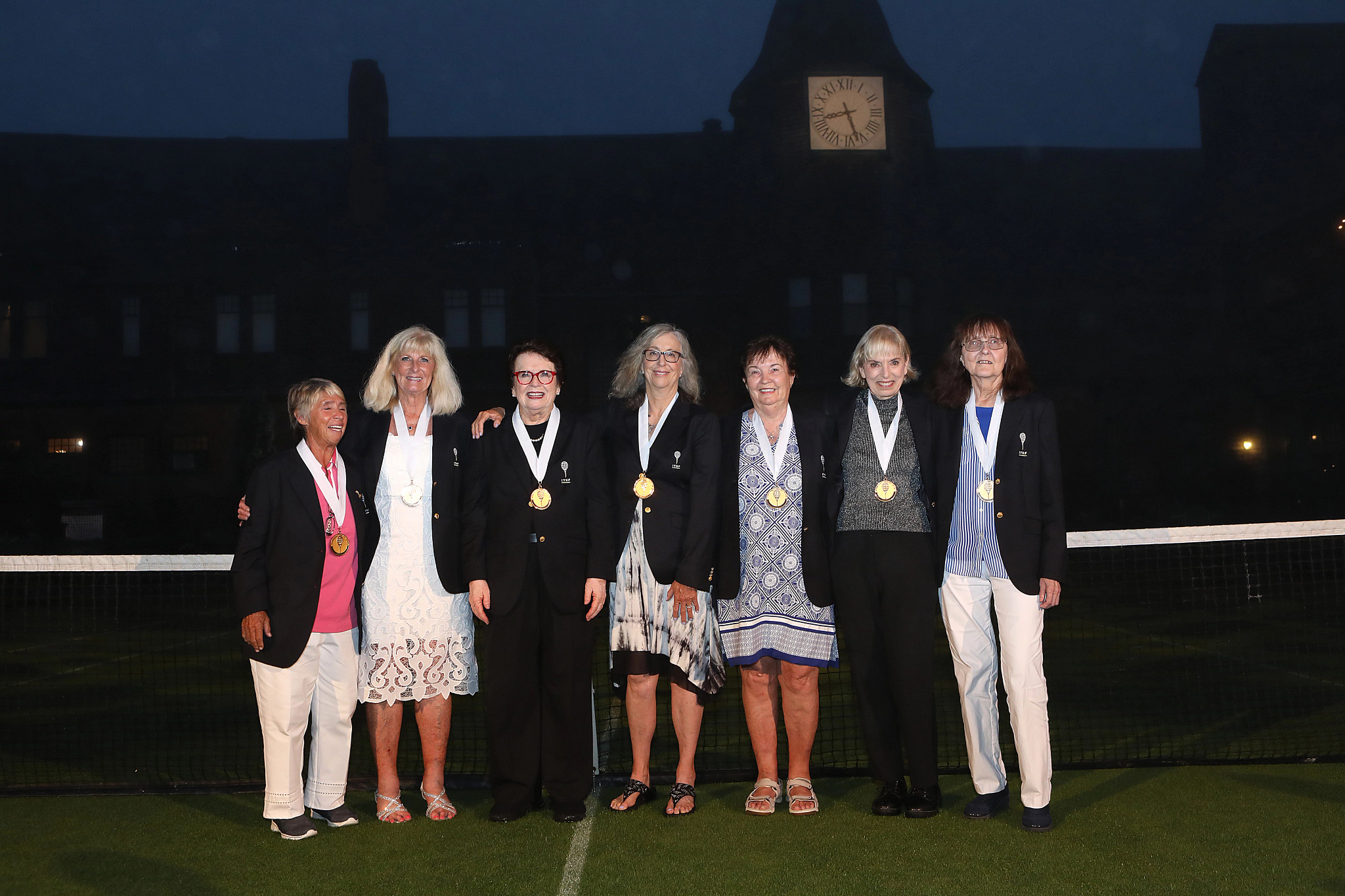
After a scorching afternoon, the skies turned gray and the fog rolled in, but that only heightened the drama and vast appeal of the proceedings. Fittingly, it all commenced with the arrival of the “Original Nine”. For the first time in Hall of Fame history, a group was honored for their contributions as if they were an individual, and no one among the cognoscenti of tennis would dispute that these magnificent and audacious women were fully worthy of the honor they were receiving.
On September 23, 1970 in Houston, Texas, the nine female competitors—Billie Jean King, Rosie Casals, Nancy Richey, Kerry Melville Reid, Judy Tegart Dalton, Kristy Pigeon, Valerie Ziegenfuss, Peaches Bartkowicz, and, last but surely not least, Julie Heldman—signed one dollar pro contracts with the estimable promoter and World Tennis Magazine founder Gladys M. Heldman.
They played their first tournament at the Houston Racquet Club which was sponsored by Virginia Slims and offered $7,500 in prize money. They were in defiance of the governing bodies of their countries, knowing they were risking suspensions and potentially having their careers severely disrupted, realizing that they might find themselves erroneously labels as outlaws by the male establishment of tennis. Yet they refused to be swayed from their convictions that women deserved equal treatment in tennis rather than prize money that went eight to one against them and sometimes was even worse than that when compared to the men.
By 1971, a full fledged circuit was in place for the women. King established herself as the first female athlete ever to earn $100,000 in a year. In 1973, the women were paid equal prize money at the U.S. Open with Margaret Court and John Newcombe both taking home $25,000 as the champions. Women’s tennis flourished thereafter, largely because the “Original Nine” had paved the way for them.
In any event, seven of the nine players were assembled in Newport the weekend before last, with Dalton appearing on Zoom and warmly addressing her fellow players and the audience. Richey was not present but even her decision not to show up in Newport could not diminish the deep enthusiasm all of the others shared in knowing how much they had contributed to not only women’s tennis but women across the board in society as a result of what they did 51 years ago.
King spoke first at the ceremony and put into context what the “Original Nine” had done to shape the future of their sport. As she said, “The nine of us along with our fearless leader Gladys Heldman had one vision for the future of women’s tennis. We wanted any girl if she was good enough to have a place to compete, to be recognized for her accomplishments and not only for her looks, and most importantly to be able to make a living playing professional tennis. Today’s women professional players are living a dream. Women’s tennis is the leader in women’s sports.”
Next up at the podium was the taciturn Kerry Melville Reid, eternally shy and ever modest. Reid was a perennial world top ten player who won the Australian Open in 1977. This Australian star spoke fondly about winning the Virginia Slims tournament in Newport fifty years ago, taking the title over Francoise Durr after upending King in the semifinals. The final went to 4-4 in the third set tiebreaker so it was simultaneous match point for both players, but Reid held her nerve to secure the victory. She reflected, “Looking how far women’s tennis has come since then, I am really proud to have been a part of that… I thought if it is good enough for Judy and if Billie Jean is doing this, they are putting their careers on the line. So I decided to join the Original Nine and I am really happy that I did.”
Kristy Pigeon followed Reid in the speaking lineup. This left-handed American dynamo came out of California, possessed a big serve and adventuresome game, and was the No. 8 ranked player from the U.S. that landmark season of 1970.
Pigeon recollected, “In 1968 I broke into the international tennis scene. At that time women played on the back courts ad women’s sports were trivialized. That same year at age 17, I became the top junior in the world by winning the Wimbledon and U.S. titles. I set a new goal and that was to go to college, play on a team and receive a scholarship. No such thing. The phone didn’t ring. Then in 1970 Jack Kramer [tournament director of the Pacific Southwest tournament in Los Angeles] got aced by nine women. We were misfits, trouble makers, rebels. So we were just crazy enough to change the world of tennis. I am proud of our efforts that led not only to a broader range of opportunities for women players, but also for other sportswomen and collegiate athletes as well.”
One by one, these distinguished members of the “Original Nine” were conveying their thoughts with originality, humor and verve. Ziegenfuss was no exception to that rule. Ranked seventh among Americans in 1970, she was first rate in singles but even better in doubles.
Always known for her salt of the earth persona and a fundamental decency, Ziegenfuss spoke from the heart and did an excellent job of defining who the “Original Nine” are and what they have meant to the sport.
She said, ‘This award means our story is officially part of tennis history for ever and ever, and it means for generations to come my relatives will be able to trace their bloodline back to me and discover our group’s contribution to the world—that is fun. Just think: we grew up with white tennis balls, wood rackets, one tennis magazine (World Tennis) and no Stan Smith tennis shoes.”
That line drew considerable laughter among those seated at the ceremony, including from Smith himself. He is the President of the International Tennis Hall of Fame, and was the world’s best player in 1972 when he won Wimbledon, but is perhaps best known now for his Adidas tennis shoe that bears his name. He was more than willing to smile freely at Ziegenfuss’s gentle humor.
Ziegenfuss continued, “What is even more amazing is we’re older than the internet, color television, personal computers and cell phones- not to mention our friend Alexa. And, by the way, Alexa knows who we are and even pronounced Bartkowicz ad Ziegenfuss correctly. Talk abut we’ve come a long way baby!”
Becoming even more philosophical, Ziegenfuss said, “The game of tennis has always given to me more than I could ever give back to it. The game prepared me for adulthood, it gave me skills to earn a living and gave me friendships to last a lifetime. Tennis has always been there for me. It is part of my past, my present and hopefully my future. It has given me so much joy playing it, coaching it, following it and parenting it. I am very proud that my daughter Allison Bradshaw played the women’s tour for three years. Maybe one day her children, Mathew and Ashley, will follow in our footsteps.”
After Ziegenfuss wrapped up her thoughtful speech, it was time for Julie Heldman to address the public. Julie was raised by the great Gladys Heldman and thus grew up with the game and with her mother’s overriding passion—World Tennis Magazine. Julie was ranked second in the United States in 1969. She reached the top five in the world as well. She was among the most cerebral players of her era and later became an outstanding television commentator.
Her speech was in my view the best of all. Her words resonated not only with me but anyone out there who wanted complete clarity on the significance and ultimate impact of the “Original Nine.” Heldman was remarkably eloquent and even lyrical.
She said, “I feel thrilled and profoundly honored that the Hall of Fame is inducting us as a group and acknowledging our contributions to women’s tennis and to women everywhere. By now most of you have seen the iconic photo of our group taken in Houston in 1970, just before the start of the groundbreaking tournament that we have come to celebrate. The photo shows eight top women tennis players grinning and raising one dollar bills alongside my mother, the architect and engineer of the early tour. She is no longer with us but we remain grateful for all the miracles she pulled off.”
Heldman explained why she was not in that famous photo. “I hadn’t planned to compete in Houston because at that time I was so deeply wounded physically and mentally that I couldn’t compete in a tournament for another five months. But I, like the other eight women, understood the importance of the moment. And when I heard that my pals and rivals were taking a risk for women’s tennis, I jumped in to join them. So I competed in Houston by playing just one point out of solidarity to stand up against the male denominated tennis associations that were threatening our right to earn a living. Billie Jean King and I went out on a side court and after a few moments of pity-pat tennis I intentionally hit the ball into the net— an act that that was totally foreign to my nature.”
As Heldman added, “Once we cemented the deal by shaking hands at the net, our group became the ‘Original Nine’. The nine of us were rebels but we were not alone. The Houston tournament could only accommodate eight players, but plenty more women would have taken the risk if they only had the opportunity. Sure, it is true that not every woman player chose to join us right away but lets not forget that soon after the tour got underway women players arrived in droves from around the world, ready to stand together. Without that kind of solidarity the tour might have fizzled out quickly. The Original Nine are being honored today for our courageous stand but also as the symbol of all the early competitors on the women’s pro tour who banded together for the present and future of women’s tennis.”
Nearing the end of her lucid, enlightening and far reaching speech, Heldman said, “This honor has been 51 years in the making, but it remains exquisitely timely. Since 1970, vastly increased numbers of girls and women have participated inn sports and many have excelled. And once again the sound of rebellion is in the air, spearheaded by the women’s National Soccer Team, but repeated throughout women’s sports, echoing our long ago demand to be respected and paid for doing what we did best. By honoring the “Original Nine” today the International Tennis Hall of Fame is sending a message to female athletes in all sports. The message is ‘keep fighting. Your time is coming.’”
Heldman’s address soared mightily from beginning to end, and so Casals was following a very tough act. But Rosie— who along with King and Richey had already been inducted in Newport previously for her individual accomplishments—made her presence known with her usual spunk and sincerity.
“I am frightened to death of all these speeches,” she said. “And I am supposed to be the closer. So I am going to close this wonderful evening.”
She congratulated some of the 2020 inductees and thanked Ilana Kloss for her role in helping the “Original Nine” get the recognition they deserve. Then Casals said, ‘Thanks to all of you for completing our journey and allowing the “Original Nine” once again to make our history in the game that we have loved and helped shape into the future. To my warriors who stood tall and invincible so long ago so women’s tennis could be what it has become— the showcase for women’s sports. One last time—I am proud to stand with them and before all of you as a humble believer that anything is possible if women stand together.”
The time had become to hear from Lucy Garvin, former President of the USTA and a longtime friend and admirer of the late Dennis Van Der Meer. Van Der Meer was elected as a contributor to the class of 2021, and deservedly so for his singular role as a teaching professional over the decades. Van Der Meer was regarded universally at the “teacher of teachers” and in his industry no one was more highly regarded.
Gavin closed her speech by saying, “The genius of Dennis Van Der Meer is very clear. He was a brilliant coach, a revolutionary in his thinking, a true visionary and a mentor to thousands including myself. He was the teacher of teachers. His greatest gift was his love of people and the game of tennis. He is what Hall of Famers are all about, truly an icon.”
After Van Der Meer’s widow and critical partner on and off the court Pat thanked Garvin and the Hall of Fame for the honor, Raquel Giscafre appeared on Zoom to present Conchita Martinez. Giscafre was the top ranked player from Argentina in the 1970’s and established herself as one of the premier tournament promoters on the WTA Tour starting in the mid-1980s.
She saluted Martinez for her multitude of successes. As Giscafre said of the Spanish stylist, “She was in the top ten in the world for nine years in a row. In 1995 she was ranked No. 2 in the world. She was the first Spanish woman to win Wimbledon in 1994, beating the great Martina Navratilova in the final. She reached the final at the French and Australian Opens and was at least a semifinalist in every Grand Slam. She also won four consecutive Italian Open titles.”
Giscafre lauded Martinez for leading Spain to five Fed Cup triumphs, for becoming the first Spanish woman to be captain of their Davis Cup team from 2015 to 2017, and for serving as Fed Cup captain from 2013 to 2017. And then Giscafre spoke of the great courage displayed by Martinez.
Martinez was true to her character— understated, dignified, appreciative, and honorable. She was terrific.
“It is a great honor for me to be here today and to be a part of world tennis history,” said Martinez. “It is my first time here [in Newport]. It is just an amazing feeling and something I will treasure all of my life.”
Eventually she spoke of the joy she found in winning Wimbledon 27 years ago. She said, “When asked by journalists and fans during which title is the most special to me, I have no doubt it is Wimbledon. I had mixed feelings about playing on grass at that time, probably because Spanish players did not have much experience of playing on this surface. But every year I improved my game on grass, working hard and accepting that I had to change things to get results. And, boy, did I get great results. I am so proud to have been the first Spanish woman to take the title home. The memory of playing against and defeating Martina Navratilova— who was going after her tenth championship at Wimbledon— will stay with me forever.”
She spoke of her pride in simultaneously being captain of both the Fed Cup and Davis Cup teams in her country and of playing for her country, which she clarified was never easy. “The responsibility is huge,” she said. “You feel you are carrying the hopes of your country on your shoulders.”
As she wrapped up her remarks, Martinez said, “This wonderful sport has given me unforgettable moments, moments that require dedication, sacrifice, effort, patience, positivity, optimism, and, above all, belief in yourself. If you want your dreams to come true, these words must become part of your daily life.”
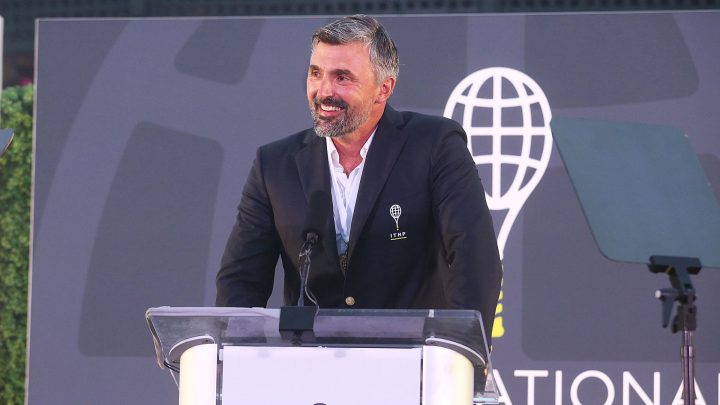
And so it all would end the only way it could, with the 2001 Wimbledon champion accepting his honor with grace, humor and reverence. Ivanisevic—who also made it to three other finals in the 1990’s but lost twice to Pete Sampras (1994 and 1998) ands once to Andre Agassi (1992) was introduced by John McEnroe on film. McEnroe said, “Can I just say at the top—- I love Goran Ivanisevic and I am absolutely thrilled to induct someone at the International Tennis Hall of Fame who is arguably crazier on the court than I was. But here’s the truth— he has been great for the sport of tennis…The bottom line is this—both on and off the court Goran did things his way and we could certainly use more players like him.”
Ivanisevic— who reached a career high of No. 2 in the world —was deeply touched by McEnroe’s introduction of him. He then said, “42 years ago I started this journey from a little town of Split in Croatia and today 42 years after I am in Newport.”
He had to talk about his fans and how frustrating he made it for them. Ivanisevic said, “It was not easy to be my fan. Wow! It was frustrating and sad. Probably a lot of people got divorced because of me. But for sure one thing—it was entertaining to be my fans.”
He spoke briefly about an outstanding Croatian journalist named Neven Berticevic who had been kind to him in print across the years, proclaiming, “Thank you, Neven, for writing every beautiful word about me.”
And then Ivanisevic gave a heartfelt salute to his parents for all they did to shape and guide him through the years. “And now,” he said, “the most important thing—the two most important persons in my career, my Mom and Dad, two people who sacrificed their health and career and gave me unconditional love for me to succeed. Mom and Dad—there are not enough thank you’s, not enough words that I can say or do for everything what you have been doing for me. And if I have to go again on this trip I gonna choose you again to be my Mom and Dad and we go through it together again. I love you and thank you for everything.”
Ivanisevic mentioned his three kids and his wife, spoke movingly about his country and amusingly about Wimbledon for giving him a wild card in 2001 that led to a long awaited triumph on those lawns, and left the stage having made everyone who was there delighted they had witnessed his induction.
It was an outstanding ceremony and one of the most enjoyable I have ever seen. It brought out the best in a good many people and gave us all an even deeper appreciation for those who were elected to the International Tennis Hall of Fame. I am already looking forward to 2022.
___________________________________________________________________________
Steve Flink has been reporting full time on tennis since 1974, when he went to work for World Tennis Magazine. He stayed at that publication until 1991. He wrote for Tennis Week Magazine from 1992-2007, and has been a columnist for tennis.com and tennischannel.com for the past 14 years. Flink has written four books on tennis including “Dennis Ralston’s Tennis Workbook” in 1987; “The Greatest Tennis Matches of the Twentieth Century” in 1999; “The Greatest Tennis Matches of All Time” in 2012; and “Pete Sampras: Greatness Revisited”. The Sampras book was released in September of 2020 and can be purchased on Amazon.com. Flink was inducted into the International Tennis Hall of Fame in 2017.

