



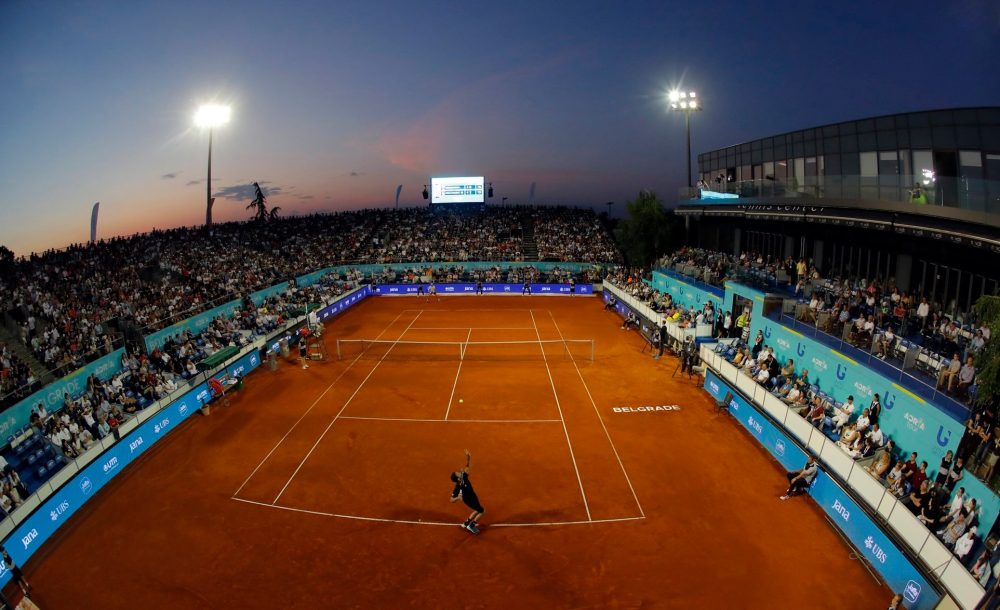
Watching the Adria Tour get underway in the Serbian capital of Belgrade has given tennis fans a much needed reminder of what the sport was like before COVID-19 brought everything to a standstill.
Hundreds of spectators sat shoulder-to-shoulder cheering on the players from the sidelines, which included three members of the top 10. Among them is co-founder of the event Novak Djokovic. The ball boys and girls had their usual tasks of handling the balls, as well as towels. Then when matches finished, the traditional signing of autographs took place. It was a delight to see, but looks can be deceiving.
On the opening day of the Tour many were quick to question the lack of social distancing at the event. A protocol encouraged worldwide in order to help prevent the spread of COVID-19. Serbia has not been the hardest hit country by the virus, but they still have a fight on their hands. According to the latest figures, there have been just over 12,000 cases with 250 deaths.
“We have different circumstances and measures, so it’s very difficult to think of international standards,” Djokovic said.
“You can also criticize us and say this is maybe dangerous, but it’s not up to me to make the calls about what is right or wrong for health,” he continued. “We are doing what the Serbian government is telling us and hopefully we soon will get back on tour collectively.”
Whilst some have criticised Djokovic’s event, it is not the first in Serbia to attract a mass crowd. In fact, earlier in the week 25,000 people turned up for a local derby in Belgrade between two football teams. Something physician Dejan Zujovic described as a “a huge, enormous, totally unjustified epidemiological risk”. Zujovic caught COVID-19 whilst treating others in the city.
Nevertheless, the Adria Tour has illustrated that it is still possible to organize a top-level tournament during the health crises. But how likely is it that the achievements and approaches taken by the Belgrade event could be applied to the Tour when it resumes again?
On Monday the United States Tennis Association will make their final decision regarding the US Open and if it will get underway on August 31st. There has been a lot of debate over the event with many player’s voicing their concerns over what Djokovic describes as ‘extreme measures.’ Under one set of proposals, players will not be able to go to Manhattan and they will only be allowed on site with one member of their team.
“All of these circumstances are pretty tough,” Dominic Thiem told reporters on Friday.
“So I think some circumstances will have to change (for it to) make sense to go there.”
Germany’s Alexander Zverev shares a similar view with Thiem when it comes to Flushing Meadows. New York has been the epicentre of the COVID-19 outbreak in America with more than 17,000 deaths. This is more than 60 times higher than that of Serbia.
“With how it is right now, if it stays like that with the quarantine times, only being able to take one person (to the site), having to stay in one hotel and not being able to use the showers on site. It’s tough to play a grand slam because everything at a grand slam has to be perfect,” he said.
“I’m not sure a lot of player’s are for it right now, but the USTA has to decide.’
“In my opinion with how it is now we should not be playing.”
The great thing about the Adria Tour is that it provides a brief break in guessing what the professional Tour’s could look like when they resume. However, in reality the idea of repeating scenes with a packed crowd and player’s interacting face-to-face with fans is still a long way off in professional tennis. Even Djokovic’s Tour has experienced their own problems related to COVID-19 with the Montenegrin leg being axed on Saturday over concerns.
“I am so sad for the Montenegro leg,” the world No.1 told Sport Klub.
“We tried everything, but the borders are still not open and we don’t have time to organise it all.”
Montenegro’s withdrawal is yet another reminder of the complexity the sport faces over the coming months. Tennis is in some way at a disadvantage of being a global sport with player’s all over the world gathering to play at one specific location at a time. Rafael Nadal, who is the defending champion at the two remaining Grand Slams hoping to be played later this year, believes the sport shouldn’t resume until it is accessible for everybody.
“If we are not able to organise a tournament that is not safe enough or fair enough where every player from every part of the world needs to have the chance to play the tournament we can’t play, that’s my feeling.” Nadal stated.
It is clear that there remains a high degree of discontent when it comes to the idea of potentially resuming the sport. Djokovic’s well organised and highly entertaining Adria Tour provides a much needed break to all this uncertainty. But don’t expect the scenes of the event to be replicated on the ATP and WTA Tour’s in the coming months.
The sad reality is that tennis still has a long way to go with many hurdles to tackle during the era of COVID-19.

