



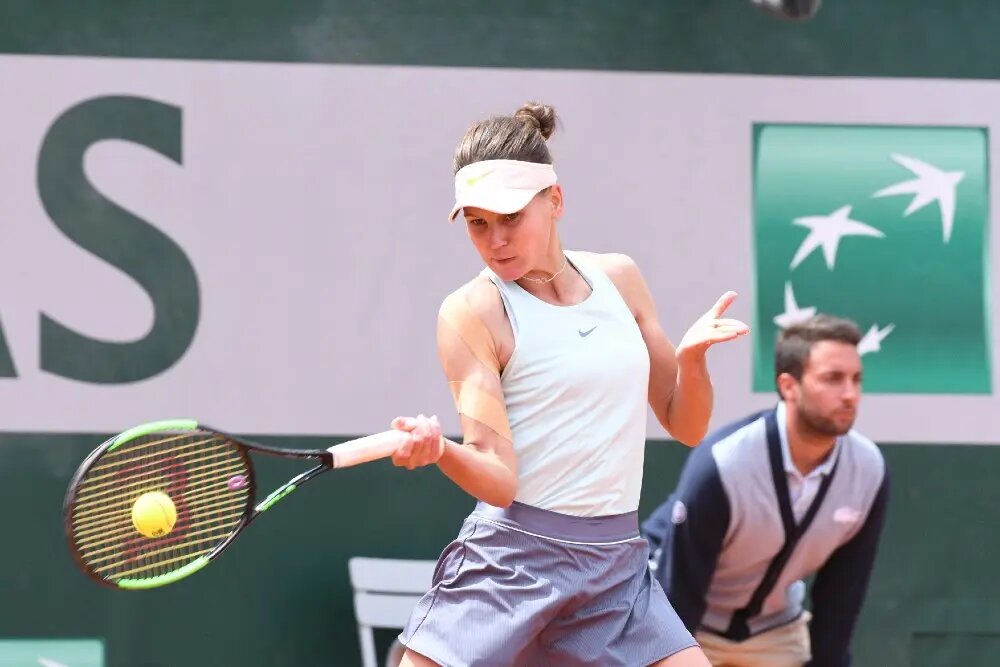
THE TECHNICAL CHARACTERISTICS OF KUDERMETOVA
How does Kudermetova play? I’ll confess that, after checking my databases, I think I had never seen her play before 2018. Or, at least, I don’t recall watching her. It is therefore difficult for me to identify what substantial progress has allowed her to transform into such a competitive player. According to her WTA profile, she is 5’9’’ (the figure seems correct to me), with legs that are more powerful than agile, and this makes her a tennis player who favours attack over defense. Surely, one of her strengths is her first serve: in 2020, she was 8th for aces per match with 120 in 24, exactly 5 per match. While having an assertive first serve obviously allows a player to manage his or her serving games with greater peace of mind, there is however room to grow with the second one.
I would say that all in all she is a symmetrical player, that is, without particular imbalances in the two groundstrokes. However, she remains a female tennis player: that is to say, she does not often try to run around the ball to hit the inside-out or inside-in forehand, as it happens on the ATP Tour. Indeed, one of her most effective shots might be the inside-out approach backhand, played from the center to the left, a typical solution of women’s tennis.
One of the most personal aspects of her game, which could allow her further improvements, is the natural propensity for vertical solutions – this is a quality that is not so common in contemporary tennis. For example, she uses the drop shot not only as a winning shot, but also as an alternative maneuver: in such situations, she deliberately performs the shot with a certain safety margin in order to lure the opponent to the net and trigger net exchanges, or even just to shake up the usual baseline attrition.
Once at the net, her proficiency as a doubles player can be appreciated. There are two aspects of her net game that need work, however: she is not very reactive, and therefore, on faster balls, she sometimes seems to lack the time to cut the ball from top to bottom, as required to put some spice in the volleys; her least effective volleying shot is her smash, though – more than once, I have seen her struggle to coordinate when dealing with higher trajectories.
I quote an interesting fact that can be obtained from the statistics of her charted matches: over 17% of her winners come from points played on the net, a well-above-average datum for contemporary tennis (the green slice of this pie-chart).
Another shot that can be improved is perhaps the return. It is true that she has two wins against Pliskova (who is certainly a great server), but a greater effectiveness versus less-than-great servers could be expected from such a solid baseline player. Who knows, it could be a problem related to the aforementioned non-exceptional reactivity.
THE COMPARISON WITH THE MOST PRECOCIOUS PLAYERS OF 1997
To conclude, I have prepared a comparison with the best of her peers, namely Bencic, Kasatkina, Ostapenko, Osaka, and Konjuh. What follows is a table comparing their seasonal performance with Kudermetova’s. The numbers next to the names are those of their official year-end ranking:

As can be seen, if we exclude the initial period in which Kasatkina and Ostapenko trail Kudermetova because they turned pro at a later date, for a long time Veronika lagged behind her peers. For example, in 2016 she was the only one not to feature in the WTA Top 50. Then, in the following years, injuries affected Bencic and especially Konjuh.
In summary, Kudermetova wasn’t competitive until 2018; from that moment, her ascent began, leading her to become the best behind Osaka in 2020 (when looking at points obtained solely during that season). Over the years, the statuses of these players have therefore varied, but it is not certain that they will remain crystallised as they are now: we are still talking about 23-year-old players, and there will still be time before conclusions on their careers can be drawn.
Translated by Andrea Ferrero; edited by Tommaso Villa

