



THE EARLY YEARS
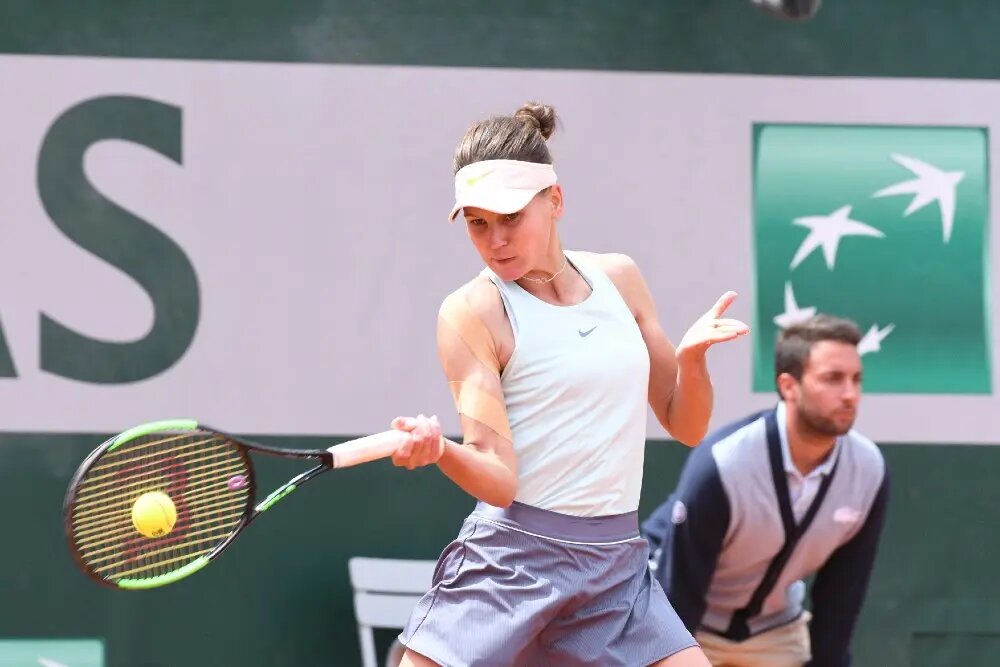
Veronika Kudermetova was born on April 24, 1997 in Kazan, the capital of the Tatar Republic, and is the daughter of a hockey player, Eduard Kudermetov. Having a professional athlete as a parent put sports at the centre of family life, and led Veronika to move around Russia, following her father’s transfers from one club to another.
As a child, Veronika started playing tennis by chance; here’s how she explained it in an interview: “I spent the summer in the countryside, and a friend of mine invited me to try tennis, because she was bored playing by herself. Not only had I never picked up a racquet in my hands, but I had absolutely no idea what it was. However, the idea seemed more attractive to me than working in my grandmother’s garden. I had a lot of energy and, surprisingly, I even managed to hit the ball. I really liked the feeling that the game gave me.”
This happened when she was seven years old, but she probably would have met tennis soon anyway, because her dad plays recreationally, and with great passion. Eduard himself recalls endless matches played with teammates during pre-seasons held in Finland which lasted until one or two in the morning, since the sun never goes down during summers beyond the Arctic Circle.
After all, in addition to Veronika, the younger daughter Polina also plays tennis: according to her father, Polina could actually prove to be the Serena Williams of the family, being the younger but more gifted sister. At the moment, Polina (born in June 2003) is 4th in the junior rankings and has just reached the semi-finals at the 2020 French Open.
In her own junior years, however, Veronika encountered the typical difficulties faced by young Russian players of her generation. In fact, it is known that the many valuable players that emerged in the early 2000s were the result of a precise sports policy wanted by Boris Yeltsin himself. At the time, recruiting and training were endowed with considerable funds, which went to help the clubs and players – there were therefore good conditions to support the crucial developing phase, the one that requires teenagers to travel without any immediate economic return. After the end of the Yeltsin era (he died in 2007), things changed, and the players had to proceed with little financial aid. Kudermetova’s father tried in part to find a solution: when he moved to play in Moscow, he asked as part of the contract that his daughter could play at a quality tennis club, in order to be taken care of by competent coaches – economic difficulties persisted when it came to international travel, though.
Kudermetova’s junior career was good but did not reach the heights of some of her peers. She won some Grade 4 tournaments, but in the higher-level ones (Grade 1 and grade A) she was often downed by Belinda Bencic and Daria Kasatkina: the Swiss beat her twice in the tournament of Santa Croce (once in the final) and also at the Trofeo Bonfiglio, while Daria defeated her at the Yeltsin Cup. On the other hand, she won the 2013 junior Fed Cup as the second-best player on the team behind Kasatkina.
Her best junior ranking was the 22nd spot reached in 2013, aged 16. In that same year, two of her peers dominated the Slams: Ana Konjuh won the two titles on hardcourts, Belinda Bencic those in Europe. The class of 1997 would then win two more majors in 2014 (Kasatkina at Roland Garros, Ostapenko at Wimbledon) and one in 2015 (Paula Badosa, again at Roland Garros), leaving little to younger and/or older competition.
With such rivals, it wasn’t easy for Kudermetova to stand out. However, she remained a player not to be underestimated, and with decent prospects. But with little help from the federation, she had to give up longer trips and select the tournaments she entered.
This is why her father, who after retiring from hockey had become a member of her team, looked for alternative solutions: in 2012, he found support from the Austrian federation – the idea was to switch sides and play for Austria. This is why Veronika moved to Vienna for a couple of months, but reluctantly so – she didn’t like the idea of changing her citizenship. Her father has said that at a certain point she explicitly told him that she would either play as a Russian or stop playing tennis altogether; the family then returned to Moscow. Perhaps these obstacles contributed to the decision of turning pro at age 16 to only play ITF tournaments. The start of her professional career, however, would turn out not to be easy.
On page 3, her early pro years

