



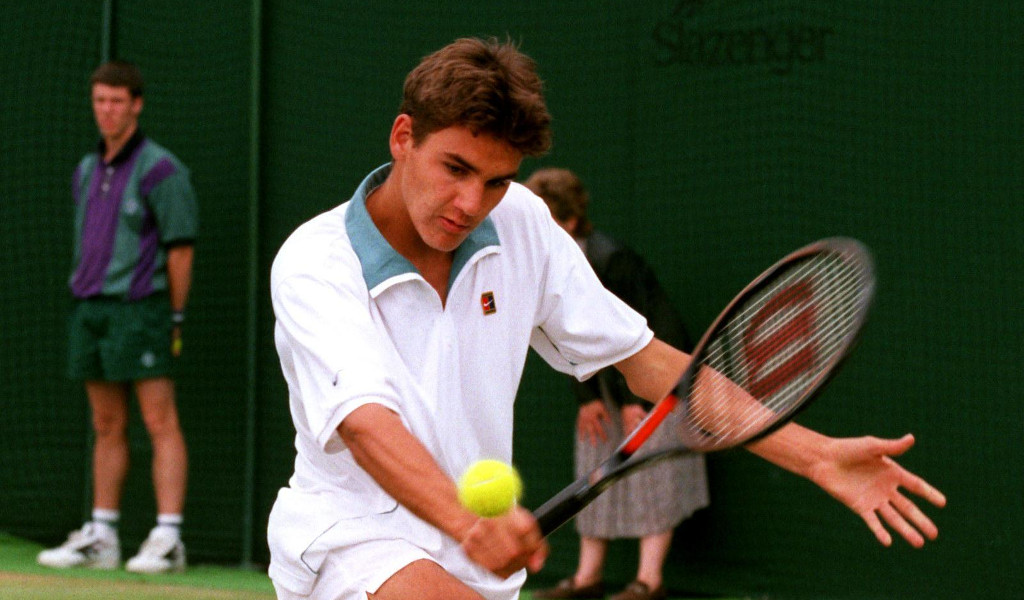
Is winning a Junior Slam the start of a brilliant career or a great delusion? This is the question we are always asking when we see a promising 17-year-old lifting a coveted trophy. Just at that moment, the most delicate phase for a young athlete approaching the professional ranks begins. He or she has to make a lot of changes: to leave the comfort zone of the junior circuit, the familiar faces of peers who have often also become friends, the club that coddle them and the support of their national federation. Once it’s all over, you suddenly find yourself having to face an unknown world, all alone. Many expectations (coming from your family, the media, and even from your own ego) threaten to saddle you with an unbearable baggage of anxiety. And on top of this, the technical transition from the juniors to the pros requires a solid guide to help you work on your game, sacrificing short-term results.
EDBERG AND THE OTHERS – Over the years, we have really seen everything, from Stefan Edberg, who achieved the “Junior Grand Slam” in 1983 and then excelled on the ATP Tour, to many players who instead fell into anonymity, sometimes quitting tennis prematurely. Here we certainly won’t try to provide a definitive diagnosis of why this happens – we will simply analyse what has happened in the last 32 years from a statistical point of view. You may wonder why we have chosen a 32-year interval. 1988 was set as the beginning of our research because from that year the Australian Open has been played on hard-court, after already reverting to a January start date in 1987 in an attempt to recover the relevance it had seemingly lost in the previous decade. The tournament had become the least competitive among the Grand Slams, both at the professional (i.e. Borg played the Australian Open only once) and junior levels. The change of date and the surface switch at Flinders Park helped to rebalance the situation and to give equal dignity to the Australian Open.
We also must keep in mind, as an essential premise, that the strongest U-18 athletes often don’t play junior tournaments, either by technical choice or because they are already winning at the higher level. Borg won the French Open when he was 18; Becker won Wimbledon at 17 and Wilander won Paris at 17, not to mention McEnroe who reached the semi-finals at Wimbledon starting from the qualifying round when he was 18. Thus, they obviously did not have a junior career, with the exception of Mats Wilander, who won the Junior Roland Garros the year before bagging the real thing – sort of a world record with regards to the speed and seamlessness of the transition from the youth competitions to the pros. More recently, Nadal and Djokovic achieved the semi-final as their best result, respectively at Wimbledon and the Australian Open. Federer (Wimbledon champion in 1998 and US Open semi-finalist the same year) and Lendl (Wimbledon and Roland Garros 1978) did better than Nadal and Djokovic. As mentioned, Stefan Edberg took his junior career seriously – in 1983, he achieved the Junior Grand Slam.
What does this data illustrate? Here you can find the tables that list all the winners of the four junior Slams from 1988 to 2020. Starting from these data, we calculated the ratio of the best ranking reached by the winners once they turned pro. The caveats in this analysis are the following: we excluded from the calculation the worst five performers for each tournament (highlighted in red in the tables) and by default the winners of the two Junior Slams played in 2020, considering that they are still too young. We considered misleading for the purposes of the analysis to include in the dataset the results reached by players who have completely failed, sometimes quitting the game early.
Considering the 27 best results for each Slam, sorting the four Slams from the one with the lowest to the highest average ranking, the following are the results:
1. US Open: 37.55 (median value 17)
2. Roland Garros: 47.88 (median value 21)
3. Wimbledon: 63.85 (median value 39)
4. Australian Open: 77.29 (median value 83)
It seems clear that the US Open’s young winners are likelier to have a better career. On the other hand, the Australian Open is the only Grand Slam whose median value is higher than average: it means that those who have obtained a worse than average best ranking outweigh those who have obtained a better one.
THE COACHES’ OPINION

Here’s the opinion of Simone Tartarini, the coach of Lorenzo Musetti, a player who is currently facing the aforementioned adjustments related to turning pro: “The Australian Open has always been an overlooked tournament (among pros and juniors alike), especially due to the complexity and cost of the trip. This year in Australia, I was talking to Ljubicic and he told me that, when he came here for the first time at 18, it was enough to have a ranking of 800 to play in the qualies. Nowadays, they would not even let you be a ball boy with that kind of background. In any case, a ranking average of 80 is worthy of some consideration because a player who is in the Top 100 still manages to make a living out of tennis.”
“As for Paris,” he continued, “I don’t know if what I say has a scientific basis, but in that tournament I have often seen some boys (especially Argentinians and Spaniards) who are already physically well-developed play against a frail boy who looked like he was still in eighth grade. Then it often happened that a couple of years later the boy grew up and overtook them thanks to his greater talent. The US Open is at the top of the ranking because we could probably call it the most universal and therefore the most coveted event. Nobody wants to miss it, and if the boy has a predisposition for hardcourts, once he turns pro that surface will be the one where most of the tournaments will be played and where he’ll build his ranking. As for Wimbledon, I would not know, it is probably the same concept, just in reverse. If at 17 you discover that you are a great grass court player, you will have few tournaments to show it as a pro.”
Finally, he added: “However that may be, the time of this transition is very dangerous, and I am happy that Lorenzo has now left it behind. I define the ranking between 200 and 500 as ‘the swamp’ – getting stuck in it is very easy. For example, last year at the Challenger in Pordenone there were seven Junior Slam winners, people aged 25/29. Players who have not followed through on their tennis talent, players who thought that they could make it without hard work, while failing to understand that at the junior level you often win for the opponent’s demerit. As a professional, you have to hit much harder and earn every point.”
Let us hear another renowned opinion. Fabio Gorietti, former Boys’ Wimbledon champion Gianluigi Quinzi’s coach for two years, stated in a recent interview: “Gianluigi was aware that he had an excellent level for the junior circuit, and he thought it would be enough to train to quickly get to the pro level. He would have needed to change his game, to evolve, to become more complete in order to have more solutions throughout matches. A talented junior player must get rid of the tactics that brought him so many points when he played in junior tournaments, because he will often discover that he will not achieve the same results playing against a pro. And he has to be able to go to the detriment of on-court results in the short term.”

