



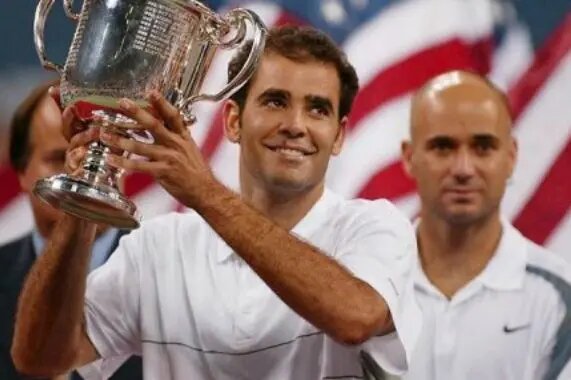
Pete Sampras stunned the tennis world when he won the US Open singles title as a 19-year-old in 1990. In essence, an unknown became known and – borrowing from Frank Sinatra – reached the “top of the heap…” in New York. Twelve years later, he took full advantage of the opportunity in that same setting to bring the curtain down on his extraordinary career. At 31, he made a final entry in the record book when he won his fourteenth major championship in storybook fashion… It seemed as if it had come full circle… To once again quote Sinatra, with a slight alteration, “It brought an end to a very good career”.
(At the 2003 US Open, after having not played another tournament since the triumph, he fittingly took a final bow where it all had begun and officially retired.)
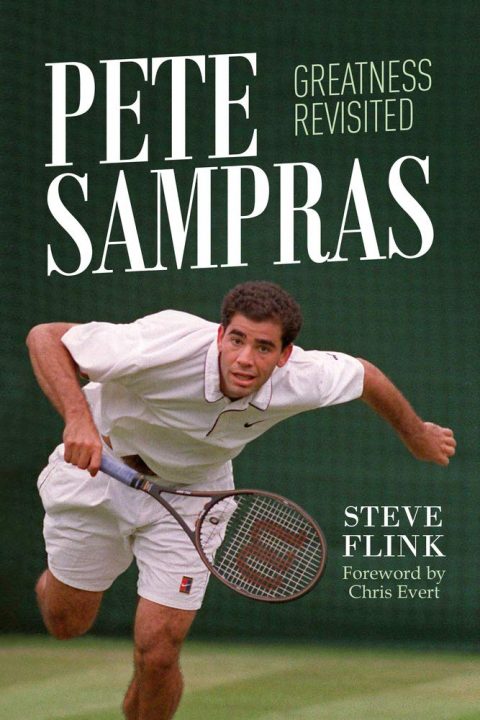
In “Pete Sampras: Greatness Revisited”, Steve Flink paints a portrait as if he were Claude Monet, who saw the reality of the world and made it more beautiful. The acclaimed Impressionist relied on the eyes of the viewer to mix the colors he used for his captivating landscapes, many of which he painted in his Giverny garden. Flink, the 2017 International Tennis Hall of Fame inductee, uses words similar to the way Monet utilized his palette to create an understanding of who Sampras is and more important, a genuine feeling for him as a player and an individual that many watched but very few really knew.
Sampras’ birthday is August 12, 1971. He joined the pro ranks at Indian Wells in 1988, five months before he turned 17. Early on, his talent had been widely recognized, but, because he was shy, he didn’t really burst on the scene. Actually, he never sought attention and he certainly wasn’t loquacious. With Rod Laver as his model and Wimbledon as his goal, he lived by the motto – I let my racquet do the talking. As a result, many tennis aficionados knew him only based on his tournament results. Otherwise, he was nearly invisible.
Flink, who has a photographic recall of points and matches played, travels through Sampras’ record setting; from New York and significant stops in between and then back to New York – from his first major to his last. The easy to read writing style weaves facts and observations smoothly, with no apparent seams in the story’s fabric. The author is so skilled that he makes the reader feel as if he/she is fortunate enough to be sitting in the room and listening to conversations between Steve and Pete as they discuss details gleaned from his Grand Slam competitive triumphs, the successes that were realized at ATP Year-End Championships and his most cherished accomplishment – finishing No. 1 in the world for six straight years – a record that may never be broken.
Every tennis “story about…” features a list of accomplishments and praise of the subject by former opponents and those who played prior to the individual’s time in the limelight. For the most part, the supporting quotes can be summarized in driving onto a dead-end street fashion – “Good player, Good guy”. Because of Flink’s relationship with current and former players, he can use a masterful variety of insights about Sampras to make the story compelling. He collects them from the likes of Jim Courier, Andre Agassi and Michael Chang, rivals that date back to their shared junior days. Mats Wilander, Patrick Rafter and Goran Ivanisevic add to the richness of the canvas. So do the thoughts offered by Billie Jean King, Mary Carillo, Martina Navratilova and Tracy Austin. Keeping with the tennis’ hierarchy parade, Stefan Edberg and Ivan Lendl make some revealing assessments, too. John McEnroe is quoted and naturally lives up to his being “ever-so-candid” by reputation. Todd Martin, a circuit opponent, who is now the CEO of the International Tennis Hall of Fame, is as usual, solid with his remembrances. Comments by Paul Annacone and Tom Gullikson, one a former Sampras coach and the other his Davis Cup captain, thread through a portion of the book and enhance its depth.
(I wrote the first Pete Sampras story that appeared nationally. It was in the “Inside The Junior Game” section of the June 1978 issue of World Tennis Magazine. Coincidentally, Steve Flink was the editor of the publication all those years ago. Perhaps it was fate, but he would go on to become a Senior Writer at Tennis Week, and I found a spot as a Contributor to that magazine as well.)
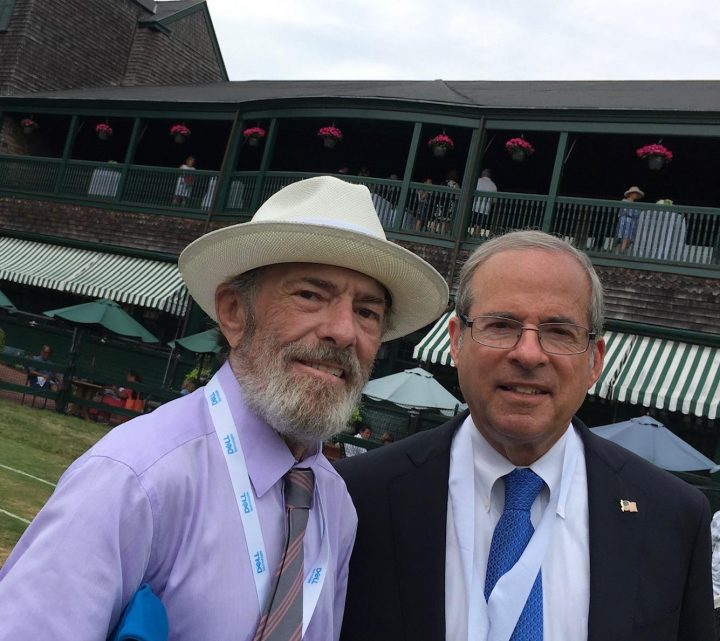
Having had a lengthy career as a journalist and having already written two books that are “musts” for inclusion in every tennis library – “The Greatest Tennis Matches of the Twentieth Century” in 1999 and later, “The Greatest Tennis Matches of All Time” in 2012, I asked Flink why he had decided to focus on Sampras. As one of the game’s premier historian, he could have written about anyone in tennis.
He explained, “I interviewed Pete a bunch of times over the telephone from 1992 to 1995. We met at Wimbledon in 1995. I wrote about him countless times both during and after his career. I would say I have done at least 15 or perhaps 20 features on Pete over the years.”
Flink continued, “It took about a year-and-a-half or slightly less to write the book, primarily because I knew the subject so well. As I said in my introduction, in my mind I had been writing the book since late in his career.”
There is much more to the book than an encyclopedic listing of Sampras’ wins and losses. In “Save the Best for Last” fashion, Flink explores one of the game’s universal questions – stepping from one era to another, in their prime, who would win? Though such ventures are speculation, it is always fun to wonder – Would Bill Tilden have been competitive against Jack Kramer? Would Richard “Pancho” Gonzalez have held his own against his one-time brother-in-law Andre Agassi? How might Rod Laver have dealt with John McEnroe?
Flink tantalizes the reader with a look at how Sampras could have done against Roger Federer, Novak Djokovic and Rafael Nadal. In a pièce de resistance, he brings the story to a close offering his Top 10 American men ever and Top 10 American men in the Open Era. I will not even hint at what he has to say, but these two chapters are standalone book-worthy in and of themselves.
“I felt it had to be done,” Flink said. “I had always wanted to do this book. Pete is too often taken for granted. His contributions to the game have been immeasurable. I felt that knowing him so well and understanding what he is about made me perhaps uniquely qualified to be the author of a retrospective examination of Pete’s impact on the game.”
A group of French artists used a complicated technique to create an optical illusion and it was called trompe l’oeil. In English, it means “deceives the eye”. In no way was there any deception or deceit to Sampras. Flink entertainingly points out that he is genuine and for that matter, purely and simply real.
“I always deeply appreciated not only his gifts as a player but also his quiet way of going about things. The bottom line is that he deserves a laudatory book done on his exploits. My goal is for many fans to be reminded of why they admired him so deeply. Hence the title: ‘Pete Sampras: Greatness Revisited’.”
“Pete Sampras: Greatness Revisited” will be available to purchase after September 1, 2020. (Check Amazon)

