



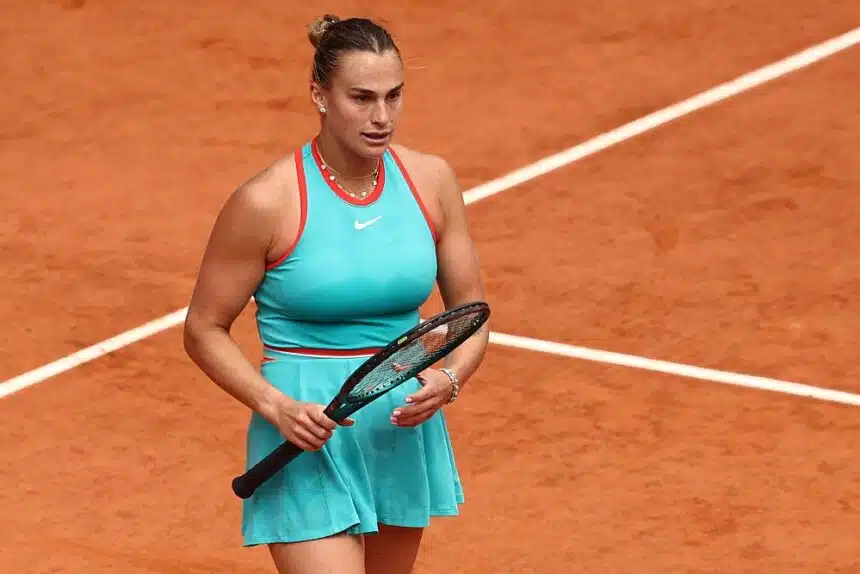
The argument surrounding Grand Slam prize money has intensified after world No.1 Aryna Sabalenka warned that players may resort to a boycott if they are unable to reach an agreement on pay.
Sabalenka was among many high-profile players who sent a letter to the French Open expressing their disappointment with its prize money distribution for this year’s event, which is a record 61.723 million euros. The group is campaigning for the four majors to give players a higher share of their revenue, with their target being around 22%. When factoring in the French Open revenue, it is estimated that players will receive a 14.9% share in 2026, which is actually a 0.9% drop from two years ago.
In response, the French Tennis Federation issued a statement to The Athletic stating that they are a non-profit organisation working based on a ‘specific economic framework.’ The federation adds that it invests in the grassroots level of the sport, as well as developing Roland Garros. However, there was no comment on whether they would be willing to increase their share of revenue for players. Instead, they said they are ‘committed to ongoing dialogue.’
Should that dialogue fail, Sabalenka warned that players might be prepared to boycott the majors. An extremely rare situation, but it has happened in the past. The most notable being Wimbledon in 1973, when more than 50 players refused to play after Niki Pilić was banned from playing by the International Lawn Tennis Federation (now ITF) for refusing to play a Davis Cup match.
“I feel like the show is on us. Without us there wouldn’t be a tournament and there wouldn’t be that entertainment,” Sabalenka said during her pre-tournament press conference at the Italian Open.
“I feel like definitely we deserve to be paid more percentage.
“I think at some point we will boycott. I feel like that’s going to be the only way to fight for our rights.
“We girls can easily get together and go for this because some of the things I feel like it’s really unfair to the players. I think at some point it’s going to get to this.”
Sabaklenka’s threat has been backed by others. Coco Gauff believes a boycott is possible if everybody unites. Both Sabalenka and Gauff were among the signatories on the letter sent to the French Open.
“It’s not about me. It’s about the future of our sport and also the current players who aren’t getting as many benefits, maybe as many as some of the top players are getting when it comes to sponsorship and things like that. We’re making money off court.” Said Gauff.
“When you look at the 50 to 100, 50 to 200, how much money each slam makes, it’s kind of unfortunate where the 200 best tennis players are living paycheck to paycheck, whereas in other sports it’s not even a discussion.”
Meanwhile, Jasmine Paolini believes there is already a united front in the sport on the topic.
“The positive thing is that we’re all united, all moving in the same direction. The Grand Slams increase the prize money slightly, but not as a percentage of how much more they earn. But, above all, they don’t help solve other problems. If we’re all in agreement—and I think we are—we could consider boycotting them,” she said.
The players with reservations
There is clearly a united front on calls for a fairer share from the Grand Slams, but not every player agrees on what action should be taken. Six-time Grand Slam champion Iga Swiatek brands the prospect of a boycott as ‘extreme.’
“I think the most important thing is to have proper communication and discussions with the governing bodies so we have some space to talk and maybe negotiate,” said Swiatek.
“Hopefully before Roland Garros there’s going to be opportunity to have these type of meetings and we’ll see how they go.
“But boycotting the tournament, it’s a bit extreme… I guess we as players are here to play as individuals, and we’re competing against each other.
“So it’s really hard for me to say how it would work, if it’s even there on the picture. For now, I haven’t heard anything.”
Former US Open champion Emma Raducanu told BBC Sport that she has no intention of missing major events due to their importance. The Brit spoke to reporters at the Italian Open on the same day as her peers before withdrawing from the tournament due to her ongoing recovery from illness.
“It gives you something that money can’t and that is what is the most important to me, and what I value the most,” Raducanu told BBC Sport.
“I wouldn’t be a part of [a boycott] but each to their own.”
Pay is a significant part of the dispute but it is not the only subject players are campaigning for. They are also calling for a greater contribution towards their pension schemes, more player representation in the decision-making process and better healthcare.
On Wednesday, the men will be conducting their press duties in Rome, with many expecting to share their views on a potential boycott.

