



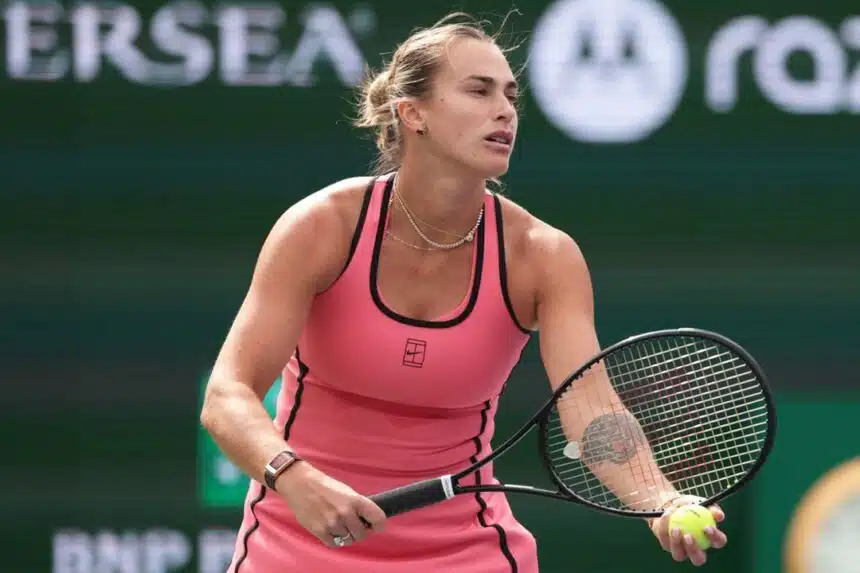
Aryna Sabalenka is unsure about playing at the Dubai Tennis Championships in the future following comments from the tournament director regarding her withdrawal from this year’s edition.
The world No.1 pulled out of the WTA 1000 event last month due to a right hip injury. Shortly before her withdrawal, a video was posted of her hitting during a training session. At the same tournament, Iga Swiatek also withdrew due to a scheduling change. Dubai takes place a week after Doha, which is also a WTA 1000.
Salah Tahlak, who is in charge of the Dubai Tennis championships, described the withdrawals as ‘strange’ before calling for harsher punishments to be implemented on players who skip tournaments at the last minute.
“I think a fine will not do anything,” Tahlak commented.
“I feel they should deduct points from the players. A monetary fine won’t help. Many years ago, Serena Williams withdrew and was fined $100,000. But what is $100,000? She would play someplace else and make $1,000,000. So the fine isn’t a big deal.”
Speaking to reporters ahead of the Miami Open, Sanalenka has hit back at what she labels as ‘ridiculous’ criticism from Talhak. Hinting that she may not play in Dubai in the future due to these remarks. The Belarusian has made nine appearances at the tournament since 2017.
“I don’t think [Tahlak] showed himself in the best way possible,” she said.
“It’s actually so sad to see that the tournament directors and the tournaments are not protecting us as players. They just care about their [sales], about their tournament and that’s it. I’m not sure if I ever want to go there after his comment. For me it’s too much.”
As the rules currently stand, players who withdraw from mandatory WTA 1000 events can be subjected to penalties if they don’t have a valid reason for not playing, such as an injury or illness. They are permitted to skip an event due to a change of schedule three times in a season, which incurs a zero-pointer but no fine.
“Going into this season, we decided … to prioritise my health and make sure we have these little gaps in the schedule where I can reset, recharge, work and be better prepared for bigger tournaments,” Sabalenka continued.
“I feel like the scheduling is going crazy and that’s why you see so many players injured, always taped and not delivering the best quality matches because it’s almost impossible.”
Numerous players have raised concerns on the Tour about scheduling and its impact on them. Recently, the WTA launched a 13-person Tour Architecture Council, whose goal is to recommend “actionable improvements.” These improvements could be implemented as early as next year. It is chaired by Jessica Pegula.
Reacting to Sabalenka’s possible future boycott, fellow player Coco Gauff said she understands why she would be angry.
“Iga and Aryna have played that tournament so many times and it wasn’t anything personal to it,” said Gauff.
“It’s tough. We’re trying our best to play the calendar. I completely understand why she would feel like that because the comments were unnecessary.”
On the WTA Tour, players are required to play a minimum number of tournaments each season. There are four Grand Slams, 10 WTA 1000 tournaments and six WTA 500 events. Furthermore, they must also take part in the WTA Finals if they qualify.

