



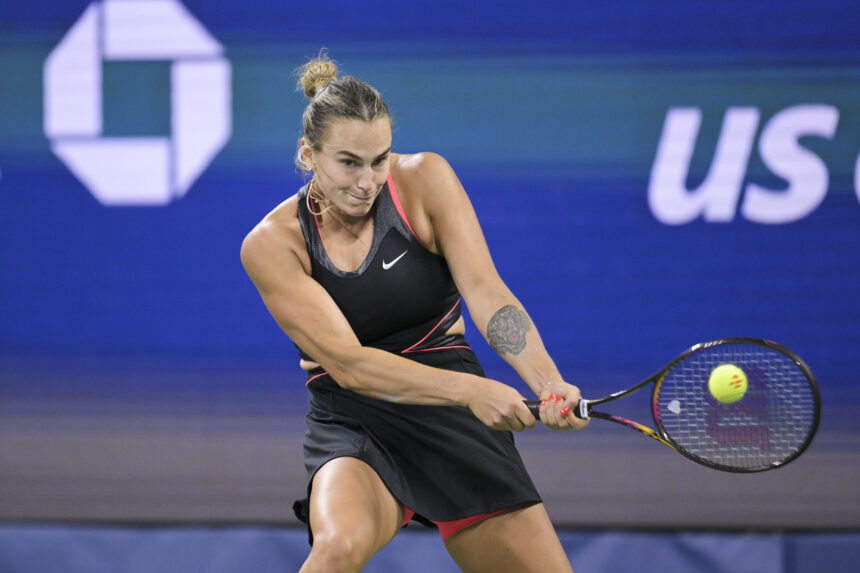
After becoming the first woman since Serena Williams 11 years ago to defend the title at the US Open, Aryna Sabalenka was quick to reveal what had pleased her more than controlling the baseline rallies in her 6-3, 7-6 victory over Amanda Anisimova – it was being in control of her emotions.
Sabalenka has had a stellar year but lost in two grand slam finals, first to Madison Keys in the title match in the Australian Open, and then to Coco Gauff at Roland Garros where she committed a whopping 70 unforced errors in windy conditions.
“I had really tough lessons earlier this season. I lost a couple of finals in the Grand Slams, and winning this one means a lot, defending the title. It feels amazing,” she said. “After Australia, I thought that the right way would be just to forget it and move on, but then the same thing happened at the French Open. So, after that I figured that, ‘okay, maybe it’s time for me to sit back and to look at those finals and to maybe learn something’, because I didn’t want it to happen again and again and again.”
Sabalenka has been the dominant hard-court performer of the last few years in women’s tennis and reached three consecutive finals at Flushing Meadows, dropping only one set en route to the final. She revealed that she had worked on changing her mindset on court while taking a break in Greece as well as turning to some self-help books.
“I was in Mykonos, reading my book, enjoying the view and I was just thinking that ‘why would I let my emotions take control over me in those two finals?’” she explained. “Going into the final I decided for myself that I was going to control my emotions. I’m not going to let them take control over me, and it doesn’t matter what happens in the match.
“My mindset was just going out there, fight for every point. Doesn’t matter of the situation. Just focus on myself and focus on things that I have to do to win the match. I think from what I understand today (Saturday), that the lesson learned and I really hope it will never happen again if I’m going to be playing another final, that I will be more in control.”
Given her tough year and fighting the mental demons in the big matches, Sabalenka admitted that this title felt different to the three other Slams that she had already won.
“I think because of the finals earlier this season, this one felt different. I felt like I had to overcome a lot of things to get this one. I know the hard work we put in, and that I deserved to have a Grand Slam title this season. When I fell after match point, it was true emotions, because it means a lot to defend this title and to bring such great tennis on court. And to bring the fight and be able to handle my emotions the way I did in this final, it means a lot. I’m super proud right now of myself.
Despite going a break up twice, Anisimova fought back to level at three games all in the second set and forced a tie-break. The top seed also missed an easy smash which would have given her match point. These were particularly testing times even for the World Number 1: “These two times I was really close to losing control, but at that moment I told myself, ‘No, it’s not going to happen. It’s absolutely okay’. I was just trying to focus one step at a time.”
Sabalenka has reached at least the semifinals in 11 of the last 12 majors, and became the first woman to reach five consecutive US Open semifinals since Serena Williams. But somewhat surprisingly she came into the match with an inferior 3-6 record in head-to-heads against her opponent, including a painful semi-final defeat at Wimbledon. But she worked on a clear gameplan with her team to minimise her errors and target the forehand.
“Going into this match, I knew what to expect,” she explained. “Anisimova is an aggressive player. She plays really aggressive tennis, and at Wimbledon I was overthinking. I was doubting my decisions, and I was stopping my arms a lot, and I was making a lot of mistakes or I would slow down the speed, and then she would just step in and go for her winners. I knew that it was going to be a very fast game, very aggressive. I was just trying to stay as low as possible, and I was just trying to put that speed, that pressure back on her and see how she would handle it.”
Sabalenka now holds a lead of over 3,000 points in the women’s rankings and remains the firm favourite for the opening Grand Slam on the hard courts in Australia next season.

