



The song “For What It’s Worth” was written by Stephen Stills and recorded in January 1967. The same year, it was added to the second pressing of the first album by Buffalo Springfield. Though the title “For What It’s Worth” doesn’t appear in the lyrics, the ideas conveyed carried weight in the late 1960s and still do today. The following bears this out…
“…There’s battle lines being drawn
Nobody’s right if everybody’s wrong
Young people speaking their minds
Getting so much resistance from behind
“It’s time we stop, hey, what’s that sound
Everybody look what’s going down
“What a field-day for the heat
A thousand people in the street
Singing songs and carrying signs
Mostly say, hooray for our side
“It’s s time we stop, hey, what’s that sound
Everybody look what’s going down…”
Fifty-years ago, Roland Garros became the first Grand Slam played in the Open Era. May 1968 is also a vivid memory because of the demonstrations and strikes by students and workers throughout Paris, particularly in the Latin Quarter, (as well as the rest of the country), brought day-to-day life to a virtual standstill.
“May ‘68” had a telling cultural, moral and social impact on France. It instilled hope, (thus the slogan, “Adieu de Gaulle”), and the April elections a year later indicated that France was ready to embrace Gaullism without the aging and ultra-conservative Charles de Gaulle as its leader. Last October, current President Emmanuel Macron said that he planned to commemorate the 50th Anniversary of the unrest, that had served to “help liberate things within French society…” – a work in progress to this day.
At the time, with so much attention focused on the civil unrest and general uneasiness, Ken Rosewall, the No. 2 seed, stealthily defeated fellow Australian and top seed Rod Laver 6-3, 6-1, 2-6, 6-2 in the men’s final. The best US showing was by Richard “Pancho” Gonzalez, who turned 40 on May 9th and lost to Laver in the semifinals 6-3, 6-3, 6-1. On the women’s side, Nancy Richey, the Texan who was seeded No. 5, slipped by Ann Jones of Great Britain, the No. 2 seed, 5-7, 6-4, 6-1.
France and the world have changed dramatically in the past five decades, and that is certainly true at Roland Garros. The 122nd version of the event kicked off with qualifying on Monday, May 21st, that will last three rounds. This year’s competition will feature 25 seconds (instead of 20 seconds) between points, along with a five-minute warmup that’s the same as a regular tournament. The Draw was announced on Thursday, May 24th, at the new Auteuil Greenhouse Gardens. Tournament play begins on Sunday, May 27th and concludes on Sunday, June 10th.
(As an aside, the Fédération Française de Tennis has for some time used the name Roland Garros instead of the French Open in order to honor Eugène Adrien Roland Georges Garros, a French aviator who lost his life in World War I combat, and because it gives the second major of the season a bit of true French “panache”.)
After years of battling the city government, along with assorted environmental groups in typical drawn out French bureaucratic fashion, the tournament has finally been allowed to make site changes and work on developing the les Serres d’Auteuil, the beautiful botanical gardens across the street from the main venue. The freedom to enlarge has resulted in three new Stade Roland Garros courts. Courts 7 and 9, featuring 1,500 and 550 seating respectively, are located in front of the Village, which is also new. Court 18, situated behind Court Suzanne Lenglen in the Fonds des Princes area on the west end of the grounds, is semi-sunken and holds up to 2,200 spectators and is the tournament’s fourth largest court.
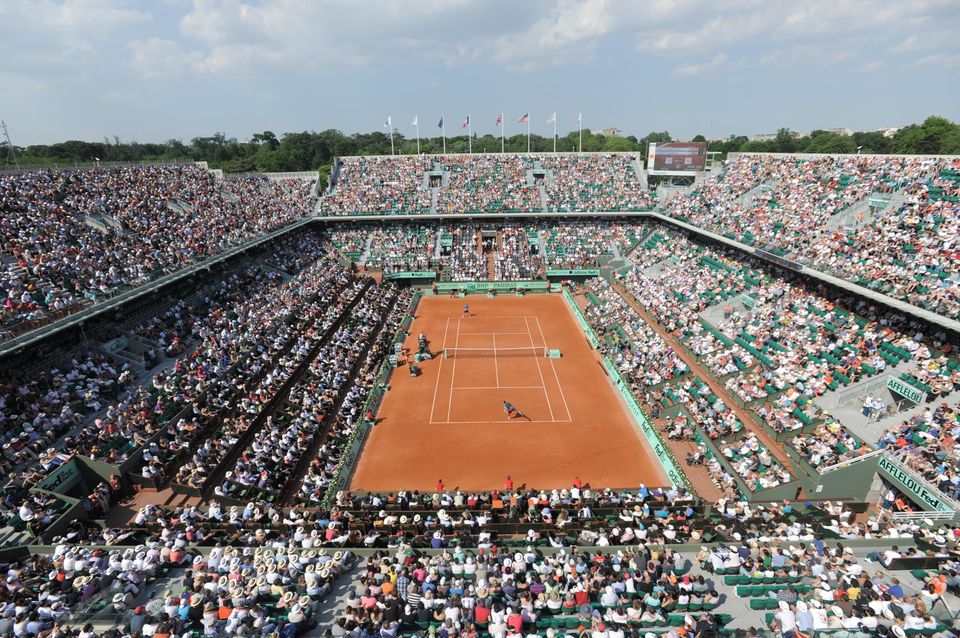
New wooden seats have been added to Court Suzanne Lenglen giving the stadium a “step back in time” look. Similar seats will be used when Court Philippe Chatrier is refurbished. Court Simonne Mathieu, when its construction is completed will have 5,000 of the wooden seats. Both projects have 2019 completion dates.
Stade Roland Garros is celebrating its 90th Anniversary and the Musée de Roland Garros will stage a spécial exhibit. A one of a kind souvenir book will be available.
In 2019 there will be four new competitive, and two practice courts completed. These changes are merely the prelude to the biggest and most expansive transformation to the Stade Roland Garros makeover. A retractable roof will be added to Court Philippe Chatrier by 2020.
To borrow from Stephen Stills, “…Everybody look what’s going down…”
With the stylish site modifications, Roland Garros promises to be even more charming than usual while remaining “Oh, so French”. More important, the new atmosphere and setting will players and spectators alike with colourful memories that will make the 2018 championships, in the City of Lights, shine even brighter.

