



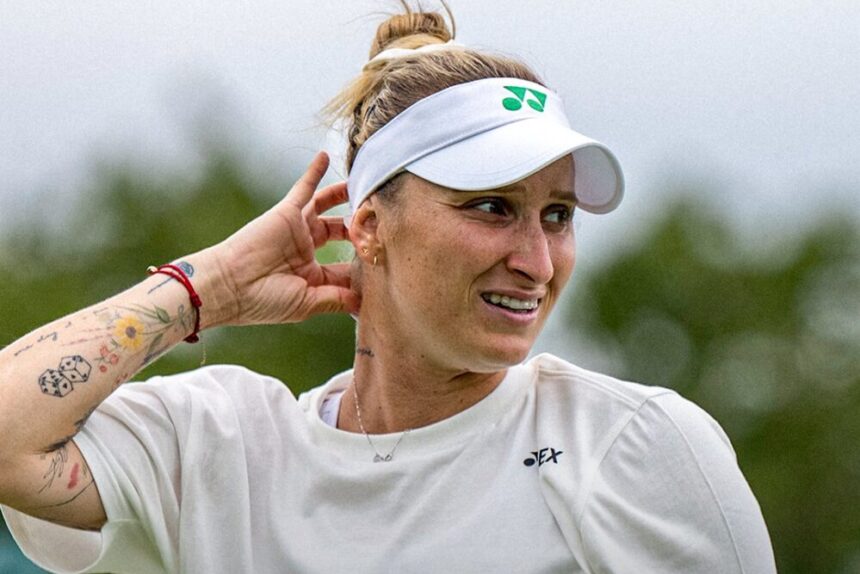
Marketa Vondrousova has been banned from professional tennis until 2030 for refusing to have an anti-doping test in what is one of tennis’ most high-profile cases in recent times.
Vondrousova, who won the 2023 Wimbledon championships and has been ranked as high as sixth in the world, had been provisionally suspended following an incident that took place in December last year. An anti-doping control officer came to her house, but she refused to let them in over fears of her safety and, at the time, cited what happened to Petra Kvitova, who was injured by an intruder in her apartment. Vondrousova claimed that the doping control officer didn’t identify herself correctly and said she reached ‘breaking point after months of physical and mental stress.’
At an independent hearing, it was deemed that Vondrousova had “no compelling justification” for refusing a test. According to an account given by the ITIA’s senior anti-doping director, Nicole Sapstead, Vondrousova signed a form confirming she refused a test and left her apartment to walk her dog.
“It was a single female doping-control officer. The player signed the refusal form outside. She left her apartment to walk her dog and made it clear to the doping control officer that she was refusing a test. The doping control officer asked her to sign the form to indicate as much,” Sapstead stated.
“We ask our doping control officers to be as clear as possible when they’re engaging with players. It’s not for them to tell a player where a sanction may lay, or if they choose to refuse. But what we do say is: ‘Please make it very clear that there are consequences, some significant consequences, if that individual refuses.’ So yes, that was made very clear to the player. It was very clear that the player did not wish to engage with the process.”
Vondrousova argued that a general anxiety disorder at the time affected her judgment. After the confirmation of her ban was made public, the Czech issued a statement in which she denied ever having consumed a banned substance.
“Tennis has been my entire life. From the moment I first picked up a racket as a little girl, through thousands of training sessions, injuries, comebacks, and moments I could only dream of back then. It gave me everything. And I gave everything back to it. I have never doped,” she wrote in a lengthy letter posted on Instagram.
“I have never had a positive test. Throughout my entire career, I have undergone countless anti-doping controls and I have always stepped onto the court with a clear conscience. Just three days after the incident that ultimately changed my life. I was tested again.
“The result was negative, just like every test before it. The past seven months have been the hardest of my life. Seven months of waiting. Seven months of uncertainty. Seven months of fighting. Seven months of hoping every single day that everything would work out in the end.”
Where could Vondrousova go from here?
Currently banned from competition until June 21st 2030, Vondrousova is yet to confirm if she will launch an appeal. In a text message to Ubitennis, her lawyer, Dr Jan Exner, said the team will review the full details of the verdict before deciding what to do next.
“We will review the written reasons and decide on our next course of action,” said Exner.
“First, we must consult with Marketa; I do not want to speculate on any further steps at this moment.”
Vondrousova has up to 21 days to launch an appeal to the Court of Arbitration for Sport (CAS) from the date her legal team received the reasoned reward. This is the panel’s explanation of the factual and legal reasons behind the outcome.
Richard Ings served as chief of the ATP’s Anti-Doping Program from 2001 to 2005 before becoming the CEO of the Australian Sports Anti-Doping Authority from 2005 to 2010. In an exchange with Ubitennis, Ings says it is hard to predict what happens next until the reasoned award is published with the full details. However, he points out the difficulty in trying to overturn such a penalty when an athlete has signed a letter confirming they refused a test.
“A player can offer any evidence she wants at the tribunal. Panels won’t demand anything. The player is facing a four year ban and she can offer as evidence any evidence she wants, including having witnesses appear for her,” Ings explained about the process.
“There is no reasonable limit there. She can introduce as evidence her entire medical history. Which can be redacted from published decisions.
“A refusal signed is an uphill battle. Players are advised to give the sample and challenge process later.”
In January 2024, Russian player Vladislav Ivanov was handed a four-year ban for refusing to provide a urine sample during a tournament in Morocco. In his case, he refused and left the venue before later returning to provide a sample.
As it currently stands, Vondrousova is prohibited from playing in, coaching at, or attending any tennis event authorised or sanctioned by the members of the ITIA.

