



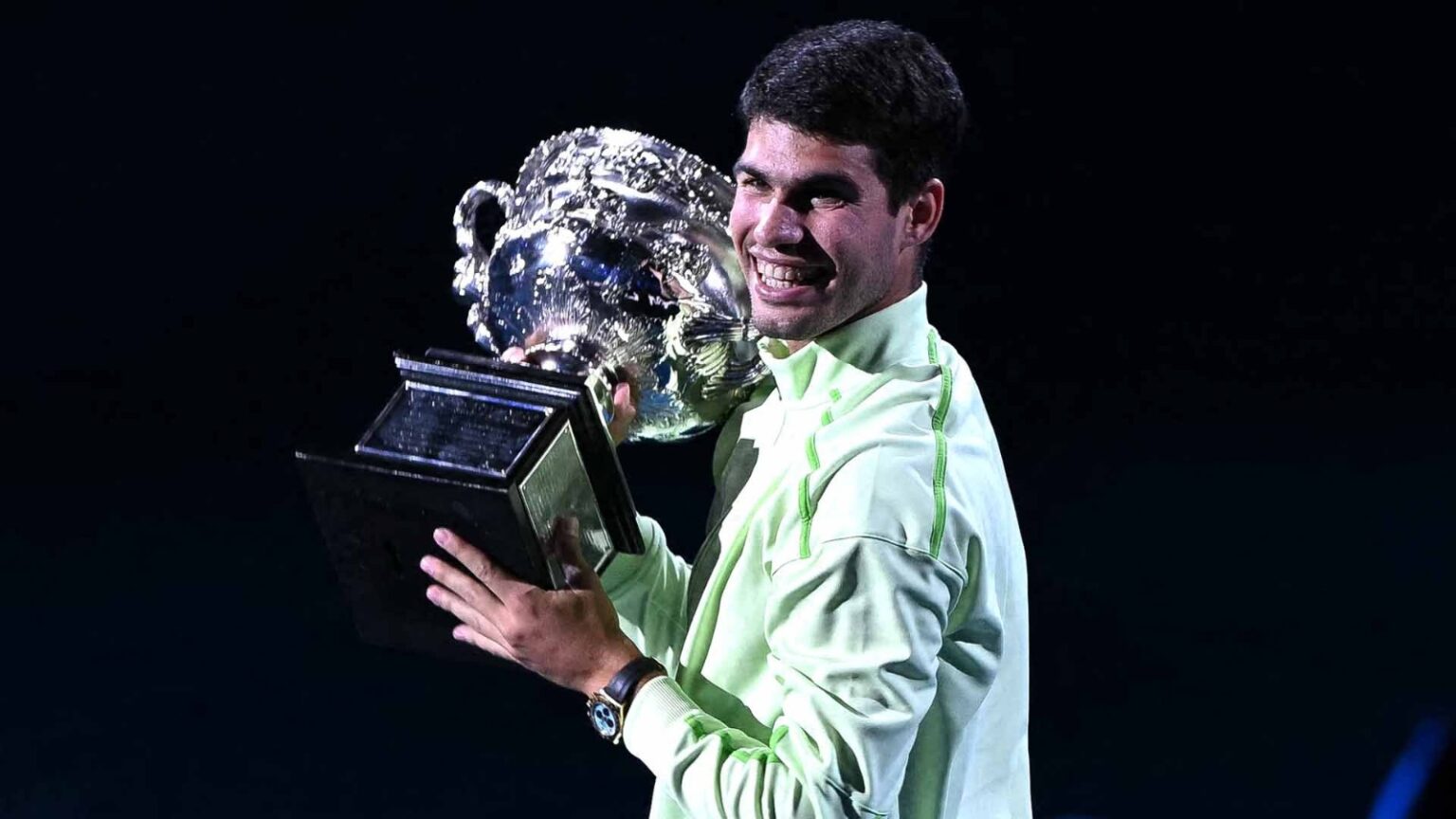
When Carlos Alcaraz and Novak Djokovic collided in the final of the Australian Open in a battle of eminent champions, both individuals realized that history of the highest order was at stake. Djokovic, at 38 years and 255 days old, was hoping to establish himself as the oldest male player ever to secure a Grand Slam singles title across the Open Era. He was determined to break a tie with the Australian Margaret Court for the most majors in singles by capturing a 25th “Big Four” prize. In addition, he was in full pursuit of an eleventh Australian Open crown, which would have put him parallel with Court.
But the historical implications of this clash were monumental for Alcaraz as well. He had his heart set on becoming the youngest man ever to complete a career Grand Slam, on joining an elite list of men who have realized that feat. Only Don Budge, Fred Perry, Rod Laver, Roy Emerson, Andre Agassi, Roger Federer, Rafael Nadal and Djokovic had done it before Alcaraz. He sorely wanted to make himself a member of that elite club by succeeding at a tournament where he had never advanced beyond the quarterfinals.
To be sure, this was not simply another meeting between arguably the two most appealing and charismatic competitors in the game of tennis. It was, instead, a showdown that would last longer in our collective imaginations because of the immense ramifications surrounding the appointment.
In the end, Alcaraz was a worthy victor at the first major of the new season, upending Djokovic with typical spirit and tenacity 2-6, 6-2, 6-3, 7-5, triumphing for the first time in Melbourne to garner a seventh Grand Slam singles title. Already he had twice been victorious at Wimbledon, Roland Garros and Flushing Meadows and perhaps it was overdue for the sprightly Spaniard to hold the trophy in the land “Down Under”.
Victory did not look likely for Alcaraz in the early stages of this contest. Djokovic was blazing along indomitably, striking the ball immaculately off both sides, beating Alcaraz to the punch, and keeping the baseline exchanges short. Moreover, the Serbian served with uncanny precision in the first set. He connected with 78% of his first serves, winning 93% of those points. Altogether he won 16 of 18 service points.
Meanwhile, he was returning magnificently as a somewhat dazed Alcaraz tried in vain to find his bearings. Djokovic secured the first break of the match to move ahead 3-1. He had a short ball off the backhand that he sent crosscourt, but Alcaraz went down the line and Djokovic had to retreat to track that shot down. Yet a solid forehand down the line coaxed the Spaniard into a backhand error. Djokovic surged to 4-1 with a hold at 15, releasing an ace, a service winner and a backhand down the line winner in that laudatory game.
After Alcaraz managed to hold on from 0-30 in the sixth game, Djokovic held at love for 5-2. Djokovic sealed that set with another break in the eighth game at the cost of only one point, hitting out freely off the forehand, including a 98 MPH forehand winner for 15-40. In only 33 minutes, without taxing himself or allowing Alcaraz room to breathe, Djokovic had taken the first set 6-2. Djokovic won 29 of 44 points in that immaculate set, making only four unforced errors. That was an ominous sign for the 22-year-old Spaniard because at last count Djokovic had a career record of 1009 victories against a mere 41 defeats after winning the first set over the course of his incomparable career.
And yet, the color of the confrontation changed dramatically early in the second set for two primary reasons: Alcaraz shifted his strategy and started prolonging the rallies with higher trajectory shots, and Djokovic started making damaging mistakes off the forehand. As Djokovic would say later, “Things changed and he deserved to win….I remain disappointed with the way I felt in the second and third after an incredible start when I felt great about myself….. The first set is one of the best sets I have played in the last couple of years. I am very disappointed I wasn’t able to maintain that feeling that I had in the first set. I knew he is a very smart all around player that changes tactics and adjusts his game. I knew he was going to raise his level. I knew what I needed to do, but my energy went completely down in like two games, north to south.”
That sharp decline in Djokovic and unmistakable elevation in Alcaraz’s play altered everything in the second set. After Djokovic rallied from 0-30 in the first game and held on from deuce, Alcaraz went to 1-1 at love with an ace. At 15-15 in third game, an Alcaraz forehand clipped the net tape, and dribbled barely over the net for a fortunate winner. Djokovic then misfired off the forehand and missed at the net on a serve-and-volley combination. To 2-1 went Alcaraz but Djokovic had a break point in the following game, only to drive a forehand down the long. The Spaniard held for 3-1. With Djokovic serving at 2-4, Alcaraz struck gold with a backhand down the line winner on the stretch in the process of achieving another break of serve. The Spaniard held at 15 in the eighth game to seal the set 6-2 in 36 minutes.
At 2-2 in the third set, Alcaraz pounced once more. Djokovic commenced that game with his first double fault, followed by a netted forehand volley off a low passing shot from Alcaraz, who soon broke at 15. Despite a double fault which knotted the score at 30-30 in the following game, Alcaraz promptly unleashed a forehand winner before holding by rushing Djokovic into an errant backhand. It was 4-2 for Alcaraz. Serving to stay in that third set at 3-5, Djokovic battled back from 0-40, saved four set points and even had two game points. But, after four deuces, a persistent Alcaraz took the set 6-3 as Djokovic was off target with a backhand down the line.
Now Djokovic found himself at a critical juncture. Serving at 0-1 in the fourth set, trailing two sets to one, still searching for solutions as Alcaraz hardly missed off the ground in the longer rallies and served masterfully, the ten-time champion fully understood his predicament. In a six deuce game, he erased six break points against him, holding on with markedly improved execution off the forehand. Two games later, he held at love. Alcaraz answered with a love hold of his own, ending the fifth game with a pair of aces. Both players held easily in the next couple of games, but Djokovic drifted into precarious territory again when he served at 3-4, 0-30.
But he worked his way out of that corner skillfully. A forehand winner and a service winner took Djokovic back to 30-30. He eventually held from deuce with two un-returnable first serves. Buoyed by that crucial hold, Djokovic was poised for an exhilarating turnaround at 4-4. He read Alcaraz’s wide serve to the forehand at 30-30 and drove it flat crosscourt with interest. Alcaraz was coaxed into an error. It was break point for Djokovic and the crowd was thirsting to see the Serbian set the stage for a spellbinding fifth set.
Djokovic, however, made an unaffordable mistake on a routine forehand crosscourt, sending that shot long, denying himself a chance to serve for the set and reignite his game and his spirits. Alcaraz then invented an angle off the forehand for an improbable winner before recovering in the next rally that Djokovic conceded with a down the line forehand long.
Now serving to stay in the match at 4-5, Djokovic was resolute and held at 15 with some bold attacking tennis, but Alcaraz was unswerving by this stage, swiftly holding at 15 for 6-5. Serving to stay in the contest for the second time, Djokovic lost a bruising 24 stroke rally on the first point, made it to 15-15 but then missed wildly down the line off the forehand. At 15-30 he aggressively drove a crosscourt forehand taken early into the net. Alcaraz was utterly composed. At 15-40 and double match point, he stuck assiduously to his game plan of keeping the ball in play and giving nothing away, wrapping up a highly professional performance when Djokovic was off the mark with another forehand down the line.
After making nine unforced errors in the short eight game opening set, the Spaniard revised his thinking and no longer attempted to out-slug Djokovic, relying instead on making Djokovic hit awkward balls above his shoulders, forcing his adversary often to generate his own pace. Over the last three sets, Alcaraz made only 18 unforced errors, 24 fewer than Djokovic. His wore his maturity proudly down the stretch to carve out a seventh victory in eight Grand Slam finals, avenging a quarterfinal defeat against Djokovic in the quarterfinals a year ago on the same court, raising his record in Grand Slam tournament finals to 3-0 over the Serbian, leveling their overall career series at 5-5. Moreover, Alcaraz came from a set down in a major final for the second time against Djokovic, ending a good many points with angled crosscourt forehands struck with power and precision that were frequently unmanageable for Djokovic on the stretch.
The final featured a scintillating first set from Djokovic, a commendable showing from Alcaraz in the second and third sets and a hard fought fourth set when both men had their opportunities. It was a fitting way to end the tournament.
But many authorities and enthusiasts will recollect this fortnight for the men just as much for the drama and high quality of both semifinals. Alcaraz opened in the afternoon against No. 3 seed Alexander Zverev, the 2025 finalist and a player who toppled the Spaniard in a 2024 Melbourne four set quarterfinal as well as a 2022 French Open quarterfinal. Heading into this skirmish, the two top of the line competitors stood at 6-6 in their career series.
For a long while, it seemed certain that Alcaraz was going to win without too much trouble. Zverev was fretting about his rackets in the first set on a stifling afternoon, spraying forehands long and not feeling the ball well at all. His distress was evident to one and all, but most importantly to Alcaraz. At 4-4 in the first set, the German started and ended the ninth game with double faults, allowing Alcaraz to move out in front by a set with a love hold.
Despite that costly lapse, Zverev went back to work diligently and, with markedly improved baseline execution, surged to 5-2 in the second set. He served for that set at 5-3, but missed four out of six first serves and was broken by an opportunistic Alcaraz. That set was settled in a tie-break, with Zverev sending a relatively easy backhand down the line volley wide at 5-5 and denying himself a set point. Alcaraz closed out that tie-break 7-5 by unleashing a trademark forehand crosscourt to win the point commandingly.
Up two sets to love, Alcaraz was seemingly ready to close the account in straight sets. But midway through the third set, Alcaraz was fighting cramps. At 5-4 in his favor, he called for the trainer, who rubbed his legs. Zverev was two points from losing at 30-30 in the tenth game but he held on. With Alcaraz ahead 6-5, he got more help from the trainer.
Zverev was confused and angered by the treatments for Alcaraz because he believed it was against the rules for cramping. But Alcaraz was not certain what his ailment was. Clearly, he was not cheating but the rules seemed murky. Zverev was tense when he served at 5-6, falling behind 0-30. It was apparent that Alcaraz’s movement and capacity to serve with his customary pace were significantly restricted.
In any event, Zverev took four points in a row to reach 6-6 and then exploited the physically vulnerable Alcaraz throughout the tie-break which he won 7-3 with an ace.
Zverev should have won the fourth set much sooner than he eventually did. He was dominant on serve, winning 24 of 30 points, but wasted too many opportunities to break Alcaraz by playing safe returns down the middle, allowing the Spaniard to step in and crack winners which required no movement. Thrice he had Alcaraz down 0-30 and once the German advanced to 15-40, but he never broke serve when it was there for the taking. Yet Zverev swept four points in a row from 3-4 in the tie-break to make it two sets all, closing out it out stylishly with a running forehand crosscourt winner.
High drama flooded through the arena across a gripping fifth set. Still struggling with his physical stability, Alcaraz was broken in the first game on a double fault. But he gradually regained a lot of strength, serving again close to normal standards, covering the court with something resembling his usual alacrity. Zverev, meanwhile, was steadily losing stamina and his legs were eventually spent, and yet he played spectacularly and determinedly. In the fourth game, he led 40-0 but later had to save a couple of break points before holding for 3-1. With Alcaraz serving in the fifth game, Zverev reached 15-30 with a stunning running forehand passing shot winner at 96 MPH. But on the next point he buried a routine forehand into the net and Alcaraz eventually held.
Alcaraz raised his hands to the crowd as he headed to that changeover, imploring them to offer their support. Zverev fended off a break point on his way to 4-2. The match was just over five hours old as Zverev served for 5-3. But he erased two break points against him and held on with a sparkling running forehand down the line winner. And then at 5-4 he served for the match. Thoroughly exhausted, he opened that tenth game with a glaringly weak forehand down the approach that Alcaraz easily devoured. The Spaniard broke back at 15 to 5-5 as Zverev failed to produce any unstoppable serves. Ironically, he had not been broken since 5-3 in the second set.
A highly charged and revitalized Alcaraz was brimming with confidence. Dropping only one point, he held for 6-5 and then picked on the faltering Zverev forehand to break again and survive a five hour, 27 minute classic 6-4, 7-6 (5), 6-7 (3), 6-7 (4), 7-5. For Alcaraz, this was proof of his capacity to thrive under pressure. But for Zverev it was another bruising setback in his tenth career semifinal at a major. He has been to three finals, losing two of them in five sets. Dominic Thiem rescued himself from two sets to love down in the 2020 U.S. Open final against Zverev. In that encounter, the German served for the match in the fifth set after leading two sets to love. In 2024, Zverev was ahead of Alcaraz two sets to one in the Roland Garros final but he fell again in five sets. Last year he lost to Jannik Sinner in the Australian Open final.
Will his time ever come? He will turn 29 in April. He surely has a few big years ahead of him. Most experts agree that he is the best player in the modern era not to have won a Grand Slam tournament. But the view here—and I hope I am wrong— is that Zverev will not make it happen at a major. It is as if he wants it too badly.
Be that as it may, the second semifinal in Melbourne was a riveting skirmish between the No. 2 seed Sinner and Djokovic. The Italian had swept five consecutive matches against his great rival, including a combined three victories in 2024-25 at the majors. One of those triumphs was at the 2024 Australian Open in a four set semifinal. Djokovic did not take a set off Sinner in their semifinal duels last year at Roland Garros and Wimbledon, although he was clearly physically below par on the latter occasion.
This time around, Djokovic was in immediate trouble as Sinner settled into their evening blockbuster. In fact, Djokovic lost the first three games, winning only three points in that span. He served at 0-3, 30-40, but served an ace and eventually held with a service winner. They stayed on serve for the rest of the set but Djokovic had found his range and had his teeth into the battle. At 1-1 in the second set, Djokovic held at love, releasing three un-returnable first deliveries. He then broke Sinner for a 3-1 lead to the delight of the audience in Rod Laver Arena, but then found himself down 0-40 in the fifth game.
Had Djokovic not responded to that serious situation with purpose and determination, the outcome of this match might have been different. But in collecting five points in a row, he missed only one first serve, sent out two service winners and concluded that hold for 4-1 with a forehand winner set up by an impeccable wide serve. In the seventh game, Djokovic was down break point but he surged to 5-2 with two aces and a service winner. Serving for the set at 5-3, Djokovic held at 15 with a forehand winner, going behind Sinner.
The two-time defending champion bided his time in the third set, saving a break point at 2-2 with a backhand pass down the line landing inches inside the sideline. When Djokovic served at 4-5, he was broken at 15, missing one of his familiar lob volleys after drawing Sinner in with a drop shot. Despite the fact that he was behind two sets to one, Djokovic seemed undismayed.
The 38-year-old simply went back to work, going toe to toe from the baseline with the Italian machine, finding holes here and there, accelerating the pace of his shots whenever he had the openings. Most impressive of all was his scorching forehand down the line, which in this match even surpassed his renowned backhand down the line.
Djokovic changed the momentum of the match immediately, breaking Sinner in the first game of the fourth set after the 24-year-old led 40-30. Djokovic made that break count, although it wasn’t easy. At 4-3 he was required to save two break points, wiping one away with an excellent running forehand that Sinner could not counter, and the other with a serve-and-volley on his second delivery. He punched a terrific backhand first volley down the line, setting up an easy overhead winner. Djokovic cemented that hold for 5-3, serving out wide to set up a forehand winner. Serving for the set two games later, Djokovic released an ace for 40-15 but Sinner rallied to deuce.
Once more, Djokovic was sturdy under duress, prevailing in a 15 shot rally with a penetrating backhand down the line eliciting an errant forehand down the line from Sinner. Now at set point for the third time, he took Sinner’s return of serve and directed an aggressive forehand crosscourt to draw another error. Set to Djokovic, 6-4.
On his way to a 3-2 lead in the fifth set, Sinner won 12 of 13 points on serve while Djokovic was fighting ferociously to hold his serve. At 0-1, he was behind 15-40 but, with a wide serve-heavy forehand combination, Djokovic saved the first break point, and he erased the second with a 121MPH service winner down the T. He held on from there. Down 15-40 at 1-2 after a double fault, Djokovic released a precise backhand down the line winner followed by an equally accurate forehand down the line winner. Sinner garnered a third break point, but Djokovic crowded him with a second serve and the Italian’s inside in forehand return landed wide. After three deuces, Djokovic got the hold for 2-2.
And yet, Djokovic held at love for 3-3 and then an opportunity presented itself. Sinner led 40-15 in that seventh game but Djokovic made it back to deuce with a massive forehand return and then an outright forehand winner from a deep position. Deliberately playing down the middle, Djokovic reached break point in a 12 shot exchange as Sinner pulled a forehand wide. Now Sinner overcooked a forehand inside out into the alley and Djokovic had the break for 4-3 on a four point run.
But serving in the eighth game, Djokovic trailed 0-40. A first serve down the T forced Sinner into a return error. Then Djokovic put away a difficult inside out overhead. At 30-40 he prevailed in another 15 stroke rally with Sinner erring off the backhand. Back to deuce, Djokovic won the point when Sinner narrowly missed on a backhand down the line and that set the table for an ace down the T at 120 MPH. Djokovic had collected five clutch points in a row for a 5-3 lead. Serving for the match at 5-4, he made it to 40-15 but lost an 18 shot rally to an unwavering Sinner. On his second match point, Djokovic’s first serve to the backhand made Sinner lunge to get it back. The return was short and the Serbian was poised to hit a winning forehand inside out. But Sinner stayed home, directed a backhand down the line which Djokovic barely got back, and then the Italian passed him off the forehand.
Improbably, from double match point, Djokovic was now at deuce. But he calmly sent a first serve down the T that Sinner returned long, giving Djokovic a third match point. This time he succeeded as Sinner pulled a two-hander wide. A jubilant Djokovic was victorious 3-6, 6-4, 4-6, 6-3, 6-4 in four hours and nine minutes. Long known as the game’s premier pressure player, Djokovic found a way to win despite the statistics making that seem impossible. Sinner served 26 aces, 15 more than Djokovic. Sinner put 75% of his first serves in, 5% better than Djokovic. Sinner won 80% of his first serve points while Djokovic was considerably lower at 71%.The Italian had 72 winners, 26 more than the Serbian. They both made 42 unforced errors.
But perhaps the key number was this: Djokovic made good on three of his eight break point chances, and somehow fought off 16 of the 18 break points he faced on his own serve. Sinner won 152 points in the match, twelve more than Djokovic. But when it mattered the most, Djokovic was the better player on the biggest points. It was the match of the tournament in my view.
It was a fascinating fortnight. Alcaraz could have lost to Zverev in the penultimate round, but he persevered. Djokovic was down two sets to love against No. 5 seed Lorenzo Mussetti in the quarterfinals but the Italian suffered a leg injury which forced him to retire when behind a break in the third set. And Sinner survived a severe bout with cramps during his third round match with Eliot Spizzirri of the U.S. on an oppressive day. He was saved by the heat rule index, winning in four sets because the roof was put into use starting in the third set.
In the final analysis, this Australian Open could have played out very differently. But the bottom line is that Carlos Alcaraz is the Australian Open champion for the first time and is now a career Grand Slammer. No one can say that the honor is not befitting of the man.

