



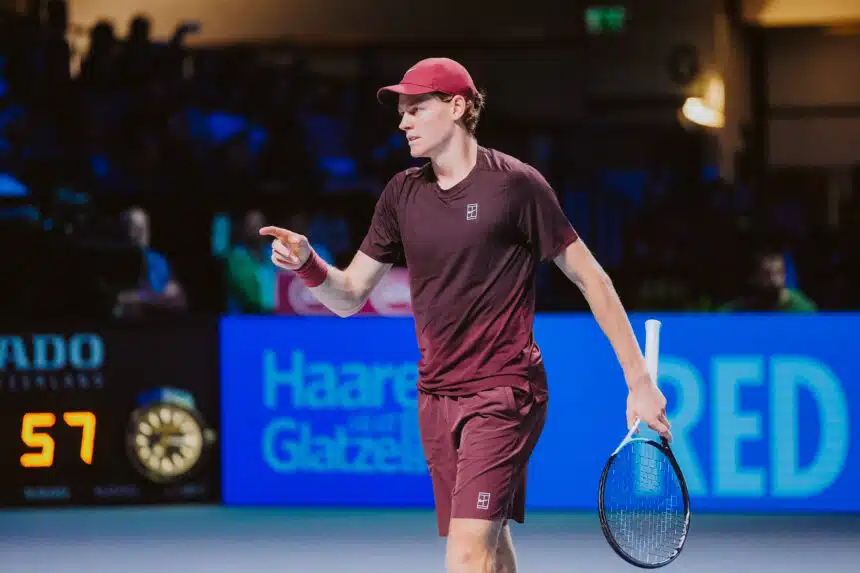
Music conductor, composer and tennis fan, Mario Ruffini, shares his view on Jannik Sinner for Ubitennis.
The ethics of silence: Jannik Sinner makes noise by staying silent. In a world that screams, Jannik Sinner chooses silence. No proclamations, no theatrical celebrations, no catchy phrases which will make the headlines. Just work, effort, concentration. He arrived in tennis from the cold, like a gust of fresh, clean, essential air. The mountains taught him silence, calm, and respect for time. God chose music to measure time, and cold to give substance to silence: for music, He chose J.S. (Johann Sebastian Bach); for tennis, J.S. (Jannik Sinner).
Sinner does not scream, complain, or seek approval. Every point he plays is a gesture that remains, which might end up in the history books. Never a scream. In modern tennis, where everything becomes spectacle, he represents a form of resistance — the beauty of simplicity. There are moments during his matches when he seems almost motionless: his eyes fixed on the ball, his body tense like a violin string. Then, suddenly, he strikes, without noise, without drama.
When he wins, he thanks everybody, without excess. When he loses, he analyses. He does not seek excuses. He shows a rare respect for his sport, and for himself. Every movement, every word, calibrated with the mature intelligence of someone older than his age, tells the story of a boy who grew up amid concreteness, not illusion.
After generations of wasted talent and flair lacking consistency, here comes a young man who does not want to be a phenomenon, but a professional. Someone who prefers training to talking. Someone who wants to improve, to be ready for every situation, whether predictable or unpredictable. Italian tennis needed someone like him. Italy needs someone like him.
Sinner has given shape to a new way of being a champion, changing everything without changing himself: concise, deep, lucid. He has brought calm to a sport that thrives on nerves. And he has done so by remaining true to himself, to his accent, to his shyness. For him, victory is just a step, never a goal. The secret of his success is character, that of someone who knows how to wait. In an impatient world, he is the exception. In a country that burns its idols, he grows gradually, perhaps slowly, but increasingly, with humility and precision.
In 2023 and 2024, he led Italy to victory in the Davis Cup, bringing home a trophy that had been missing for nearly fifty years. He did it with apparent coldness, but also with gentleness, light smiles, and restrained embraces for his teammates, almost staying in the background. In him there is a kind heart, which he shows in his own way: through the calm of someone who has nothing to prove.
Each time he steps onto the court, he seems to be carrying with him a piece of his mountains, patience, focus, solitude, silence. And perhaps this is his secret: Sinner does not flee from silence; he lives within it. That is where he builds everything. Some champions win through charisma, others through voice. He wins through quietness. In him coexist the staticity and composure of Piero della Francesca’s works. In his calm gaze we can recognize something we have forgotten in the modern world, the beauty of calm.
A Man who knows how to say no and why
Being Sinner, in this country, cannot be easy. He deserves a little gratitude. As Ubaldo Scanagatta says (on his YouTube channel Ubitennis) and writes on his website, Sinner “is a creditor, not a debtor, to Italian tennis.” A creditor for having brought Italian tennis to the top of the world. For having made an entire nation wake up at four in the morning, just to watch him play. For having made the country cry like children when even the grass of Wimbledon bowed before him. For having united Italy under a single and overwhelming passion. For having overthrown the old national sports paradigm, shifting it from football to tennis. For having filled clubs, streets, eyes, and hearts with his shots. For the daily example he has given for years: an example made of sweat, dedication, silence, composed words, and no excuses.
Yet, no way! Because he doesn’t join the national-pop circus of Sanremo. Because he lives, and above all trains, in Monte Carlo, together with some of the world’s best players. Because he doesn’t always go to the Olympic Games or to the Quirinale to meet President Mattarella. Because, after giving Italy two Davis Cups, he chooses to focus on himself — so as to become even stronger, to let us enjoy his feats again and again.
No, being Sinner in Italy cannot be easy: a spark that keeps shining in a country that is willing to forgive everything but success, as Enzo Ferrari once said. A country where, when someone achieves success, they must stop being themselves to satisfy the whims and desires of the others.
As for the controversy that broke out when he declined President Mattarella’s invitation, a few words must be said: if the Quirinale’s ceremonial office, in agreement with the Italian Tennis Federation, had planned the meeting with the Davis Cup winners during the Italian Open in Rome in May, everything would have been simple. It is wrong to issue an invitation that may unsettle the delicate balance of a great athlete, constantly traveling across five continents for eleven months a year, whose schedule is sacred if such a high level is to be maintained.
The Davis Cup
In recent days, many have eventually remembered that tennis is an individual sport, not a team sport. And that at Wimbledon, on the day of his final with Alcaraz, the King of Spain was there while no minister of our government showed up. But let’s be clear, with facts and dates.
First of all, if the Davis Cup were really so pivotal and important in the world of tennis, why is it scheduled at the end of the season, when all players are tired and worn out after a long, draining year? And when people talk about it today, they refer to the Davis Cup of the past, which was played with completely different formats and scheduling.
Roger Federer, in 24 years of career, played the Davis Cup 15 times. Rafael Nadal: 18 times in 24 years. Novak Djokovic: 17 times in 22 years. Andre Agassi: 10 in 21 years. Jimmy Connors: 4 in 25 years. Björn Borg: 9 in 11 years. Even the players most devoted to their national colours have often skipped several editions. From Connors’ extreme case to Stefan Edberg’s loyalty: he played 14 editions in 14 years. The statistics tell the story.
This year, Sinner is not going to the Davis Cup — and in Italy, the sky falls! A Greek tragedy! “Sinner must report to the Parliament!” People who had disappeared from the public scene, desperate for attention, pundits or institutions striving for a front page, now know the surest way to get it: attack Sinner.
This year, Sinner has chosen to skip the Davis Cup to prepare as best he can for the 2026 Australian Open, after realizing that he had arrived at the last two editions (albeit victorious) without optimal preparation, which now he’s legitimately seeking. His goals are clear, world number one ranking, and perhaps, though he will never mention it, the Calendar Grand Slam.
At Melbourne, he’ll be defending 2,000 points, Alcaraz only 400. This means he is “obliged” to win again. Another small detail: in the Open Era, only Novak Djokovic has managed to win the Australian Open three times in a row.
In an individual sport as tennis is, all players’ priority is their personal career. The season is exhausting, the pressure immense. Expecting an athlete to put everything at stake for the Davis Cup is unrealistic — especially if that player has already won it twice in the last two years.
Jannik Sinner’s decisions are those of a true professional, one who thinks on a grand scale and makes an entire country dream. He is a blessing for Italian tennis. Let’s thank him.
Short Memory
History teaches nothing when people have a short memory.
September 2023: people cried scandal because Sinner skipped the Davis Cup. It became a “national case.” Jannik tried to explain that he needed to train, but no one believed him. From there began his climb to the world throne: four Grand Slam titles, two Davis Cups, a triumph at the ATP Finals, and the number one in the ranking — all within the twenty-four months following that choice.
It is difficult, within this national-popular mentality, to understand that tennis is not football. People confuse sports that have completely different dynamics. For a football supporter, the World Cup means everything. For a tennis lover, only winning Wimbledon can compare.
The Davis Cup today is not the same as it used to be: it has become a team tournament squeezed into one week at the end of the season, and much of its original meaning has faded. Let’s come to terms with it.
Thank you, Sinner, always.
NOTE: This opinion article was written in Italian for ubitennis.com and translated by Kingsley Elliot Kaye

