



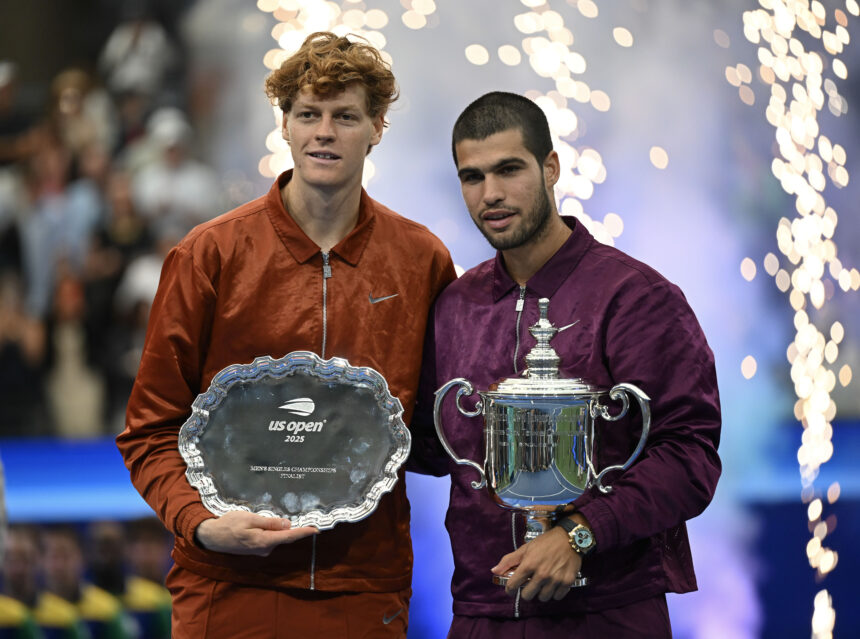
For the first time ever since Open Tennis commenced way back in 1968, the same two men contested three Grand Slam tournament finals in a row during the same year. After Jannik Sinner opened the 2025 campaign by collecting a second Australian Open crown in a row by eclipsing Sascha Zverev in the title round appointment, he then lost an epic five set final against Carlos Alcaraz despite reaching triple match point in the fourth set of the final at Roland Garros. Sinner avenged that defeat—and simultaneously ended a five match losing streak against the Spaniard— with an impressive, come from behind four set triumph over Alcaraz in the final of Wimbledon.
Sinner and Alcaraz had already sweepingly set themselves apart long before they came to New York for the U.S. Open. But their meeting on the hard courts at the USTA Billie Jean King National Tennis Center was one of the most eagerly anticipated clashes the men’s game has produced in a long while. In my view, Sinner sorely needed a win to back up his Wimbledon victory. He wanted to show his chief rival that what happened on the lawns of London was no accident, to demonstrate that he could string together some substantial wins against the Spanish wizard who had been such a thorn in his side these past couple of years. Moreover, it was a chance for Sinner to prove his superiority on hard courts after claiming the last three majors played on that surface.
But Sinner was crushed in the U.S. Open final by a top of the line Alcaraz. The 22-year-old Spaniard has seldom beaten Sinner, 24, so comfortably as he did this time around in New York. Alcaraz triumphed 6-2, 3-6, 6-1, 6-4 in two hours and forty two minutes, losing his serve only once in four sets, winning 83% of his first serve points and 57% on his second delivery. It was a fitting way for him to conclude a tournament in which he dropped only one set, and was broken only three times in 22 sets. This might well have been the cleanest major tennis tournament Alcaraz has ever played in his young career, and now the Spanish superstar has amassed six Grand Slam tournament titles, capturing the French Open, Wimbledon and the U.S. Open two times each.
Perhaps his latest triumph in New York will mark a career turning point in his rivalry with Sinner. Only a few years ago, Sinner was ahead 4-3 in this increasingly important historical series, but now Alcaraz has won seven of their last eight duels and is in front 10-5. Of particular significance is the fact that the U.S. Open confrontation was so one-sided. To be sure, it was four sets, but atypically so. Every set Alcaraz won was decisive and straightforward. In fact, the only break point Alcaraz faced was in the second set when he suffered his lone loss of serve.
The opening game of the final essentially set the tone for the match. Sinner led 30-0. He later had a game point. But he was broken after three deuces on an errant sliced backhand from the Italian. Alcaraz was off and running, and would prove to be unstoppable. He broke Sinner again in the seventh game, coming to the net twice to force his adversary into backhand passing shot mistakes. At 30-40, Sinner netted a backhand drop volley attempt. To 5-2 went Alcaraz, and then he held at love, connecting with three out of four first serves to wrap up the set 6-2 in 38 minutes. Alcaraz won 16 of 19 points on serve and kept Sinner unsettled throughout the set.
Sinner was in jeopardy at the start of the second set, down break point in the opening game. But an impeccably located second serve down the T at 108 MPH saved him there. He held on. With Alcaraz serving at 1-2, Sinner made his move. He broke at love as the Spaniard made two surprising errors and Sinner hit a couple of winners. From 3-1 in that set, Sinner sedulously protected his serve. Twice he held at 30 and then at 5-3 he lost only one point on his delivery. Set to Sinner, 6-3. It was one set all, and it seemed entirely possible that the two best players in the world were going to settle into another of their classic encounters.
That, however, was not the case. Serving in the second game of the third set, Sinner released a first serve at 124 MPH down the T and got the short return he wanted. But, much to his chagrin, he missed a forehand inside-in. The top seed was furious with himself, smacking a ball in frustration. That piece of good fortune was all the Spaniard needed to reestablish his momentum. In the following game, Alcaraz was down 0-30. Sinner lofted a lob deep down the middle which Alcaraz had to take on the bounce. Somehow he hit the smash hard with slice and Sinner could not chase it down. It landed for an astonishing winner. Alcaraz served an ace for 30-30, won the next two points and surged to 3-0.
Sinner was understandably dismayed. Despite making four out of five first serves in the next game, he was broken at 15. Then Alcaraz held at 15 for 5-0. He closed out that set two games later with a service winner, holding easily to seal it 6-1. At the outset of the fourth set, Sinner survived a four deuce game, saving two break points to hold on for 1-0. But at 2-2, the Italian was broken, double faulting at 30-30 and then overcooking a forehand and sending it long at break point down.
Up two sets to one and a break, Alcaraz was feeling almost invincible. On his way to 4-2 he served two aces out wide in the ad court, both measured at 132 MPH. Sinner stood his ground with a couple more holds, and then the Spaniard served for the match at 5-4. He took a 40-15 lead before Sinner saved one match point with a scorching forehand crosscourt and a second with a backhand down the line return winner off a second serve.
It was deuce. But Alcaraz was far too confident to be rattled by the Sinner stand. He came forward to put away an overhead and then served another ace out wide in the ad court at 131 MPH on his third match point. His victory was utterly decisive. Because he won all three of his sets so commandingly, it seemed more like a straight set match than a four setter.
Now Alcaraz has taken a two major lead over Sinner, leading six to four. They have split the last eight Grand Slam tournaments since the start of 2024. But Alcaraz won two of the three finals they contested this year at the majors and he has the clear upper hand in the rivalry. Sinner spoke afterwards about how he might need to add elements to his game and spice it up with more variety to keep up with the virtuosity of Alcaraz.
That will be a delicate balancing act. Sinner has built his reputation on being a powerhouse who refuses to make foolish mistakes. At his best he is solid as a rock without backing off his shots. But finesse has never been a leading feature of his game. Will he drop shot more? Is his plan to attack with greater frequency to prevent the creative Alcaraz from getting up to the net first? Will Sinner try to play more high trajectory looping shots to break up the Spaniard’s rhythm?
No one really knows at this point. At Wimbledon he was highly successful with the backhand down the line but not too much in New York. Will he look to start implementing that shot more regularly in the future?
The bottom line is that Sinner knows he needs to find the right formula to start beating his premier rival. When he lost those five matches in a row prior to Wimbledon, Sinner could well have won at least two or three of those meetings. He took the first set in four of the five losses, and had two set points in the opening set of the Rome final.
But the U.S. Open final was so clearcut that Sinner seems to be reeling from it. He talked after the defeat about perhaps needing to risk losing more losses to different players as part of the process of reimagining how to stop Alcaraz.
What makes this so fascinating is that Alcaraz said he studied the Wimbledon final carefully with his team and learned considerably from what he watched. Then the Spaniard spent two weeks leading up to Cincinnati practicing the elements he felt he needed to beat the Italian. Sinner will surely do the same thing now with the U.S. Open final and examine where he went wrong. He will also realize that his game was less stellar than usual in his third round duels against Denis Shapovalov and his semifinal against Felix Auger-Aliassime. Both matches went to four sets and Sinner seemed off his game. In the latter contest he left the court for a medical timeout to treat an abdominal issue. That might have been a factor in the final, although he did not use it as an excuse.
Whatever Sinner decides he wants to do in the future against Alcaraz, it seems as if the Spaniard has at long last taken his serve to another level. Since the ATP started tracking statistics from matches in 1991, only Pete Sampras at Wimbledon in 1997 has surpassed what Alcaraz did at this U.S. Open by losing his serve only three times. Sampras was broken just twice 28 years ago in London. The majestic American also was broken only three times at Wimbledon in 1994.
Getting broken so infrequently in seven matches over the course of a major is no mean feat. If Alcaraz starts making a habit out of that, he will force Sinner to play incredibly well to beat him. Winning tie-breaks might be Sinner’s only path to victory. It will be fun to follow it all. Perhaps Sinner will find a solution to his problems with defeating Alcaraz. Maybe he will not. But I am confident that they will meet in at least six major finals over the next three years. Their rivalry is the centerpiece of the sport. That is why it is preferable that the rivalry remains compellingly competitive with both men winning their fair share of battles against each other. Tennis would benefit tremendously if they go back and forth over the next decade and the outcomes of their clashes are very unpredictable. Sinner knows full well that he must keep up his end of the bargain if the rivalry is going to flourish. It will not be easy for him.

