



All four have been phenomenal both on and off the court. It’s impossible not to respect them. But I feel Rafa closer to me, more deeply human and genuine than all the others.
This is an editorial by Ubaldo Scanagatta, published by Ubitennis on 27/05/2025, translated by Karolayne Da Rosa
Don’t be misled by the title. I haven’t always rooted for Rafa Nadal, especially when he played against the other three Fab Four. When I say Rafa was the Fab Four player I preferred, I mean the man Nadal, not the left-handed tennis player from Manacor who, by winning Roland Garros, set a record that no one will ever beat (at least not while I’m alive…). I’m going to explain why, assuming anyone’s interested.
My constant, but civil, support has always been only for Italian players, in team competitions as well as individual tournaments. Not for any personal gain and without exceptions. I know some won’t believe me, but I always rooted for Fabio Fognini too, even though he was so convinced I was against him that for years he refused to answer my questions — and not only mine but also those of my colleagues at Ubitennis. That had no justifiable reason at all. I hope with time he will change his mind.
I have always written that Fabio was the most talented of our players for about fifteen years, but also the most reluctant to understand that if he behaved badly on the court, I couldn’t write that he behaved well. At the same time, if Ubitennis readers criticized him for one reason or another, I didn’t think it was right for my moderators to censor comments when the criticism was expressed politely.
As for the great duels among the Fab Four, first the “classic” Federer-Nadal, then with Djokovic arriving as the third intruder between the two historic rivals, and then Murray, I always went for the best story… from a journalistic point of view.
Let me explain: with Nadal dominating on clay at Roland Garros in the years before 2011 (Djokovic’s breakthrough year), I rooted for Federer. Or perhaps it’s more accurate to say I “preferred Federer to win.” Similarly, on the grass of Wimbledon, where Roger was king, I preferred Nadal to win. I remember one of the most memorable finals ever, Rafa’s first victory in 2008, 9-7 in the fifth set.
When Djokovic appeared alongside the two “Martians,” I was happy for his early successes. He broke the duopoly. And when Murray started reaching the Australian Open finals, losing them, and being crucified in the UK (which wasn’t so united since tabloids always emphasized his Scottish birth and often called him a magnificent loser…), I hoped he would eventually prevail.
I also always rooted for Wawrinka whenever he reached a Slam final. I was happy when he won his three titles, just like with Murray.
Having clarified — I hope — this tennis aspect of my support, I want to explain why my favorite is Rafa Nadal. I could sum it up with a simple sentence (“No one truly, always, and regardless of the name or status of the interlocutors, respects others like him”), but that might be influenced by the fact that Andy Murray is the one among the four I know least, with whom I’ve had fewer “personal” encounters. Maybe on a human level, Andy, whom I’ve met less, is on par with Rafa, but I don’t know. Probably because Spanish, Swiss, and Serbian journalists were never very numerous (especially in Australia, I sometimes recall only one or two per country), so it was easier to have relations and exchanges with Spanish, Serbian, and Swiss players. Meanwhile, the English journalists swarmed, surrounded, and crowded Murray in every situation, every press conference, and event — always numerous, intrusive, and sometimes a bit pushy. They didn’t leave space for foreign-language colleagues, although I remember once — exceptionally — some British colleagues came to me to ask if I could ask a couple of questions they were hesitant to ask because Andy was quite distrustful of them at the time. I took it as recognition, if not an honour.
As a premise, and without any intention of flattery — three out of four of them have stopped playing … so there’s no need to shower compliments — these four phenomena have been exceptional on the tennis court, but also all four have been great, indeed extraordinary, men off the court. None of them deserves criticism for being a champion but a mediocre man. No. All have shown absolutely extraordinary personality, intelligence, charisma. I may prefer one of the four; another may prefer another, but none of them has been — I repeat — an ordinary, common man. They shaped an era, a long era, on the tennis court, but all showing themselves to be true men of such a level that I’m sure they would have gone far even if, instead of dedicating themselves to tennis from childhood, they had chosen other paths to succeed.
So, I’ll start by saying what I think — not as a tennis player but off the court — of the one among the Fab Four whom I had fewer opportunities to know, Andy Murray, although I have had several conversations and some confidence with his mother Judy, who, beyond the funny and witty compliments always kindly directed at Deliciano Lopez, is a person of considerable stature.
I met Federer when he was 16 years and 8 months old when he won the junior Easter tournament at my Tennis Club in Florence, and then I saw his Davis Cup debut against Italy’s Sanguinetti and Pozzi when he still had blond highlights… while I first met Rafa Nadal at 16 years and 9 or 10 months, playing in Monte Carlo against Albert Costa in 2003, and I immediately interviewed him in those days…while I spoke with Djokovic for the first times always in Monte Carlo (but in 2005), when he was 18 and was coached by Riccardo Piatti. I met and interviewed Murray — less precocious than the other three —when he was older, with fewer chances for revealing tête-à-têtes about his personality. He was never alone.
About Andy, however, I can only speak well. Because his faults mostly showed up on the court when he insulted his team in a strangely unintelligent and rude way — except with Ivan Lendl, who he never allowed himself to disrespect… not by chance did his greatest successes come with him — but never off the court, where he always seemed a model of education. Respectful. Proper. Professional. I always appreciated both the intelligence of his answers, never banal, and the effort he made to try to provide satisfying answers to anyone who asked him anything. He seriously committed to that practice, which he could have easily avoided. Never was he arrogant, never unpleasant. Always showing understanding even toward journalists who could be inexperienced or unprepared enough to ask the same questions already posed just days before.
Andy faced enormous pressure, in a country that hadn’t won the only tournament the English seemed to really care about, The Championships (The Championships… as if other tournaments didn’t exist), since Fred Perry (1936). The British press didn’t always go soft on him, especially in the early stages of his career, and he never lost his temper. He never had — as far as I remember — rude reactions off the court. Maybe I missed some, but I don’t think so.
On the other hand I saw Djokovic several times in special situations, like when, year after year, he worked very hard to attend the traditional Players Party in Monte Carlo — and since I was allowed for several years to prepare sketches and even act or sing (you should have seen me playing Elvis Presley, all dressed in white like at his famous Hawaii concert and with a very unlikely tuft on my bald head while singing, paraphrasing, “Are You Lonesome Tonight” as “Are You Lonesome Galbraith,” pretending to be Connell’s doubles partner who had split from Galbraith!) — I saw Nole perform in various roles with a spontaneity and playful sparkle that was truly remarkable. I remember him convincing a group of very serious players to transform into drag queens with high heels and bikinis and participate in a beauty contest. Today, with the fury of social media, that wouldn’t have been possible — some pictures would have leaked. Maybe that’s why the Players Party was not organized this year.
The first Djokovic was very different from the more recent one. After all, who remembers his impersonations of Nadal, Becker, Sharapova, McEnroe, before world with less sense of humur and tennis players with overly sensitive managers stopped him? And who remembers his pseudo-tennis matches “with a pan in hand” with Fiorello [a popular Italian TV comedian] can realize how spontaneous Djokovic was then and how much more of “a posed character” he inevitably became lately, even before the COVID and vaccine episode. On the other hand, if Nole decided to pursue a political career in Serbia, they’d immediately elect him president of the Republic. In Serbia, they love him, he’s a GOD, and he knows it. That doesn’t help. However, if everyone has put him on such a high pedestal regardless of his tennis merits, it means he has earned it. For example, in Italy, no one has forgotten his generosity when he donated one million euros to the hospital in Bergamo. No one forced him to do that. COVID was raging in Serbia as well. He has often done good things. He’s never lacked sense of humour, quick wit, and a certain genius,, as you may have noticed from some gags he shared with me. He also suffered a lot from the pressure of a crowd audience that was not always generous with him. Every time he faced Federer and often Nadal, almost everyone was against him. These are not situations which can easily be forgotten, even off the court. So he couldn’t always be “completely genuine.” Always nice, courteous, respectful, and available with the most important people, not always with those a bit less so… This is, in my opinion, his biggest difference with Rafa Nadal. Although it would be unfair to say he was a hypocritical character. Maybe less genuine than Nadal, yes, but at least in my opinion, even Novak (not only for the famous “NOT TOO BAD”) likes him because he remembers what he was like. Today, for example, I can’t stand his absolute lack of punctuality in any circumstance when the people that are waiting… don’t count.
And finally, Roger Federer. Like on the court, off the court he is Mr. Perfection. Maybe too perfect to be entirely genuine. Elegant, refined, never over the top (well, tenniswise, he was definitely OTP…), never would he be caught making a mistake or a gaffe. You can make jokes about his “Swissness” — please forgive my awful neologism — about his ability to always take neutral positions without ever leaning too much. Human to the point of tears in some respects — how many times have we seen him cry! — and not only when he found himself hand in hand with Rafa Nadal during the Laver Cup. A perfect family, a devoted wife, model parents, four twins, a foundation he seems to dedicate himself to not just to offset his multi-billionaire income. I never had anything to reproach him for. We often used to joke together. I remember once when the moderator of a press conference said that mine would be the last question of an ATP Masters that he had won, Roger said: “Well, you couldn’t end the year better than this!” And some may remember the exchange we had — it’s on YouTube — at Wimbledon when he beat Berrettini 6-1, 6-2, 6-2 in the round of 16 after I had written that the only score that could not happen was precisely that one (I was relying on Matteo’s capability of better defending his service games). I said it and Roger joked: “Are you saying I should suggest you retire?”
But beyond jokes and sketches, Roger has often shown great manners and remarkable sensitivity. I would have liked him to take a stronger stance more often in some of the disputes involving tennis’s great powers, all those organizations that never agree even on the easiest strategies to adopt. He soon turned into a businessman, together with his manager Tony Godsick, and when it came to launching the Laver Cup, he used his position to secure advantages that no other exhibition event would have obtained… (it is absurd that matches without even a third set are considered equal to head-to-heads on the real ITF and ATP circuits) — but with the money and power all these four phenomena have accumulated, it’s unthinkable not to also enjoy some privileges. Nobody is perfect, not even the phenoms. You really can’t blame them for some little bullying toward those who… can’t.
Too easy to criticize. Surely, he, like the other Fab, is a decent, honest, reliable person.
And last but not least, Rafa Nadal. I don’t know if I would have wanted as a son — tennis qualities aside — someone like Djokovic, Murray, or maybe even Federer.
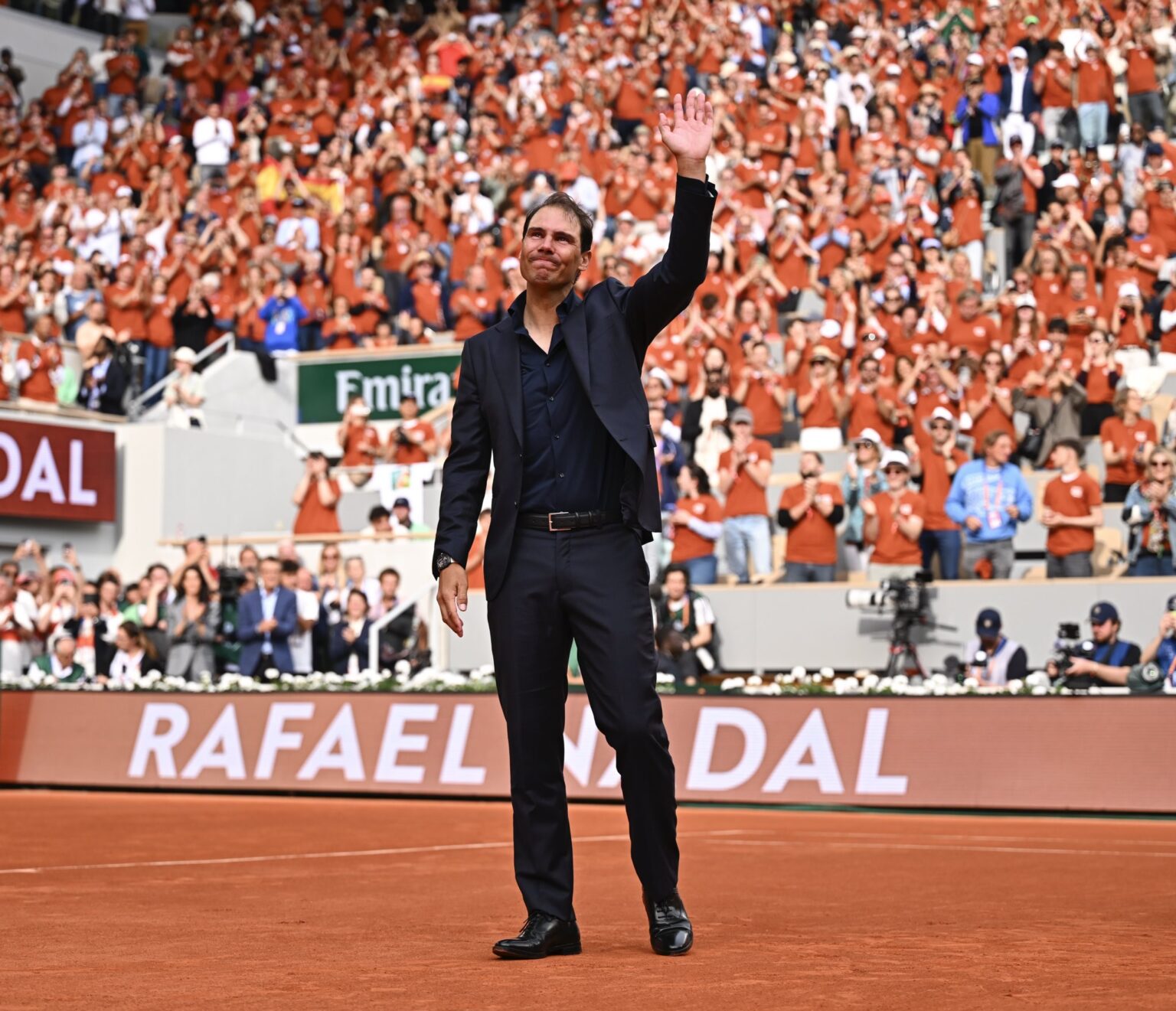
Rafa, however, yes. He always seemed genuine, never artificial. Humble and affectionate even with humble people. Kind to everyone. Always. Only once, due to a linguistic misunderstanding, he misunderstood me and said something not very nice, for which he later apologized, saying, “I don’t speak English very well.” Actually, I had expressed myself poorly too. For years, I saw him at the end of every press conference go to greet and thank the people of the ASAP, those who work transcribing press conferences at record speed. He would have no need to do it, but he always did, even when no one was watching… he doesn’t do it to appear generous or nice. Even at the ceremony on Sunday in Paris, you could see how much respect he has for everyone, for all those who work behind the scenes. And I have seen this everywhere. It’s no coincidence that everyone loves him. Not just friends and relatives, or fans. Everyone who has dealt with him. He has innate humanity. His relationship with his wife, delightful, always kind, always in the background, says a lot. Rafa suffered terribly, perhaps the worst period of his life, when his father and mother — always united before — had problems and became less united. Rafa, very attached to his grandmothers and sister, could hardly play anymore.
I practically never needed to ask him anything, but it’s as if I always knew that if I needed it, I could count on his likely support. I never had the same feeling with the other Fab. Once DjokerNole made me a promise he never kept, although another time he worked a miracle to solve a problem of mine, but maybe that’s a feeling without much foundation. All these four phenomena have a charitable foundation, and with the many millions they’ve accumulated, they have shown the will, the desire to help others without showing off to be more appreciated by those who don’t know them. I repeat, they are all exceptional individuals in every respect. I just feel closer to Rafa Nadal. But that doesn’t mean I don’t consider the other three to be truly great as well. I have so many stories I could share, but I’ve already written so much that… It will have to wait for another time. I hope I haven’t bored you too much.

