



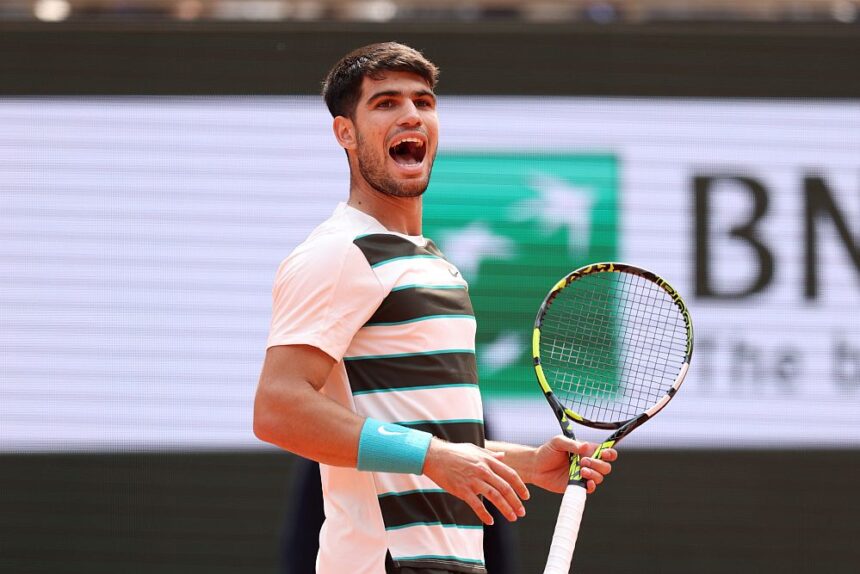
Tennis enthusiasts realized when Carlos Alcaraz walked on court to confront Jannik Sinner in the French Open final that there was a distinct possibility an epic contest was about to unfold. After all, since the start of 2024 these two magnificent players have taken every major title between them. They have established themselves as the two best players in the world. They are in the process of building a long term rivalry that will someday be seen in a similar light to the riveting skirmishes played by the iconic trio of Novak Djokovic, Rafael Nadal and Roger Federer against each other in the greatest era the game has ever known.
To be sure, Alcaraz and Sinner have timed their ascent impeccably as Djokovic moves closer to the end of his playing days and joins Nadal and Federer in the land of retirement. They knew full well that the public and their colleagues were expecting nothing less than the best from them this time around at Roland Garros. The Spaniard and the Italian had collided on eleven previous occasions, including three appointments at the Grand Slam championships which included Alcaraz saving a match point in a five set 2022 U.S. Open triumph. But this was their first ever meeting in the final of a major, and that raised the stakes exponentially.
Although Alcaraz was returning forcefully and showing off his flamboyant shotmaking capabilities persuasively in the early stages of this Paris extravaganza, Sinner withstood the barrage from his gifted adversary, maintained his focus, and went to work determinedly with his usual stoicism and grit. Sinner had held in 80 of 83 service games heading into his title round duel with Alcaraz, but in his first three service games he was under siege. In the opening game of the match he was taken to deuce five times and faced three break points across 12 minutes but he held on. He fended off two more break points en route to 2-1. In the fifth game, however, Sinner did lose his delivery as Alcaraz moved in close to the baseline for his second serve returns and took control, gaining the break on his seventh break point of the set.
Alcaraz thus had a 3-2 lead, but it swiftly evaporated. Sinner found his range off the ground and his deep returns got him back to 3-3. Sinner dropped only one point in his next two service games to take a 5-4 lead, and then broke an error prone Alcaraz in the tenth game to seal the set. Sinner had captured four of the last five games to move out in front.
The Italian maintained the momentum in the second set. After a tough opening service game, Sinner took eight of ten points to reach 3-0. He surged from there to 5-2. At that stage he had secured nine of the previous twelve games as Alcaraz sprayed his groundstrokes out of court and Sinner measured his shots immaculately. At 5-3, Sinner served for a two sets to love lead but he was apprehensive in that ninth game. Alcaraz pounced to get the break and soon leveled at 5-5.
And yet, Sinner soon made it to a tie-break, and in that sequence he played some of his finest tennis in the match. After Alcaraz took a 2-1 lead, Sinner won five straight points to reach 6-2. Although Alcaraz saved two set points, Sinner prevailed 7-4 with a trademark running forehand crosscourt that elicited a forced error from the Spaniard. Sinner had put himself in an enviable position, ahead by two sets to love, seemingly in control of his own destiny.
Alcaraz had been down two sets to love on eight occasions in his sterling career, but had never escaped from that predicament. Early in the third set, Sinner was poised to start pulling out of reach. He broke Alcaraz in the opening game and reached game point for 2-0, but pulled a forehand crosscourt wide with an opening. Alcaraz not only broke back for 1-1 but he did so again for a 3-1 lead after Sinner wasted a 40-15 lead and three game points. Alcaraz served for that set at 5-3 but the Sinner running forehand paid rich dividends again. He coaxed an error from Alcaraz at 30-40 and was back on serve again.
Not for long. Sinner commenced the following game at 4-5 with an inexplicable forehand down the line mistake and was broken at love. The third set went to Alcaraz 6-4. But the sprightly Spaniard secured it tenuously.
Alcaraz was ahead 3-2 on serve in the fourth set when Sinner found some of his most inspired tennis of the day. Sinner held at love for 3-3. In the following game he caught Alcaraz off guard with an exquisite forehand drop shot for 0-30 and he broke at love for 4-3. The Italian held at 15 for 5-3 and then surged to 0-40 when Alcaraz served in the ninth game. It was triple match point for Sinner, who had won 15 of the last 16 points with superior ball control, deep concentration and tactical savvy. Alcaraz, meanwhile, had come apart at the seams and was drowning himself in a sea of self inflicted wounds.
On the first match point at 0-40, Alcaraz forced his adversary into a forehand down the line error. The Italian did not miss by much. At 15-40, Sinner had a look at a second serve. He went for an aggressive backhand return to the Alcaraz backhand but timed it badly and hit it well long. Now Sinner was at match point for the third time. Alcaraz hit a shot fairly deep down the middle with a healthy dose of topspin and a slightly awkward bounce. But Sinner had a high forehand he should have controlled. Instead, he drove it into the net.
Shockingly, it was deuce. Relieved and more relaxed, Alcaraz released an ace followed by a forehand down the line winner. He was improbably back to 4-5. The fact remained that Sinner— despite his misfortune in the previous game—was still serving for the match in the tenth game. He landed only two of five first serves, made two unprovoked mistakes off the forehand, and lost his serve at 15 as Alcaraz took full advantage of Sinner’s tension.
Both players held to set up another tie-break, and Sinner took the first two points in that sequence. He won only one more the rest of the way as Alcaraz captured seven of the last eight points including two aces and three other outright winners.
A shellshocked Sinner and a revitalized Alcaraz now proceeded to a fifth set. Unsurprisingly, the Spaniard broke in the opening game with a backhand drop shot causing Sinner to miss a backhand down the line. Alcaraz swiftly held for 2-0. He had won eight of eleven points to take a 2-0 lead. Sinner responded with a solid hold in the third game and even had two break points in the four deuce game that followed, but Alcaraz moved to 3-1 with an inside out forehand winner. Both men held comfortably over the next four games, and so Sinner was serving to stay in the match at 3-5. With four out of five first serves going in, Sinner held at 15.
And so it was time for Alcaraz to serve for the match at 5-4. At 15-30 his drop shot seemed certain to turn into a winner but somehow Sinner got a racket on it and his response became an accidental drop shot winner. Then he unleashed a deep backhand return down the middle that Alcaraz could not handle. Remarkably, Sinner had broken to square the match at 5-5. In the eleventh game he opened up a 40-15 lead but an obstinate Alcaraz saved three game points from there. On the fourth, however, Sinner struck gold with a forehand winner down the line.
Astonishingly, Alcaraz was serving to stay in the match at 5-6. At 15-30, he was under some duress but nothing extraordinary. Sinner went crosscourt off the forehand and was simply attempting to keep his shot deep. But it travelled well long. Instead of possibly reaching double match point, Sinner was at 30-30. Alcaraz miraculously stretched for a forehand in the corner and sliced it deep crosscourt. It seemed certain to go wide but landed just inside the line. His next shot was a winner off the backhand. A backhand down the return winner from Sinner put him two points from victory for the second time in this game but Alcaraz rushed the Italian into a passing shot error and then produced a stunning backhand passing shot winner to hold on for 6-6.
Now it all came down to a 10 point tie-break to decide the outcome of a stupendous final. But Alcaraz turned that tie-break into a virtuoso display of shotmaking. He was unstoppable in collecting the first seven points in a row. Sinner managed to take two points on his serve, but Alcaraz swept three in a row for a 10-2 triumph in that final sequence. Fittingly, the flamboyant Alcaraz made a spectacular forehand down the line passing shot winner on match point to conclude a 4-6, 6-7 (4-7), 6-4, 7-6 (7-3), 7-6 (10-2) in five hours and 29 minutes. It was the second longest Grand Slam tournament final behind the Djokovic-Nadal 2012 Australian Open final which lasted five hours and 53 minutes. Moreover, not since Djokovic rallied from double match point down against Federer in the 2019 Wimbledon final had anyone prevailed in a major final from match point down.
Alcaraz maintains his unbeaten record in major finals at 5-0 while Sinner slips to 3-1. In turn, Alcaraz enhanced his five set record and is now 13-1 while Sinner is 6-10. Alcaraz claimed his fifth major title with this win in Paris, two more than Sinner. Last year the Spaniard defended his Wimbledon title with a second final round victory over Djokovic. Now he has defended his Roland Garros crown with a second straight five set, final round success. A year ago he came from two sets to one down and defeated Sascha Zverev.
More importantly, Sinner once had a 4-3 winning record over Alcaraz but this was his fifth defeat in a row against his chief rival who now leads 8-4 in their series. The troubling thing for Sinner is how often he has been in advantageous territory only to lose against Alcaraz in this stretch. At Indian Wells in 2024, they met in the final and Sinner looked unbeatable in a 6-1 first set romp. But he lost in three sets. In their next clash at Roland Garros last year, Sinner took eight of the first ten games to lead by a set and a break but lost the second set. He regrouped to win the third but fell in five sets nonetheless. In their Beijing final last autumn, Sinner was serving with a 3-0 lead in the final set tie-break and never won another point. And then in their most recent showdown in Rome, Sinner had two set points in the first set but did not convert and bowed in straight sets.
This Roland Garros final will linger the longest in his mind and sting severely. It was their first head to head duel in a major final. Not only was Sinner denied a morale boosting victory over the Spaniard, but he lost out agonizingly on claiming a first French Open crown. That is a double whammy which will be hard for him to accept. Sinner has made it a big priority in his tennis life to figure out what is required for him to find success against a rival who has turned the tables on him time and again over the past 15 months.
There were some extenuating circumstances surrounding this setback. This was only his second tournament back after a three month suspension from the sport. He has lost to Alcaraz in both tournaments but perhaps—despite an outstanding performance in defeat—Sinner is just shy of recovering his peak level of efficiency. We will find out soon enough when and if Sinner will find a way to close out accounts against the inimitable Alcaraz. Somehow the Spaniard seems impervious to pressure whenever he steps on a court with Sinner these days.
Meanwhile, how should we look at this latest Alcaraz-Sinner confrontation in the realm of history? In my view, when examining the greatest men’s matches since Open Tennis commenced in 1968, this clash belongs in the top six. The other matches are Djokovic beating Federer from double match point down at Wimbledon in 2019, Nadal ousting Federer in the 2008 Wimbledon final on the edge of darkness, Bjorn Borg toppling John McEnroe at Wimbledon in 1980 after the New Yorker saved seven match points in the fourth set, Ken Rosewall ousting Rod Laver at the WCT Finals in a fifth set tie-break in 1972, and Djokovic defeating Nadal at the 2012 Australian Open in the final. Each of these contests went to five sets and the common thread running through all of them is that the most compelling and best played tennis without exception was in the fourth and fifth sets.
If I had to rank these battles now, Nadal-Federer would be at the top with Borg-McEnroe second and Rosewall-Laver in third place. I would put Djokovic-Federer at No. 4, Alcaraz-Sinner at No. 5 and Djokovic-Nadal close behind at No. 6. The beauty of Alcaraz and Sinner was that they could play with such verve and display such remarkable court coverage in the latter stages of such a long and demanding journey. The quality of the backcourt exchanges sparkled down the stretch and the speed and athleticism of both players was off the charts.
It will be up to Sinner to put the pain of this loss behind him as quickly as possible, but in time he will know that there was no shame in falling narrowly short of victory in a final fans will remember long after the dignified Italian has left tennis. Alcaraz, of course, can be immensely proud of his latest, and arguably greatest, triumph and what he did to raise the profile of tennis with his performance. I can’t wait for the next time they step on a court together, which might well be in the final of Wimbledon.

