



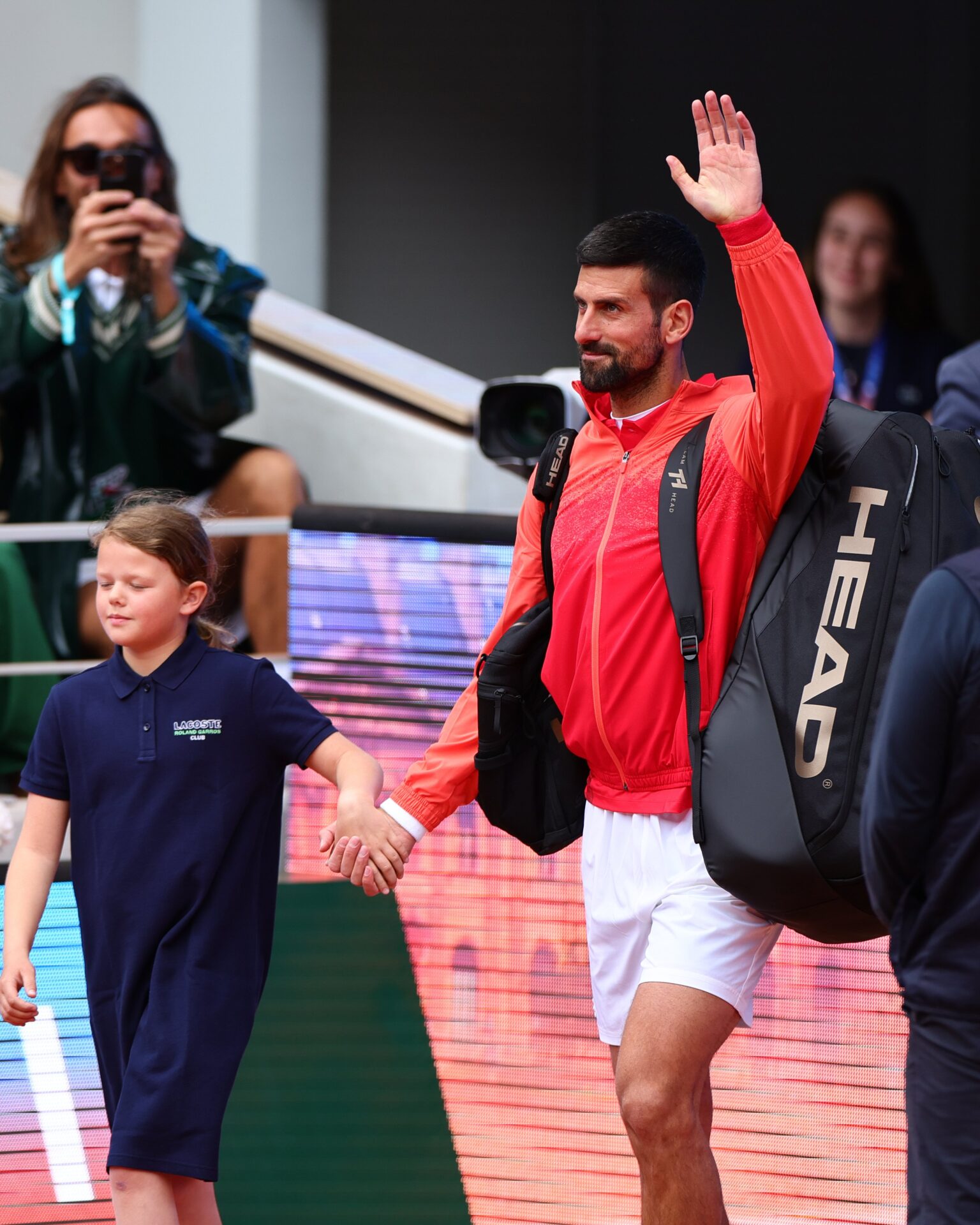
Novak Djokovic reflected on injuries of the past and his struggling form as he continues to show why he is the greatest of all time even through the pain.
Given Djokovic’s clay court season you would be mistaken for thinking that the Serb’s Grand Slam glory days are over.
However, even through pain and the bad moments Djokovic finds a way to get through it and today was no exception as he won in straight sets over Mackenzie McDonald.
12 months on from Djokovic’s Olympic glory, the Serb reflected on his return to Court Philippe-Chatrier, “Well, the emotions were really nice. Last time I was there playing was finals of Olympics. Of course I did relive those memories that were wonderful,” Djokovic explained in his press conference.
“But, you know, it was quite challenging conditions I think at the beginning of the match with the wind and rain and everything that was happening. So, you know, it took me some time to really find the rhythm on the court with striking the ball and moving. These conditions were quite different from Geneva.
“All in all, a solid match. Three times 6-3, so, you know, it’s good. It can always be better, but I must be content and satisfied with the first round.”
Getting through the bad times in order to find the good has always been the motto of Novak Djokovic and that has shown from his clay court preparations.
Having not won a clay court match before last season, Djokovic remained resilient and claimed his 100th career title in Geneva.
The Serb spoke about his clay court preparations and how getting back on track has been worth it, “It was decision to play Madrid instead of Rome this year. That was not normally the case,” Djokovic revealed.
“If I had to choose between the two, I would normally be choosing Rome, as schedule-wise it was just better. Yeah, this year I wanted to play Madrid. I haven’t played in a while. I felt like, yeah, I just didn’t want to play both, as I played Monte-Carlo quite early after, shortly after Miami, which maybe wasn’t the best decision.
“Anyway, Geneva was not in the plans, it was not in the schedule. But I was talking with my team and decided to have that, because I didn’t have any practically, only two matches on clay. I’m the type of player that is required to play a bit more in order to find the right game for clay. It doesn’t come very natural to me as maybe for some other guys. I rarely started really well on clay, like, if you analyze all of my seasons in my career.
“So it takes a little bit of time for me to, yeah, get accustomed with the surface and movement and striking the ball. So I think it was good move to go to Geneva, to be honest, because I was also struggling a little bit with confidence level, you know, doubting my game a bit. So it was good that I got four matches under my belt, won a title.
“Coming into Roland Garros, it feels different than I had comparing to the feeling I had three weeks ago. Let’s see how far I can go here, but I have a good feeling for now.”
The Serb’s 24 Grand Slam titles have all been a resilient of Djokovic’s character and how talented he is.
Along that road is suffering and how to overcome that suffering in order to achieve greatness.
In 2017, Djokovic suffered an elbow injury that would change and define how he would play tennis.
As all great champions Djokovic adapted and he explained that process in his press conference today, “I mean, that was probably the most major injury I have had in my career. I have had injuries, but that one, you know, I carried on for quite some time and played with medications, et cetera. Then at one point it was just too much, so I had to take a break,” Djokovic analysed.
“But I didn’t make a surgery and then decided to make a surgery. Then came back after that with a completely different serve. My biomechanics were very disrupted, were basically modified because of the injury. So it was, yeah, obviously always the confidence level that you try to seek when you’re away, when you’re injured, when you haven’t played, it comes with matches.
“But for me it was even more challenging because I completely changed the motion for the serve. So I had to find that again or find a new one, which actually if you see the service motion I had prior to that injury, and post, my service motion is quite different. I think that’s always a big challenge for a professional tennis player or professional athlete, just in general. But when you’re an individual athlete, if you’re injured, you’re injured. That’s it. You can’t do your job.
“I spent quite a bit of time in making sure that every step of the way in preparation and prevention is respected in order for me to still be able to play on this level. That’s on a physical side. A mental side, of course, there are always challenges. There are always, you know, doubts. But there is also motivations and goals, you know, what inspires you, what’s the purpose of you still competing.
“Of course, I have those questions. But thankfully I have several different motivations that keep me going. Of course history and making records and achieving great things in this sport is definitely one of them. So I don’t hide that at all. You know, I don’t mind vocalizing that. Yeah, that’s really what I feel and what I try to kind of carry into my weekly life on the court, which definitely doesn’t become easier in terms of motivation.
“So you have to kind of dig deeper and be also surrounded with the right people. I have a good environment, is also key, because you’re very repetitive. I try to mix things up and do different sports that keep me going, do different things, just keep my mind fresh.”
Through suffering Djokovic has remained resilient and has triumphed to prove how great he is.
Roland Garros may just prove to be a summary of Djokovic’s career if he can once again overcome suffering to win a historic 25th Grand Slam in Paris.

