



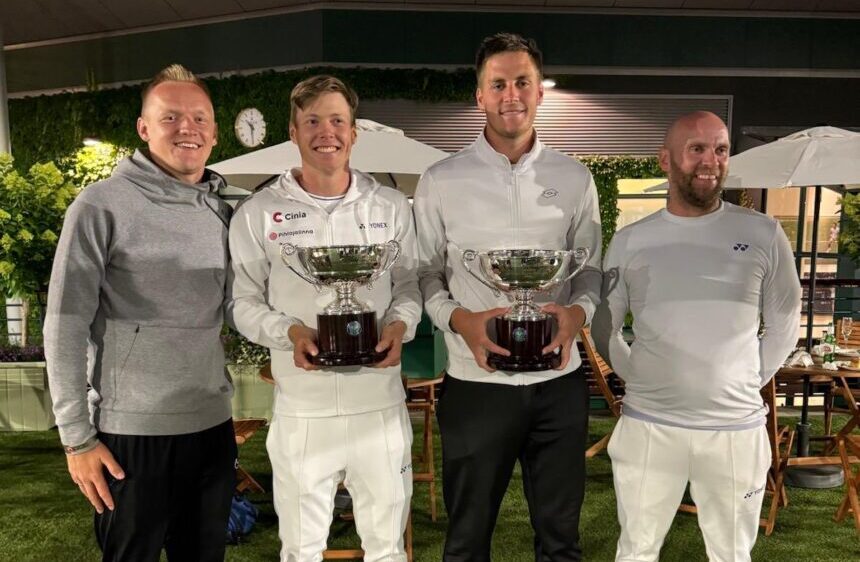
To those on the doubles Tour, Calvin Betton is a name as widely recognised as the likes as Darren Cahill or Juan Carlos Ferrero and for good reason too.
He is the principal coach of two players who have already won silverware this season. Luke Johnson is currently at a ranking high of No.53 in doubles and won his second ATP title in Hong Kong last month with Sander Arends, defeating Karen Khachanov and Andrey Rublev in the final. Betton is also in charge of Henry Patten (world No.3) who recently won his second Grand Slam title in less than a year at the Australian Open with his partner Harri Heliovaara. On top of this, he also supports Heliovaara, who has his own coach, when needed.
Betton recently returned to the UK after a brief stop off in Finland where he took part in some coaching education. His coaching journey began at Barnsley Tennis Club before going on to mentor players to junior national championships and British number-one spots. Now working at the pinnacle of men’s tennis and traveling the world, he is different from other coaches in that he isn’t afraid to speak his mind. Even though those in charge of the sport might not be happy to hear what he has to say….
EDITOR’S NOTE: Throughout this article, all players are referred to by their surname
UBITENNIS: What are the positives and negatives of working as a doubles coach on the Tour?
BETTON: I don’t really see positives or negatives. It’s just what I do. As a coach, the pluses are how much I get to travel. It’s quite a nice life around competitive sport.
UBITENNIS: You work with Patten, Heliovaara and Johnson during various stages of the season. How do you divide your time between these three players?
BETTON: I mainly work with Johnson and Patten. I work with Heliovaara when we’re away but he has his own coach, whereas I’m Johnson and Patten’s only coach. How I divide my time between Patten and Johnson is that we have a pretty informal arrangement. They’re good friends, and it’s never been an issue.
At the four big tournaments (Grand Slams) I’m with both of them. The Masters we’ve never really done but I think Johnson kind of knows that I’ll go to the Masters with Patten for the ones that I go to, and Heliovaara’s coach doesn’t go to.
Patten lives in the States, so Johnson gets a bit more of me in sort of training weeks and that kind of thing. We speak a few weeks in advance and go over which weeks the guys want me, and which days?
UBITENNIS: What are the differences in game style between Patten and Johnson?
BETTON: Patten’s a six-foot-six lefty, so he’s different from a lot of players but they also have quite a lot of similarities. I think that they’re both in the top ten returners in the world. Johnson is one of the top 3 or 4 returners in the world, he’s kind of moved up to that level. He’s always been an excellent returner but he has moved up a bit more in the last six months where he’s consistently showing that.
He played a match in Montpellier and won 70% of points on return, which is unheard of. If you’re getting 40%, then you’re counting that as a really good returning day.
I don’t know if one’s better than the other, but they’re both excellent returners. Patten is, I think, the best server in the world overall in terms of how well he serves his first serve, his second serve his first and his first volley to back it up.
They’re both very professional and great lads to work with. I’m very lucky. I include Heliovaara in that as well, he is very easy to work with.
The main difference is that Patten’s serve and volleys and Johnson is one of the very best baseline players. He can hang with any of the singles guys from the back of the court. As he’s shown this year already when they (Johnson and his partner Sander Arends) beat Khachanov and Rublev (in the final of the Hong Kong Open) and he won more points than he lost when playing baseline to baseline.
Then in the Aussie Open, he went toe to toe with Carreno Busta from the baseline and was getting the upper hand on him most of the time as well.
Patten’s got an excellent first volley. Beautiful touch around the net. Their partners complement them as well. I don’t want to make out that they’re they do all this on themselves.
UBITENNIS: Congratulations on your Australian Open win. How did this victory compare to winning Wimbledon?
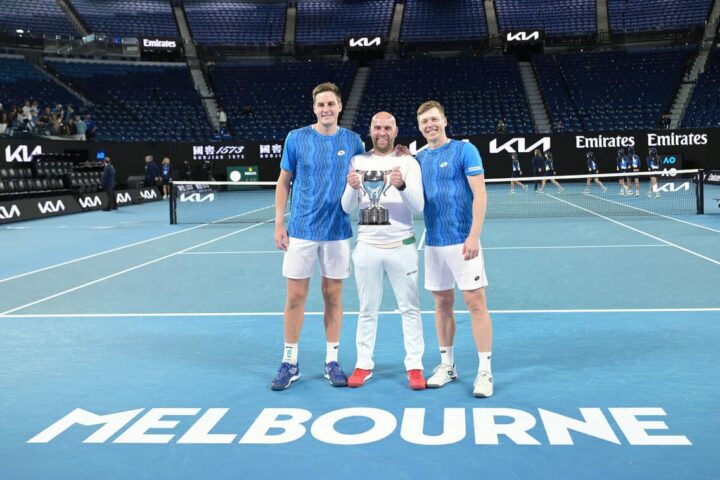
BETTON: It was entirely different and mainly down to the timing and the schedule.
When we won Wimbledon, we went on court at about 4:30 or 5:00. The stadium was full within about half an hour of the match starting and it stayed full for the rest of the match. The match finished at about 8:00, which was a great time for viewing.
At the Aussie Open, the match went on the court at 11:00pm and we didn’t finish until around 1:50am. At the start of the match, I think there were about 2000 people (in the stands) but by the end of the match, there were maybe 150 in there as people had to get home.
Me and the players were tired. So you notice the difference in the reactions to winning Wimbledon. It was pure elation and joy from Patten and Heliovaara. Whereas when they won the Aussie Open, Patten’s face was relief. He was knackered. I think it’s a little bit of a shame. The Aussie Open, which is a great tournament, is probably the best of the slams. They just have to sort this issue out with the scheduling for the doubles final because the same happened last year as well.
UBITENNIS: How well do you think the Grand Slams are doing in promoting doubles?
BETTON: It’s strange at the Australian Open because they seem to like their doubles.
I know Craig Tiley (the tournament director) is keen to promote the doubles. But the strange thing about it is that at the start of the week the first three rounds, the stands are full because there are no small courts at the Australian Open.
Then when you get to the later rounds they don’t put any matches on the outside courts. They’re all on the stadium courts and because of that there are less people who are buying ground passes because there is less tennis to watch. So you kind of go from in the first two rounds, playing to full stands and great atmosphere.
Then after that, you’re in stadium courts where there’s hardly anyone in there because there’s no one buying ground passes. You kind of lose out on the walk-by viewers. I think that in that regard, they do charge.
Once you get to the first Friday, it’s 90% of people who’ve bought tickets for the two main stadium courts and the doubles doesn’t go on the main stadium court until semi-finals. It’s a bit of a strange atmosphere.
The French Open is quite bad which is strange because the French have quite a lot of doubles players. Last year when I was booking a court, I went to book a practice court for the boys. I went to the practice desk and they said, are they players or doubles? Suggesting that the doubles players weren’t actually players. That was a bit poor.
Wimbledon’s pretty good. The US Open has been excellent. Although they’re making some changes this year, I hope that they’re not going in the wrong direction with that.
Editor’s Note: This topic was also mentioned by Players’ Council Doubles representative Andrea Vavassori after the men’s Australian Open doubles final. He told Italian media – ‘There wasn’t much of a crowd and it’s a shame of a Grand Slam final. Doubles has a lot to give, and this is the only tournament when the men’s doubles final is played so late. We need to find ways to involve people in doubles, I am pushing a lot on marketing, trying to use social media to get people to know the players, and the stories behind them, we are great tennis players, and I think that a doubles match can give fans a lot of emotions, even if it’s a much faster game than singles. Patten and Heliovaara are not well known, but they are great players, you have to do something incredible to reach the level they have reached. We hope next year things will change, I hope what I said during the award ceremony will have some effect, I spoke to Tiley during the past few days together with other doubles players, and he is willing to make some changes for next year to improve the situation for doubles, and I hope other Slams will follow suit as well.”
UBITENNIS: Similar question but what about the ATP Tour and their approach to doubles?
Embed from Getty ImagesBETTON: The tournaments in general are excellent at putting the doubles on and they’re accommodating. I think the Tour itself is very poor. The powers that be seem hell-bent on trying to do away with doubles.
They’re trying to make out that they don’t have any option, but it seems like they’re driving the decision. And the people at the top of the ATP tour really should be ashamed of themselves with the way that they’re dealing with doubles at the minute.
UBITENNIS: Why do you believe the ATP are dealing with this the way they are?
BETTON: I think it comes down to greed from the singles players. I think the singles players are putting pressure on them (the Tour) because they think they look at it and they see that the prize money is generally split. The prize money is split 80 over 20, but really 80, ten, ten because the 20 is split between two doubles players.
The singles players think that they should get 100% of the prize money. They don’t see why doubles are getting any. Which I think is downright greed. When you look at the amount of money that the singles guys are earning. It’s an obscene amount of money, but they want a little bit more.
I think the execs at the ATP kind of follow the singles players.
I don’t think that they like the idea that they can be criticized for not promoting doubles in the best way. They like to think that there’s nothing they can do to help it.
But when you look at the people who like to watch doubles where you only have to look at the Australian Open, you sell the grounds passes and people will go in to watch doubles.
I’ve been at numerous ATP finals this year. The stands are usually pretty busy. And not necessarily to do with singles players or homegrown players.
So people do want to watch it, but the powers that be will have you believe that no one wants to watch it, and they’ve making zero effort in the marketability of it.
They flat-out refuse to commit anything to marketing.
There are some tournaments where people don’t watch it, but they usually the tournaments where people don’t watch anything other than the show court.
UBITENNIS: Following what you have said, do you have concerns about the future of doubles?
BETTON: I think everybody’s concerned. The ATP needs to remember that they’re called the Association of Tennis Professionals. They’re not the Association of Singles Tennis Professionals.
Some of the things they’re talking about are downright disgraceful. And I think probably illegal the way that they’re looking to do away with jobs and the way some of the tricks that they were pulling last year where they hit a legal problem and that they were forced to change that*. I don’t know whether that’s backing them down or anything, but they’re not. The way that they’re acting is not that of a proper governing body. They really should get some co-owners and tell the singles players you’re already getting enough money.
*EDITOR’S NOTE: The legal problem being referred to is the move to reduce the size of draws for doubles tournments. Betton explained that an attempt to change the draw size (which would have led to fewer players having the chace to earn money at certain ATP events) have to go through a due diligence process first.
UBITENNIS: Change of topic, you once said there is no such thing as a perfect technique in tennis. What do you mean?
There is a difference between technique and skill. An example, I always used to use is from about 15 years ago. The three biggest forehands in the world were Federer, Nadal and Del Potro. All brilliant forehands, but all completely different techniques.
Which one of those has the perfect technique and who’s going to tell the other two that their forehands are technically not correct?
The difference between technique and skill is technique is the ability to do something. And skill is the ability to do something within a context. And all the tennis asks you to do is to get the ball over the net and in the court and try and win the point with that. And when you have the most effective shot within that, however you choose to do it is fine.
I think what people tend to think when talking about technique is what they’re really talking about is the aesthetic of it.
They like shots that look nice. People would say Federer has the perfect technique, which I’m not arguing against. But it’s saying they say that because it looks nice. It’s not based on anything else.
Whereas you look at Del Potro, who’s had a bit more of an unconventional technique, but probably a bigger forearm. So are you going to go to Del Potro and go, no, no, you need to hit your forearm more like Federer, or you’re going to go to Nadal and say that forehand doesn’t look enough like Federer’s?
To suggest there is a perfect technique, it suggests that everyone should be striving to get there, whereas there isn’t. It’s just depends on what you want to do.
Not to say there aren’t some fundamentals that it’s better to have than it’s not to have.
UBITENNIS: You’re a Manchester United supporter. Have you ever seen any coaching techniques or methods used in football and decided to implement them in your tennis coaching?
BETTON: I do think that what I’ve experienced through being a huge sports fan, and particularly a football fan, has led me to look at the elite sport in a different way. For most of my life, Man United was a very good team and would have an attitude and a mentality that I would like to think that my players have.
United always had a sort of reputation for never giving up and always finding a way to win. And I think because of that, that’s how I kind of subconsciously look at tennis matches when we’re a set and a break down, when we’re match point down, I’m constantly just thinking that we can win this match and I never doubt it. Then it always comes as a bit of a surprise when we do lose.
UBITENNIS: Finally, what are your goals for the rest of the season?
BETTON: We don’t set goals. Patten’s not a big goal setter. I don’t massively talk about them with Johnson. There are certain things that you always want to do. I think Johnson’s next goal would be getting in the top 30 and getting in all the masters.
I think just winning more tournaments, trying to be trying to improve things like performance goals and trying to make sure the first serve percentages are higher. Trying to win more points on return. Trying to win more points on ball four, which is a big, big part of my coaching philosophy. Trying to win some masters and trying to win some more majors.

