



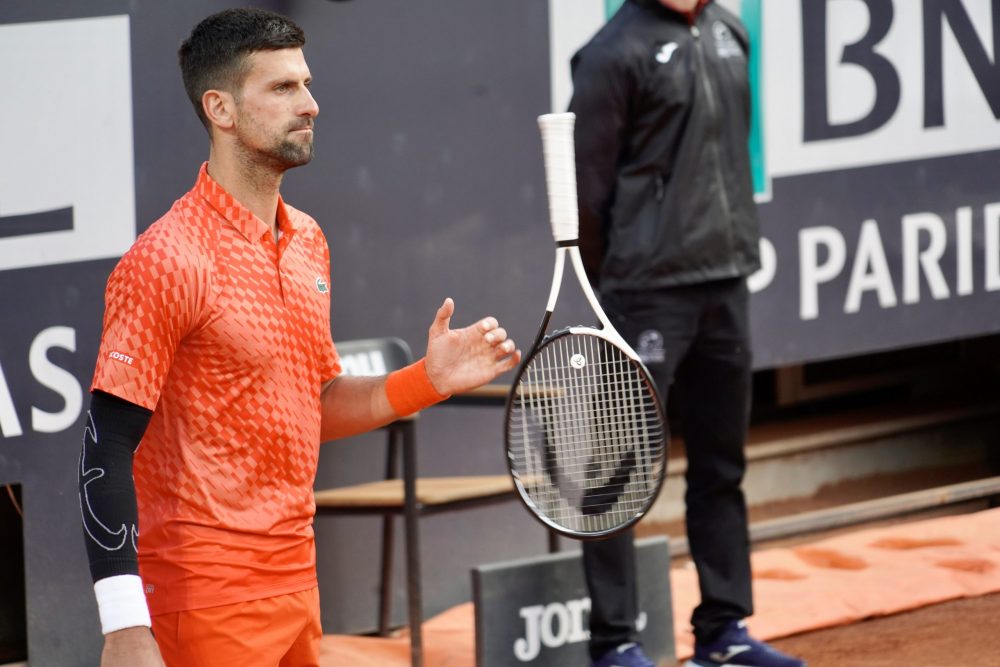
Novak Djokovic said his decision to write a message on a camera lens at the French Open calling for calm in Kosovo was the least he could do.
The 22-time Grand Slam champion kicked off his campaign at Roland Garros with a 6-3, 6-2, 7-6(1), win over Aleksandar Kovacevic. Just moments after the match, he wrote on the camera lens ‘Kosovo is in the heart of Serbia! Stop violence.” His gesture coincides with a flare-up of tensions in the region.
Kosovo is a largly ethnic Albanian-populated region which declared independence from Serbia in 2008. Its independence has been recognised by around 100 countries, according to the Associated Press. However, Serbia still considers it as part of its territory. The recent tension centres around an election in northern Kosovo which was boycotted by Serbs who represent a large majority of people in that region. Subsequently, Albanian mayors have been elected to office which has prompted Serbs from trying to stop them from doing so. Both Kosovo and Serbia are led by nationalist leaders.
The NATO-led peacekeeping force in Kosovo (KFOR) confirmed on Monday that at least 25 of their peacekeepers have been injured in the clashes.
“I am not a politician, nor do I intend to enter into debates. As a Serb, it hurts me what is happening in Kosovo, our people have been expelled from the municipalities,” Djokovic commented on the situation.
“This is the least I could do. As a public figure, regardless of the area, I feel an obligation to show support for our people and all of Serbia. I think many do not know what the future holds for Kosovo, but it is important to show harmony in situations like this.” He added.
However, Djokovic’s message of support has prompted outrage from Kosovo’s former Minister of Foreign Affairs, Petrit Selimi, who claimed on social media that the former world No.1 has ‘a history of support for Serbian nationalistic causes.’ It can be argued that Djokovic’s gesture is an example of political messaging which is usually banned at Grand Slams but it is unlikely he would be penalised in any way.
“I don’t know if someone will punish me or something like that, But I would do it again. I am against wars and conflicts of any kind,” Djokovic stated.
“Of course I have sympathy for all people, but the situation with Kosovo is a precedent in international law and according to the UN charter, we all know about resolution 1244. I’m sorry we’re in the situation that’s happening. I feel the responsibility as a public figure to provide support, and I especially feel it as the son of a man who was born in Kosovo. There are many reasons I wrote this.”
A similar situation occurred earlier this year at the Australian Open when Karen Khachanov, who is half-Armenian, wrote messages of support for those living in the disputed Nagorno-Karabakh which prompted anger from Azerbaijan. Under international law, Nagorno-Karabakh is part of Azerbaijan but its population is largely Armenian. The two countries have engaged in fighting over the region.
Djokovic will play Marton Fucsovics in the second round at the French Open.

