



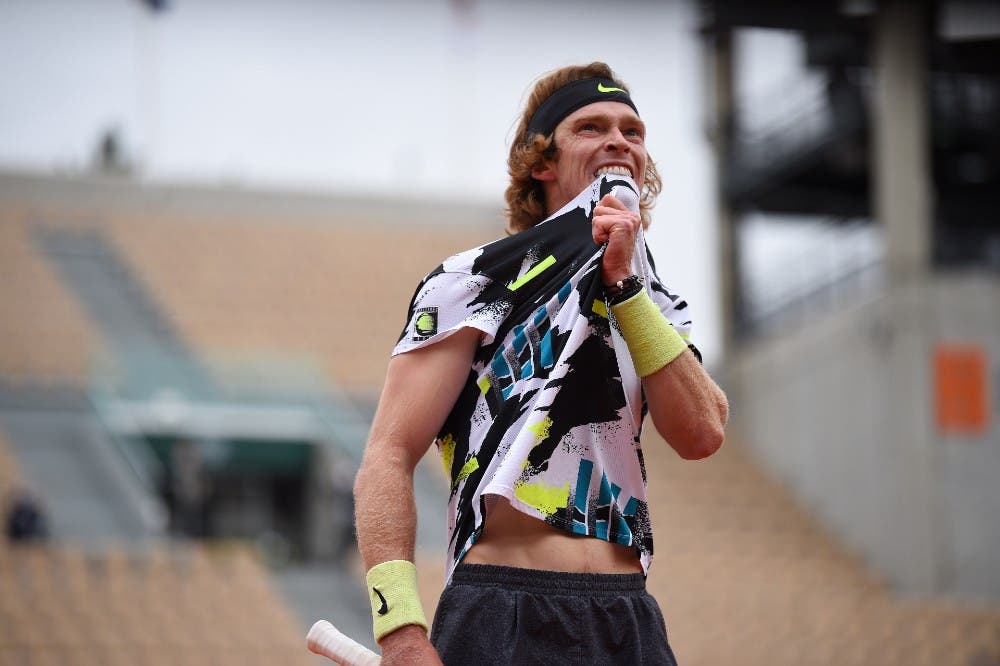
Andrey Rublev has released a documentary in Russian. In a long interview to Russian sports journalist Sofya Tartakova the Russian tennis star looks back to his life from his early days to his first steps in the professional circuit providing a glimpse into the experience of a young talented player in the world of tennis, his childhood games, his grandparents, who were his first fans believing in his talent.
“I wanted to share a part of myself. Something special to me that I have never done before. Team sportsru created a documentary movie. This is an attempt to see who I am. I tried to show myself more deeper. Things you have never known about me before”, said Rublev.
Rublev takes viewers to the Spartak Club in Moscow, where he moved his first steps in the world of tennis. In the interview Rublev had the chance to tell how his tennis career started.
“It seems that I have always been on the tennis court, even before I started training. I used to spend the whole day and I met my best friends there. The Spartak Club was just than a club. It was my whole childood. All my friends come from the tennis world. Every time I visit my club, it’s an amazing experience”, said Rublev.
Rublev started playing tennis at the age of 3 following in the footseps of his mother Marina Marenko, a tennis coach, who worked with former Russian star Anna Kournikova.
“My parents gave me everything I needed. I really enjoyed playing tennis with my mother and my friends. I did not like the weekends, as I stayed at home”.
Rublev moved to Barcelona in 2016 to train with Spanish coach Fernando Vicente.
“I did not achieve good results, soon after my move to Spain. Some people started putting pressure on my parents, wondering why they left me stay in Spain. Someone questioned my decision and thought that I had wasted my potential”.
His career went differently and Rublev had a turnaround in his career in 2017 when he broke into the top 100 and reached the US Open quarter finals. He won his first title in Umag and became the youngest US Open quarter finalist since Andy Roddick in 2001. He reached the Next Gen ATP Finals title match in Milan.
Rublev enjoyed a major breakthrough in his career in 2020 when he moved up from world number 23 to a career-high 8 in the ATP Ranking. Last year he won five titles in Doha, Adelaide, Hamburg, St. Petersburg and Vienna and qualified for the Nitto ATP Finals in London for the first time in his career.
“I enjoy every visit in Moscow. It recharges me. I have definitely lost a sense of home over all these years. Without them I would feel alone. I don’t know who I would be without tennis. During the tournaments in St. Petersburg, Hamburg and Vienna I felt depressed. Now tennis keeps me busy and I feel recharged. I was worried about my grandparents. I lived only on tennis courts and in the hotel. My grandmother died last October when I was playing at Roland Garros. It was a hard period. My grandparents were very important persons in my life. My title in St. Petersburg was the most emotional win in my life”.
In the second part of the documentary Rublev talks about his tennis style and what he needs to improve in his game.
“My weakness is not in my head, but in my body. I should be much faster on the pitch. I can improve a lot. When I was 13 years old, many people told me that my forehand was fantastic. I had always thought that it was my weakness. I am not so quick as I could. I move slowly on the court. I have room for improvement. Danil Medvedev is much faster tha me.
In the documentary Rublev looks back to his first ever match against Medvedev when he was just six years old. It the only time he beat Medvedev, who has now built an impressive 4-0 win-loss record over Rublev on the ATP Tour, including the quarter final match at the 2020 US Open.
“I remember that I played my first tournament when I was six years old. I played my first match against Danil Medvedev. It was the only time I beat him. We played four-game sets. The third set was decided by a seven-point tie-break. We played this match for two hours and a half. We played lobs until exhaustion and every rally lasted ten minutes”, recalls Rublev.

