



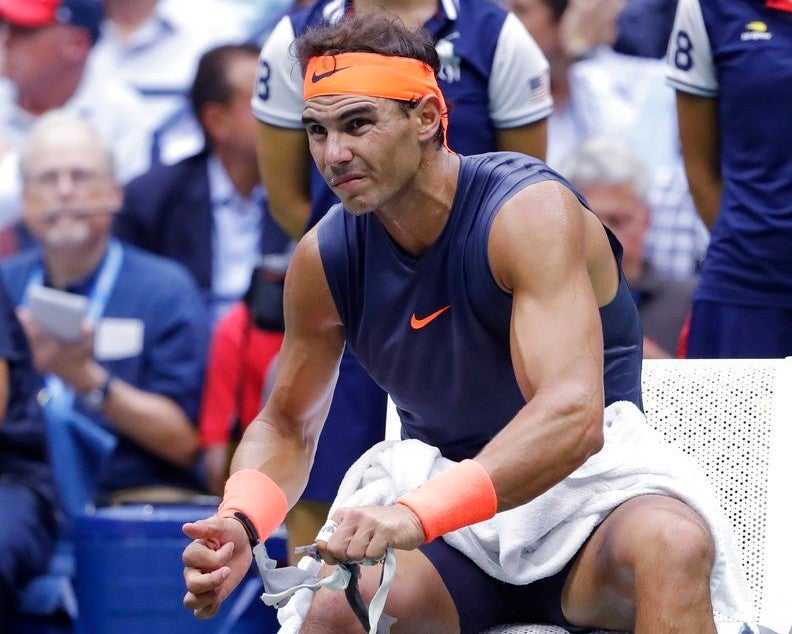
1 – Medical Time Out
And we come to the main problem, the notorious Medical Time Out. A tennis tradition that generates a thousand controversies. For those who know tennis marginally we repeat the rule in a few words: a player is allowed to ask for a break from the game to take advantage of a medical intervention, but only in the case of an “occasional” injury, and not a condition physical due to a bad state of form such as, for example, cramps.
The rule is very brainy and has several grey areas and shades. In countless years there have been accusations from the fans, the crowd, and sometimes from tennis players themselves towards athletes guilty of having pretended an injury just to distract the opponent, take their rest, get some tactical advice. The Medical Time Out does not really make anyone happy, it is a too questionable rule and frankly without a sport logic. Injury isn’t a pleasure, but it’s part of the game. Obviously in contact sports it is necessary to foresee the possibility that an injury may be caused by the action of an opponent, in which case allowing treatment is logical and lawful. Tennis, however, is not one of these.
The problem has two solutions. The first is to fully eliminate the Medical Time Out: those who are no longer able to play withdraw and give free way to the opponent. However, what we want to propose, probably more fair and simple, is to simply remove the word “Medical”, and transform it into a normal Time Out, which already exists in many other sports. In many other disciplines, Time Out can be requested and there is no need to adduce (or pretend) any particular motivation. Sports such as basketball, volleyball, water polo even make Time Out an art. Taking a break to tidy up and at the same time make the opponent lose the “momentum” is more than legitimate, on the contrary: it is the very essence of Time Out.
The quibble why in tennis this should be considered immoral, and why it should be masked behind the (often fictitious) motivation of medical needs, could perhaps have made a logical sense in the past, but it certainly no longer has it today. In a sport with a high psychological component such as tennis, the establishment of Time Out, during which maybe admit coaching, can only make the sport more interesting, and certainly eliminate many unnecessary controversies. On the modalities then we can discuss separately: a proposal could be one Time Out per match, plus an additional one in the event of a decisive set, to always be called when changing the field. If for any reason a player wants to take advantage of the Time Out at another time, he must grant all the points until the next change of field.
And now the word to the readers. Do you agree with the proposals listed in the article? What ones do you find most urgent and sensible? What other changes would you propose to change tennis in terms of rules? Have fun with the comments.

