



-
The limitations of her repertoire
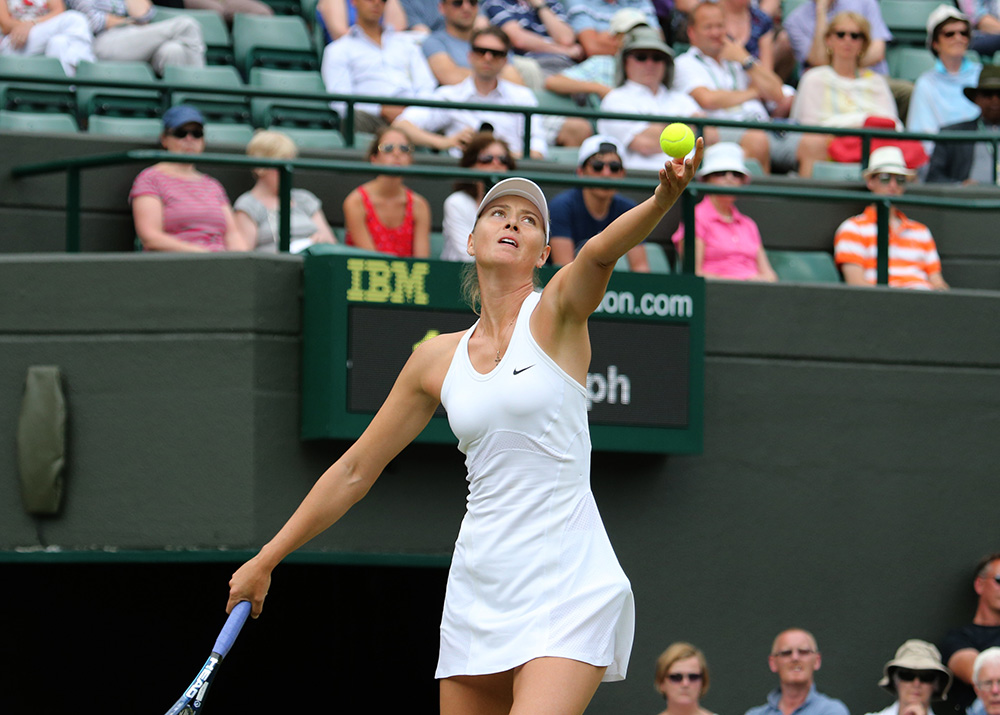
Before delving into Sharapova’s best assets, we need to introduce one last strategic element, and that is the very limited nature of her repertoire. Masha’s game was pretty much moulded around the three basic shots of the contemporary game – power serve, topspin forehand, and topspin backhand. To be fair, Sharapova had a penchant for hitting quite flat, but this is just a figure of speech meaning that she didn’t inject a lot of rotation on her shots, but she still did inject some.
What the about the other shots then? Slice backhands, volleys, drop shots – these were always under-utilised by the Russian, despite being part of her technical arsenal. In this regard, I would single out a couple shots, just to be thorough in my examination: the first one is her slice backhand was venomous, because of the amount of sidespin she hit it with; the second one is her defensive left-handed forehand. This is a weird shot, because it was a direct consequence of her subpar mobility. However, Sharapova found this way to make up for it by exploiting her superior wingspan. So, if she found herself too far from a shot going to her left, she resorted to the southpaw stroke as a final prayer: she simply took her right hand off the racquet and gained a few inches to make contact with otherwise unreachable trajectories – the result was a left-handed forehand:
Going back to my point, though, if we look at the bigger picture, these shots were mostly impromptu, with no essential role in her matches. Her game revolved entirely around the three basic shots – on her best days she might hit some unrehearsed drop shot winners, but she never built her wins around them.
At this point, it’s possible to summarise the hallmarks that we’ve discussed so far:
-power tennis;
-high intensity;
-fast second serves;
-attacking returns;
-aggressive on-court positioning;
-limited repertoire, revolving around the three main shots.
These were the elements that constituted the foundation of her game from a technical and tactical standpoint. After so many years spent watching her play (she was involved in over 800 pro matches), all of this feels a little perfunctory and expectable, but it wasn’t at the time when Masha ascended to the peak of the women’s game. Needless to say, she wasn’t the only pioneer of this type of tennis, but the fact that she was so successful no doubt turned her into a huge source of inspiration.
This is why Sharapova became a morphological specimen when it came to the recruiting of young players, so much that today female players over six-feet tall are no longer an exception. Perhaps she became so influential because her game was seen as easy to replicate, built as it was on a few, and very clear, ingredients. However, the truth is that this approach can only work at Sharapova’s level when something immaterial and not as easily replicable is there along with those three shots. It’s something that has nothing to do with physical and technical tools, and it’s called “mental strength”.

