



-
Physical build and tactical choices
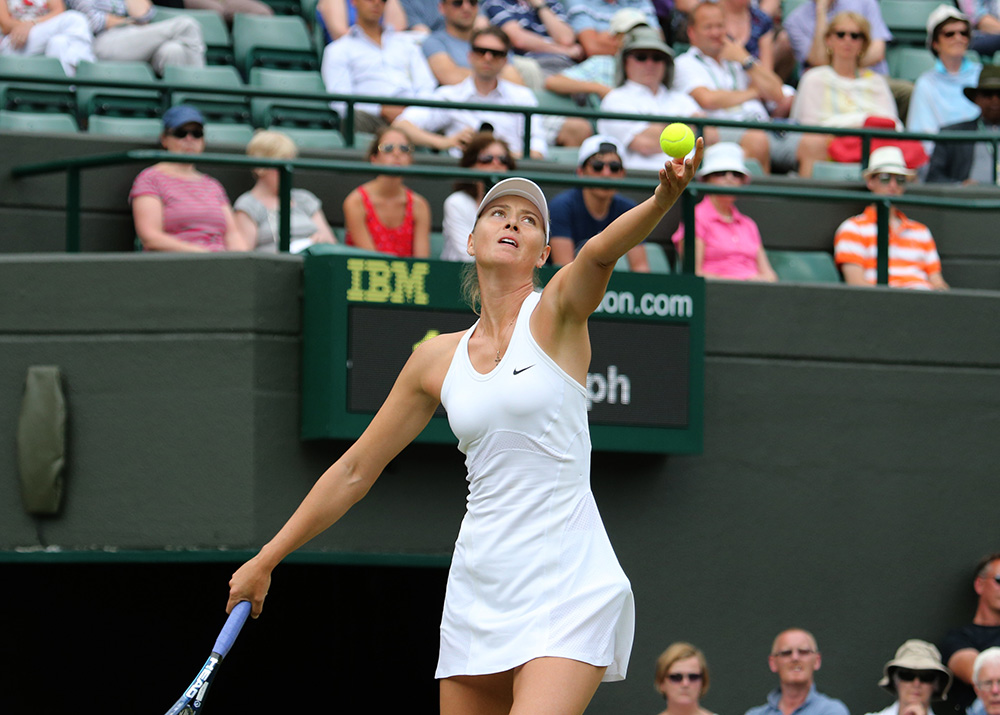
Not many words are needed here, since her physical tools are pretty clear, e.g. her height, length, and long limbs which provided tremendous leverage. Maria was the epitome of a player who was in her element when she could dictate, while struggled in containment and defence.
This is the reason why she needed to devise attacking game-plans based on short rallies and frequent winners, eschewing interlocutory exchanges and never letting her opponent take the initiative. Throughout her career, Sharapova built her game in a coherent manner, in order to valorise her assets while hiding her weaknesses.
I’d say that she worked on two shots in particular to take them to the extreme end of the tactical spectrum – her second serve and her return. Case in point: these were the serve speeds of some of the best players at the 2012 Australian Open (on tournament average), with both first and second serves:
- Azarenka: 90 and 80 m/h
- Kvitova: 92 and 84 m/h
- Serena Williams: 99 and 78 m/h
- Sharapova: 93 and 88 m/h
As noticeable, Sharapova had the fastest second serve, and also the one that was closer to the first serve. The explanation is very intuitive: while hitting numerous double faults, the Russian wanted to hit her second serve as hard as she could in order to play as many rallies with the same tactics, and in order to control and dominate the points from the get go. Come si vede, la giocatrice con la seconda più rapida, ma anche più simile alla prima, era proprio Sharapova.
However, the most relevant aspect in the implementation of this strategy might be her approach to her own return game. Over the course of her career, Sharapova always tried to dominate the rallies on every occasion, and that included the games in which she wasn’t serving. Inherently, she always had top notch returning skills.
Ultimately, aggressive returns were the natural and irrenounceable complements to her game – her aim was to erase the difference between serving and returning games, which takes us back to a concept already discussed above, namely that variables needed to be reduced to a minimum, and matches had to played along one strategic tracks.
Nowadays, we are used to considering aggressive returning as a dogma of women’s tennis, but it wasn’t always the case. Let’s look, for example, at the 2004 US Open semifinal between Dementieva and Capriati, and specifically to the way they behaved during their respective return games. The shot was conceived as a mere gateway to the rally, and wasn’t hit to hurt, let alone as a winner, and this approach was still implemented by Capriati despite Dementieva’s subpar serving. Just by picturing how Sharapova would have behaved in that situation we can understand the difference between the contemporary game and that of the previous decade, still rooted in old tactics.
The assumption that aggressiveness is the hallmark of returning on the WTA Tour was confirmed by the highest of witnesses, Roger Federer. This is what the Swiss said after training with Belinda Bencic at the 2019 Hopman Cup: “Sure, Belinda’s serve isn’t hard to counter, as it’s easier to read than the men’s serve. On the other hand, every time I hit a second serve she pushed the return very hard, and I wasn’t used to it. On the men’s tour we don’t play like that, and we don’t train the return as much as the women do.”
If Bencic and her peers have developed this kind of attitude towards returning, it’s in part because of the success that Sharapova had before them.
A final note on the subject – her on-court placement. Always looking to control the rally, Sharapova placed herself in an aggressive position, standing as close as possible to the baseline. In some ways, despite a very different physique and a different individual setup, Monica Seles’s example is noticeable in this aspect of Masha’s game as well.

