



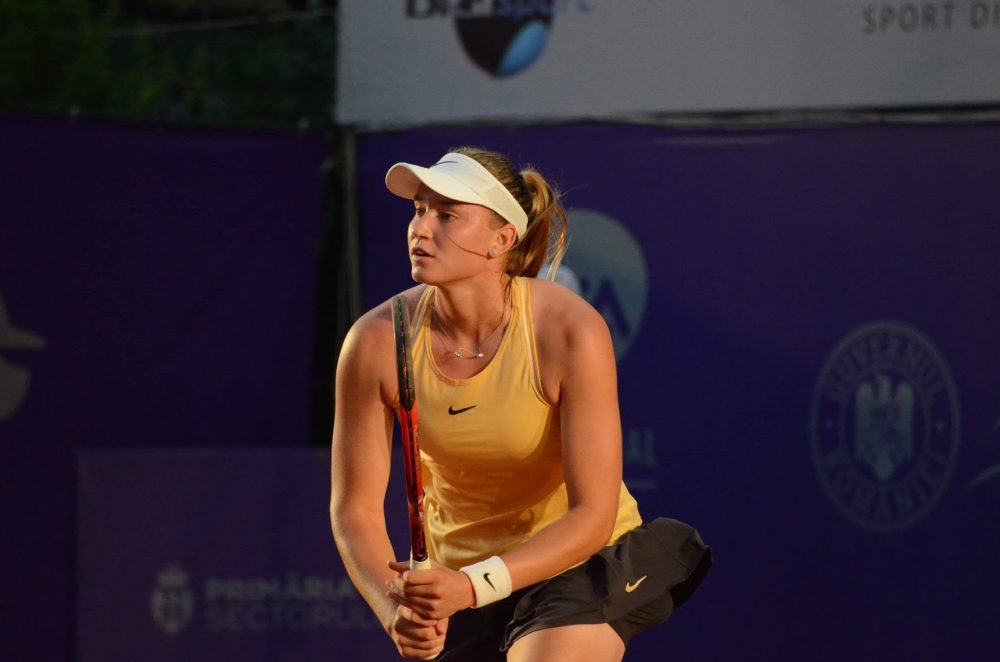
Now it’s time to highlight a few weaknesses, after this much praise. Firstly, she appears to have a few issues with her first shot after the serve – in my opinion, a player with such peaks on her serve should get a lot more points with one-two combos. Instead, when Elena doesn’t win a direct point with an ace or an unreturnable serve, too many times she struggles to build on the advantage she’s gained, to the point that she all but has to start constructing the rally from scratch. This tactic is actually central to the modern game, as can be seen in every match played by Williams, Keys, Kvitova, or Osaka.
More generally, she should also win more clutch points on serve. Obviously, a player needs the killer instinct to go for his or her best shots in the decisive moments, but it’s also true that some free points won on serve are just as important – Serena and the best version of Osaka are a lot more assertive than Rybakina from this point of view. Moreover, a player with such power at her disposal certainly has some margin to improve her kick serve, which could become a bulwark of her game, especially to cover for a second serve that is still too vulnerable.
Then there are some points to be made about her mental strength. It’s perfunctory to say that it’s too soon to evaluate this trait of a player, but her negative record in WTA finals is a fact. Of the six she’s played, four have been losses – she’s beaten Tig and Zhang, and lost against Peterson, Alexandrova, Bertens, and Halep. In my opinion, she could have fared better: Peterson and Alexandrova are not insurmountable foes, whereas her defeat against Bertens, in St. Petersburg, was disappointing for her passive approach rather than for the defeat itself, collecting just four games (6-1 6-3) in a match in which she admitted herself that she wasn’t able to execute her game-plan.
By comparison, her loss against Halep in Dubai was a welcome sign of improvement, since she was edged at the finish line (3-6 6-3 7-6). The only source for dismay in that match was the way she wasted the advantage she had built in the deciding set, which she surrendered immediately due to a streak of avoidable unforced errors.
It should also be underlined that Rybakina has somewhat been a victim of her own success of late. By reaching the final of almost all the tournaments she’s played, she has hardly got a break or some rest, thus hindering her ability to play at her mental and physical peak (as a matter of fact, she had to retire before her third round match in Doha), but I think that this aspect is contingent to her issues.
What seems to be her defining tract is a native shyness, which translates to great on-court composure: she rarely express frustration or celebration, even at the end of matches. Maybe she’ll learn to loosen up over time, or maybe this is quite simply her nature. On the other hand, I believe she will become more outspoken with a microphone in front, although she probably won’t sound as genuine:
https://twitter.com/theoverrule/status/1229829120772780033
I’d like to end on an aspect that I deem essential. Several times, Elena has stated that she enjoys tennis a lot. She likes it as a sport, and she always has fun during matches, and to this day, it still is a game to her: “I love tennis. It was always a game for me. Even now, I don’t think it’s a job. It was always a game, and if I cannot do something I like I cannot improve it, fix it. I love everything in tennis.” To be able to enjoy oneself (to the point of not seeing it as a job) isn’t just a sign of passion, but also a great stroke of luck, because it allows to train without boredom or effort, almost without feeling fatigued, and this is a good omen for further improvement in the future.
Original article written in Italian. Translated by Tommaso Villa.

