



Footwork and point construction
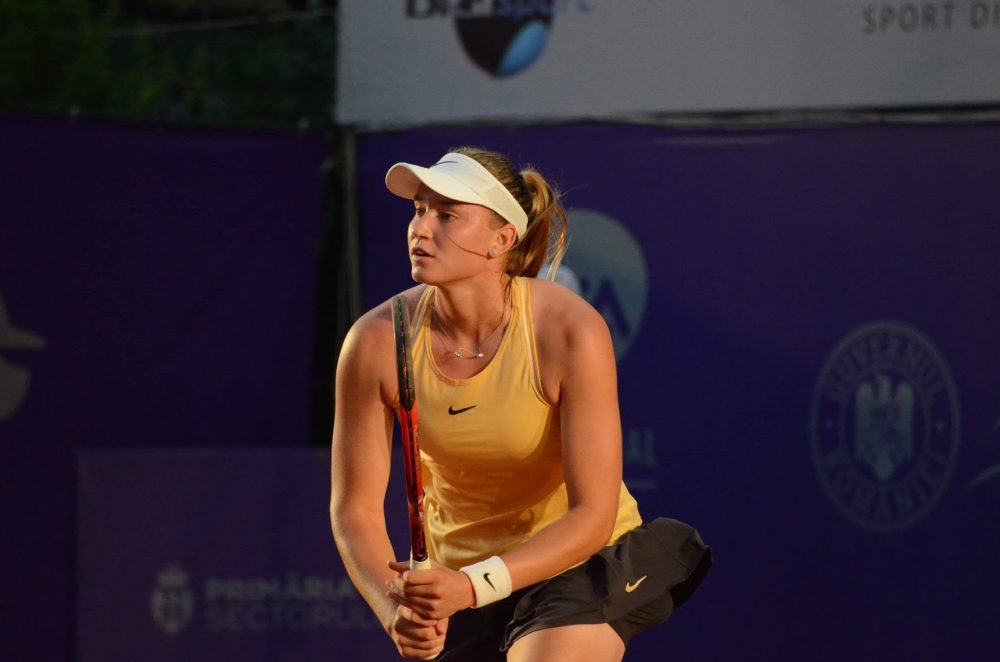
Now that the genesis of her game has been investigated, we can go back to analysing her 2020 matches, highlighting her Protean talents. Right now, Rybakina is admirable for the ease with which she imparts speed on the ball. She’s minimalistic in her shots, with no flourishes, akin to Amanda Anisimova in this regard. However, her mobility needs to be underlined once more: her legs are very elastic and her footwork impeccable, giving her a total control over the execution of her shots. These traits are special for a player this size, albeit she clearly will never be as reactive as someone who is 5’3’’ or 5’5’’.
What is even more surprising than her athletic prowess, though, is the technical and tactical flexibility she has showcased over the last few months – flexibility that is, in my opinion, the product of the peculiar development I described above. I honestly can’t think of another player of her size who possesses such a wide array of shots, and this is why I don’t understand the fans who criticise her game as “banal.” How can you call that way a player who hits so cleanly, and who is so varied in her solutions?
Being varied means, for instance, that she can effortlessly hold her own in rallies with an average speed of 60 m/h as well as in others who reach 80 m/h. conversely, most players have a cruise control pace that they prefer, but tend to get lost when wading away from the shallow of their comfort zone. One more example: Rybakina can lay the groundwork for a safe rally, with the ball bouncing two or three metres inside the baseline, but is just at ease at going all-out with trajectories that land just shy of the lines.
Consequently, depending on her opponent she can construct points with right- and left-bound shot placements (encompassing the more or less extreme trajectories that the definition entails) without taking too many risks depth- and power-wise – on such occasions, she resembles her teenage, Bonfiglio self.
Other times, she can just rely on depth, without moving play too much horizontally. These are the rallies in which she pressures her opponent down the middle or on a single diagonal vector, putting the ball so close to the baseline that her adversaries struggle despite the static nature of the exchange – an undeniable token of executive feel, which allows her to dictate play while perfectly gauging the length of her shots and the risks she’s taking.
When the situation requires it, she instead pushes the N.O.S. button and hits with power, dramatically increasing the speed of the rally and letting her opponent feel her sheer physicality. This is what we might call the new Elena, the one who has learned to exploit her own morphology to her advantage, and who can ace at over 120 m/h or stone-cold her opponents with assertive groundstrokes.
I hope I made myself clear, but an analysis of her game needed to be as inherently elaborate as much as her strategic choices have been during this short but meaningful span of her career. Rybakina has been performing at this level for such a short period that it almost feels like she can offer something new, or unexpected, in every match.
However, I think I’ve singled out a recurring special shot: despite her backhand being perhaps a little more natural, the shot I am the most in awe of, a bona fide signature shot, is her forehand down-the-line hit from outside the right corner. I’m calling it a down-the-line shot to make it simpler, but it’s more of a slightly crossing shot with a curving trajectory. It’s a stunt she pulls on her returns (countering wide serves) or during rallies. Here’s an example on a return, to be better appreciated in slow-mo:
The trajectory starts from outside the court, and needs to be hit slightly diagonally in order to target the opponent’s backhand without landing wide. The difficult part is to gauge the angle at which the ball needs to be struck, in order to have it curve just as much to make it land next to the alley – it’s an incredibly difficult shot that Rybakina makes look easy, almost natural.
Of course, it’s not always possible to dictate the point, and when this happens, it’s mandatory that one’s own defensive abilities be sharp, and I’d say that Rybakina has shown a passable grinding game. Here’s an example from her recent meeting with Sofia Kenin. The American returns aggressively a weak second serve, forcing Elena to try and contain her opponent’s charge: she hit a backhand slice, then a forehand slice (with some sidespin added in for good measure), fending Kenin off until she could get herself back into the point and take the momentum of the exchange. By doing this, she managed to push Kenin back before hitting a drop-shot winner:
On a side note, it should be noted that Elena uses a sliced backhand quite often, especially to charge the net, employing tactics that remind of a classical tennis strategy that was typical of the last century’s game.

