



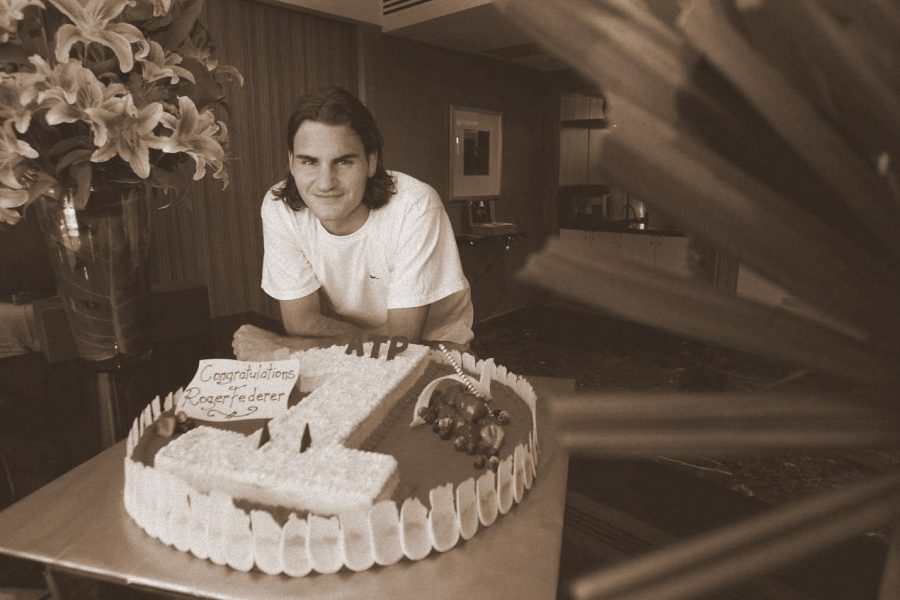
In 2004 few expected a 22-year-old Roger Federer to still be contending for the No.1 spot 14 years later. Yet this has happened this week following his recent run to the Rotterdam Open title. Spending his 303rd week as world No.1, Federer’s journey back to the top is one that fascinates many.
After winning the 2017 Australian Open and the two American Masters 1000 tournaments in March, the Swiss player chose to skip the European clay court swing to prepare his Wimbledon campaign. A schedule similar to the one once arranged by the 30-year old Ivan Lendl, who in 1990 did not play any tournament on clay (including Roland Garros where he was the clear favourite) to keep alive his dream of a Championship title at SW19. Federer’s gamble paid off unlike the Czech’s one, who was already No. 1 before making that decision. He managed to keep it only until August when he was surpassed by Stefan Edberg (Roger’s former coach).
As per the Swiss, the injury suffered in the Montreal final against Alexander Zverev forced him to skip one of his favourite tournaments, Cincinnati, limiting the chances of success at the US Open where he did not go past the quarter-finals. Last year, Federer did NOT play 5 of the 9 Masters 1000s and one of the 4 Slams, leaving 7,000 potential points on the table. He collected points in just 12 tournaments (3 Slams, ATP Finals, 4 Masters 1000, 4 ATP 500) as he was defeated in his opening match at Stuttgart by his friend Tommy Haas. An incredible result considering that Nadal had to play a full schedule to secure the year-end No. 1 in 2017.
Federer’s points breakdown
| Tournament | Points |
| Australian Open | 2000 |
| Rotterdam | 180 |
| Dubai | 45 |
| Indian Wells | 1000 |
| Miami | 1000 |
| Stuttgart | 0 |
| Halle | 500 |
| Wimbledon | 2000 |
| Montreal | 600 |
| US Open | 360 |
| Shanghai | 1000 |
| Basel | 500 |
| ATP Finals | 600 |
This week Federer has returned back to No.1 in the world 14 years after the first time – February 2nd, 2004, (no, it’s not a typo). Let’s analyse the Top 100 as of February 2, 2004. While the name of the player next to the N.1 is the same, the others are not. Only 9 of those 100 players are still active. Strangely enough, Nicolas Mahut is right at the N.100. Just the same place as in 2004 (at least as of February 16th).
Thus excluding the first and last of the list (Federer and Mahut), the number is reduced to 7 players, many of which had aroused great perspective in 2004. One managed to live up to and excel expectations – a Mallorcan player named Nadal. Others also had an excellent career such as Tomas Berdych and Richard Gasquet, albeit without confirming expectations. Feliciano Lopez has lost only 4 positions compared to 2004 and David Ferrer has improved, but he has past his peak. Add to this Ivo Karlovic and the Mikhail Youzhny, two players who are defying Father Time.
And what about the other 91 names on the list? Either they are retired or have the dramatically fallen down the rankings. Not only the one born in 1981, but also the younger ones. Roger’s current coach, Ivan Ljubicic can be found in the list and also Nadal’s mentor Carlos Moya!
How on Earth is it possible that Federer is still the number one?
Note: article originally written by Luca De Gaspari for ubitennis.com.

