



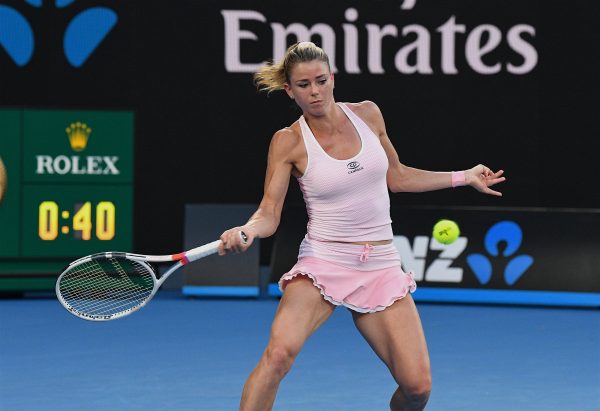
MELBOURNE – After a strong showing in Sydney and a hard-fought battle against world No. 18 and local star Ashleigh Barty in Melbourne, Camila Giorgi proved that she can compete with the best players in the world. Will the talented Italian ever fulfill her massive potential and become part of the elite? At 26 years of age, is she too old to make such a significant jump? In recent years, other fellow Italian players such as Francesca Schiavone and Flavia Pennetta won Grand Slam titles in their late twenties or early thirties. In 2016, Angelique Kerber had the best season of her career after she turned 28. And the list of late bloomers in tennis has gotten longer and longer in the past few years. “Thirties are the new twenties,” Venus Williams always reminds everyone when asked whether she is ready for retirement or not.
Camila Giorgi’s game has often been highly praised and at the same time extremely criticized. Her powerful ground-strokes and the boldness with which she takes on higher ranked opponents are unquestionably her major strengths, but many criticize a certain lack of variety in her game and the fact that Italian never relies on a plan B. There is certainly room for improvement in Camila’s game, especially from a tactical point of view.
Today’s physical game is not a sport for teenagers anymore. The years when Martina Hingis, Arantxa Sanchez, Steffi Graf and Monica Seles used to win Grand Slams as teenagers are long gone. The average of women’s players ranked in the top 100 is 26.5 years of age. Players ranked in the top 50 are on average 27.4 years old, while 26.6 is the average of the players ranked in the top 20. A few exceptions might still materialize with players such as 15-year-old Kostyuk, who this year reached the third round in Melbourne. Last year we saw 20-year-old Ostapenko shock the tennis world with an unexpected victory at Roland Garros, but winning a Grand Slam at 17 or 18 years doesn’t seem feasible in today’s game anymore.
Camila Giorgi’s life hasn’t always been peaches and cream. Her 23-year-old sister Antonella died in a car accident in Paris in 2011. For the entire Giorgi family, it was a very traumatic experience to overcome. Camila’s father Sergio is certainly an interesting character with an exuberant personality and a very difficult role: Being both a father and a coach is never an easy task.
The Giorgis’ finances went through many difficult moments and Camila was surely affected by the multiple moves to different countries, legal disputes with certain sponsors and lawyers and – later in her career – controversy with the Italian Tennis Federation. She grew up in a very challenging environment for an athlete that would need serenity, tranquility and concentration.
Italian tennis never produced teenage phenoms in its long history. Pietrangeli started winning at 24 years old, Panatta had his first few important victories at 20 but his best year was 1976 after Adriano turned 26 and Barazzutti peaked at 25. Among the women, Silvia Farina was a late bloomer, Francesca Schiavone won the French Open at 30 and Flavia Pennetta won the US Open at 33 against 32-year-old Roberta Vinci.
Why hasn’t Italy been able to produce any young champions? It probably has to do with the Italian education, culture, traditions and disorder. Italians grow up with an education based on traditional family values: Parents always provide a warm and pleasant environment for their kids. There is no reason for a teenager to run away: Life at home is very good. Italy doesn’t have colleges away from home where teenagers are sent to study and experience life on their own. Italians always look for schools as close to their families as possible, that way they can go home during lunch breaks and enjoy some good meals prepared by their mothers or grandmothers. Without underestimating the fact that this lifestyle certainly saves a lot of money to Italian families, it is fair to say that it provides Italian kids with a less challenging, safer and more comfortable environment. That is why Italian teenagers are less independent than French, American, Spanish or German kids, and the same applies to those kids that start a career in sports.
Italian tennis players usually come from upper middle-class families, sometimes even upper class and they are certainly lacking the same motivation that Easter European players have in abundance. Access to coaches, tennis clubs and tournaments is extremely easy and financed by the player’s family.
In Italy there is also a great deal of disorder when it comes to the entities that should promote the sport, build solid infrastructures and provide knowledgeable staff. The Italian Tennis Federation should be managed by passionate, motivated and skilled individuals, but unfortunately it is not. Most of the Italian tennis centers don’t rely on the best and most valuable coaches that are available in the country. There are a few tennis federations in South America that are financially very poor, which is certainly not the case in Italy. Italians can only blame themselves for their bad management.
I still think that Camila Giorgi has a lot of room for improvement and eventually become a top player in the next few years. At the end of the day, she’s 26 years old, but, considering the Italian standards, she could be 22.
(Article translation provided by T&L Global – Translation & Language Solutions – www.t-lglobal.com )

