



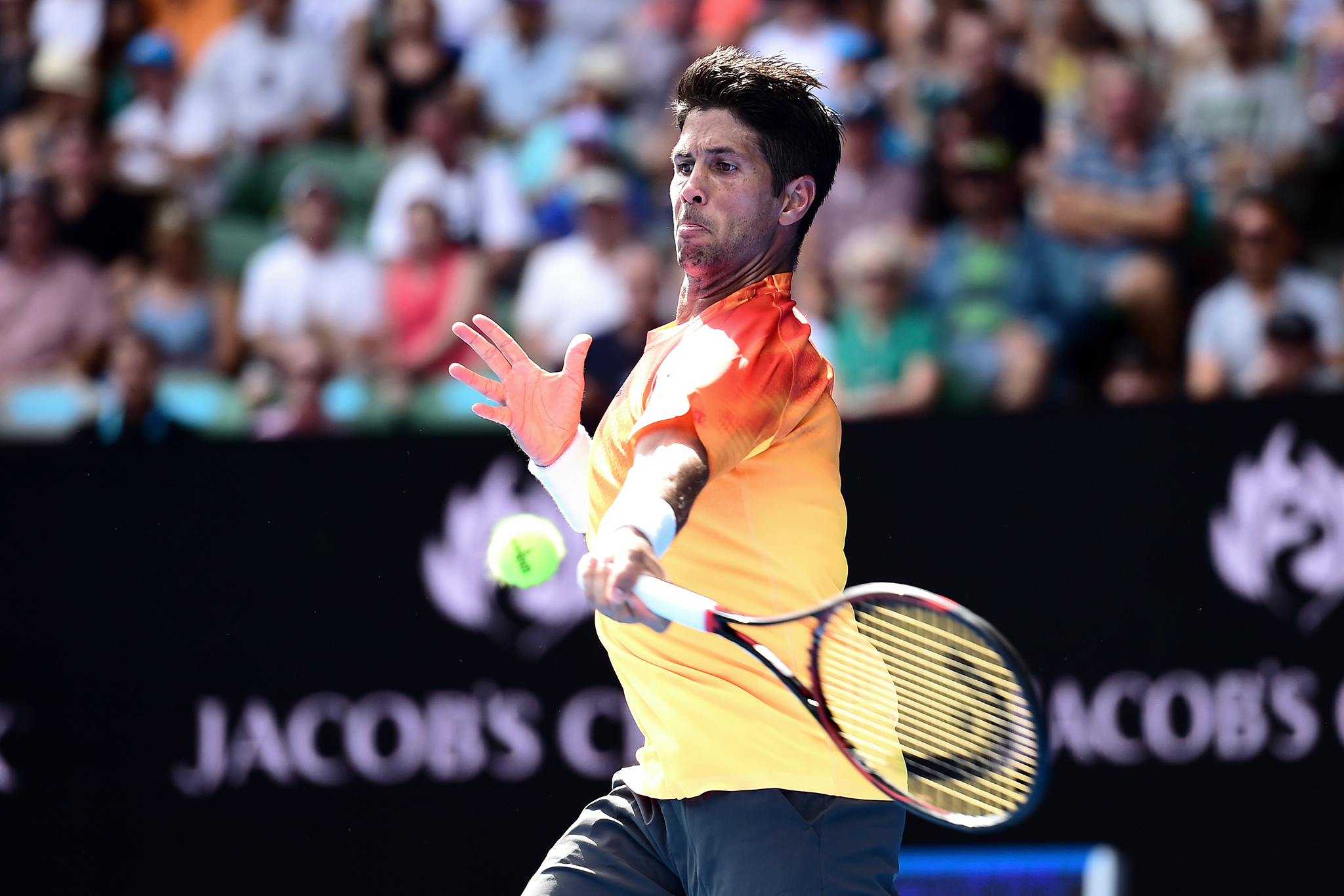
Fernando Verdasco, 1R, 19 January 2016 – Ben Solomon/Tennis Australia
https://www.youtube.com/watch?v=T9fZAxZ2P5U
It was an unlikely result even 20 minutes prior to its conclusion. When Nadal broke Verdasco’s serve at the start of the fifth set and then held his own serve for a 2-0 lead, the match seemed to have taken a final decisive turn. Indeed, Nadal had a break point for a surely unassailable 3-0 lead, but in a manner that was central to his victory, Verdasco reeled off three aces to hold serve, before winning the next five games.
The key to Verdasco’s strategy throughout was whether he could hit enough winners while limiting his unforced errors. And oh how he did. In a match where Nadal hit 37 winners, Verdasco hit an incredible 90 winners, each one percussive and emphatic, and none more so than his 40th forehand winner on match point. It is not surprising that just as Verdasco hit 53 more winners, so he also hit 53 more unforced errors. However, his winners to unforced errors ratio and the sheer number of winners he hit was enough to keep Nadal off balance and ultimately at bay. Nadal, typically gracious, acknowledged as much afterwards: “He played better than me. He played more aggressive than me. He [took] more risks than me, and he won. Probably he deserved.”
The Match Point:
https://www.youtube.com/watch?v=Znbor5xYl2w
In some ways, it seems odd to acknowledge that this match was on Verdasco’s racquet. Verdasco is not the one with 14 grand slam titles, nor the one, before this match, leading the head to head 14-2. But however much Nadal has rightfully earned his place among the top 5 over the last 12 months, some observers doubt that this is – yet – the Nadal of old, the Nadal who following his semi final victory in 2009 over Verdasco would 2 days later survive another five sets to defeat Federer in his prime and lift the title.
Of course, much of the build up to the match today recalled the semi final of 2009. However, that the match today was a first round match rather than a semi final signals Verdasco’s gradual fall from pre-eminence; that the outcome of the match was different this year may signal Nadal’s (even if, ultimately, he proves this to be temporary). When Nadal was broken back for 2-all in the fifth set, it was two forehand unforced errors from the Mallorcan that opened the door for Verdasco. Similarly, when Nadal took a 2 sets to 1 lead, few would have given Verdasco much hope.
Some match reports will inevitably talk of Verdasco avenging his loss in 2009, but Verdasco and Nadal are doubles partners on-court and friends off it. However, Verdasco acknowledged that he had rewatched the 2009 semi final 10 times and had tried to learn from it: “[In 2009 in the fifth set] with 4-4, love 30, I [was] supposed to be more aggressive, go forward more, try to play deeper. If I miss, I miss long. But no like in the net [where Verdasco hit the ball]. Today I was just like trying to be as aggressive as possible, but also not like so crazy.”
Remarkably, defeat today for Nadal marked just his second first round defeat in 44 grand slam tournaments, and his first since losing to Steve Darcis at Wimbledon in 2013. Nadal acknowledged that his own forehand had not been able to keep his opponent off balance: “In terms of creating damage to the opponent with my forehand, I didn’t. So I was hitting forehands, and he was able to keep hitting winners. Cannot happen when I am hitting my forehand.”
Verdasco’s opponent in the second round will be Dudi Sela who beat Benjamin Becker in four sets, 6-1 6-3 2-6 6-2. Verdasco leads their head-to-head 2-0, both on hard courts, and is yet to drop a set to the Israeli.
Nadal will next play in February in Rio de Janeiro, Brazil, at the ATP 500 event on clay.

